The Evolution of Jazz Music Styles: From Ragtime to Fusion
The history of American sound is inextricably linked to The Evolution of Jazz Music Styles, a transformative journey spanning from the syncopated rhythms of Ragtime to the electronic textures of Fusion. Jazz is not a monolith; it is a high-bandwidth medium of expression that has undergone constant iteration, much like a software stack being rebuilt for every new hardware generation. To understand the evolution of these musical styles, one must look past the smoky club aesthetic and analyze the underlying architecture of rhythm, harmony, and improvisation that defines this art form.
- The DNA of Jazz: A Systematic Overview
- The Pre-Processing Era: Ragtime and the Blues
- The Big Bang: New Orleans and Dixieland
- Scaling the Sound: The Swing Era and Big Bands
- The Great Pivot: Bebop and the High-Frequency Revolution
- Optimization and Abstraction: Cool Jazz and Modal Jazz
- The Avant-Garde: Free Jazz and Non-Linear Logic
- Integration: Fusion and the Electronic Shift
- The Tech Behind the Tone: Instrumental Innovations
- The Computational Side of Improvisation
- Real-World Applications: Jazz in the Digital Age
- Pros and Cons of Stylistic Shifts
- Frequently Asked Questions
- Further Reading & Resources
- Conclusion
The DNA of Jazz: A Systematic Overview
At its core, jazz is a system of real-time musical processing. While classical music often relies on a "read-only" execution of a score, jazz functions as an open-source framework where the performers are the primary developers. The genre emerged at the turn of the 20th century in New Orleans, acting as a cultural API that merged African rhythmic traditions with European harmonic structures. This was not a random collision but a systematic integration of disparate data sets—blues tonality, marching band instrumentation, and ragtime syncopation.
To analyze the evolution of jazz music styles, we must identify the core variables that change across eras:
- Rhythmic Complexity: The shift from simple 2/4 "stomp" rhythms to complex, multi-layered polyrhythms and irregular time signatures.
- Harmonic Density: The transition from basic triad chords to extended tertian harmony (9ths, 11ths, 13ths) and eventually non-functional harmony.
- Improvisational Framework: The movement from collective "paraphrase" improvisation to virtuoso soloing and eventually "free" improvisation without a pre-set structure.
By treating these elements as modular components, jazz musicians were able to "refactor" the music every decade, ensuring its survival and relevance in an ever-changing technological landscape.
The Pre-Processing Era: Ragtime and the Blues
Before the official "Jazz" label existed, the foundational code was written in the form of Ragtime and the Blues. Ragtime provided the syncopated structural integrity, while the Blues provided the emotional "blue notes" and the 12-bar cycle that remains a standard protocol in jazz performance.
The Ragtime Protocol
Ragtime, popularized by Scott Joplin, was primarily a piano-based style. It introduced the concept of "ragged" time—syncopation where the melodic line hits between the beats of the steady bass. In a tech context, Ragtime was the "assembly language" of jazz. It was precise, written down, and lacked the fluid improvisation we associate with later styles, but it established the rhythmic offset that would define the genre. Much like the evolution of modern cinema storytelling, Ragtime relied on established tropes while introducing revolutionary techniques that would later become industry standards.
The Blues Operating System
While Ragtime was structural, the Blues was atmospheric. It introduced microtonality—notes that exist "between the keys" of a piano. This provided the "human" element in the evolution of jazz music styles. The 12-bar blues form acts as a repeatable loop, a logic gate that allows musicians to communicate ideas within a predictable, yet highly flexible, sequence. It is the "kernel" upon which almost all subsequent jazz development was built.
The Big Bang: New Orleans and Dixieland
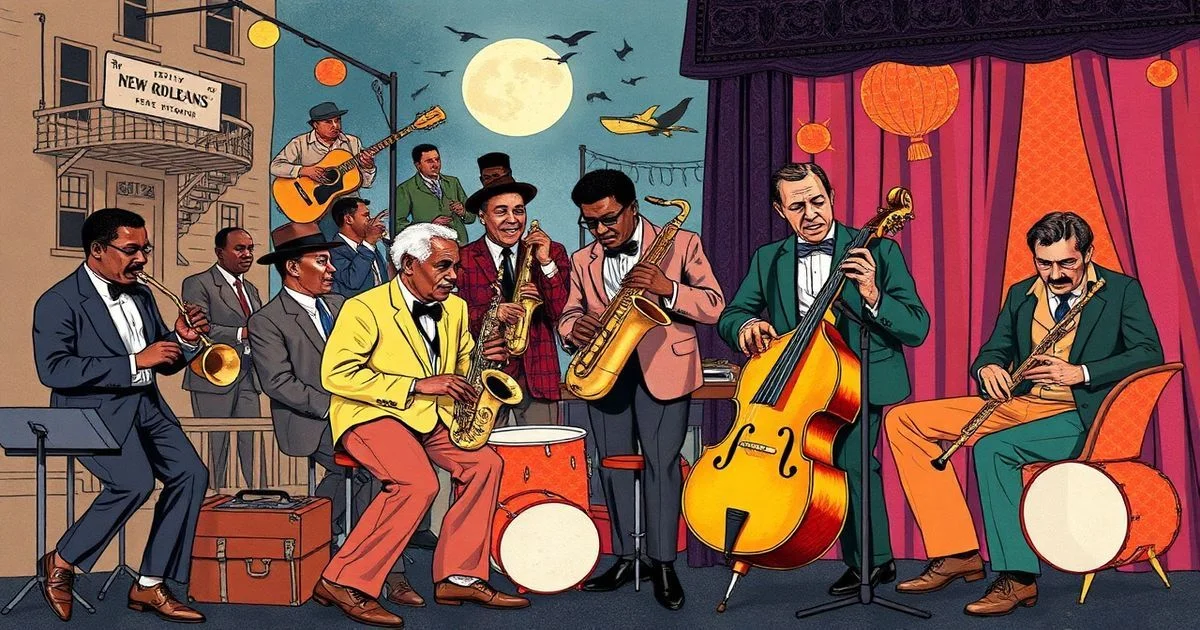
Around 1910, these elements coalesced in New Orleans. This style, often called Dixieland or "Hot Jazz," represented the first stable "build" of jazz. It was characterized by a "front line" of instruments—usually a trumpet, trombone, and clarinet—supported by a rhythm section.
Technical Characteristics:
- Collective Improvisation: Instead of one soloist, the entire front line improvised simultaneously, requiring high-bandwidth listening and real-time adjustment.
- Polyphonic Texture: Multiple independent melodies intertwined, creating a dense "data stream" of sound that was both chaotic and organized.
- The Flat-Four Beat: A steady pulse on every beat, providing a stable clock speed for the ensemble to operate within.
New Orleans jazz was designed for social utility—parades, funerals, and dance halls. It required a high degree of "low-latency" communication between players to ensure the collective improvisation didn't collapse into noise. This era also marked the beginning of jazz's global spread, facilitated by the history of global trade routes that brought New Orleans musicians to international ports.
Scaling the Sound: The Swing Era and Big Bands
As the 1930s approached, the evolution of jazz music styles hit a scaling phase. Small ensembles were no longer sufficient for the massive ballrooms of the Depression era. This necessitated a shift from "distributed processing" (collective improvisation) to "centralized management" (the Big Band).
The Architecture of Swing
Swing was the "enterprise level" of jazz. With 15 to 25 musicians on stage, collective improvisation became impossible. The solution was the "arrangement"—a pre-written script that organized the band into sections (reeds, brass, rhythm).
- The Rhythmic Shift: The pulse moved from a stiff 2/4 to a fluid, driving 4/4 "walking" bass, which created the "swing" feel.
- Call and Response: Sections would "ping" each other with musical phrases, creating a dynamic dialogue within the arrangement.
- The Rise of the Soloist: Within the structured arrangement, specific "time windows" were opened for individual soloists like Louis Armstrong or Coleman Hawkins to shine.
Key Performance Metrics of Swing
Ensemble Size: 15–25 players
Primary Rhythm: 4/4 Walking Bass
Harmonic Focus: Major/Minor Triads + 6th and 7th chords
Primary Cultural Function: Mainstream Popular Dance Music
The Great Pivot: Bebop and the High-Frequency Revolution
By the mid-1940s, a group of young "developers" including Charlie Parker and Dizzy Gillespie became dissatisfied with the commercial constraints of Swing. They wanted to push the hardware (their instruments) to the absolute limit. The result was Bebop, a style that prioritized artistic complexity over commercial accessibility.
Engineering Complexity
Bebop represented a radical increase in "data density." If Swing was a user-friendly UI, Bebop was the command line. It was fast, complex, and intentionally difficult to parse for the uninitiated.
- Increased Tempo: Tempos often exceeded 300 BPM (Beats Per Minute), requiring extreme physical dexterity and mental processing power.
- Contrafacts: Musicians would take the "chord progression" of a popular song and write a brand-new, complex melody over it, effectively "forking" the original song to create something new.
- Extended Harmonies: Soloists began playing the 9ths, 11ths, and 13ths of chords, creating a "dissonant" but sophisticated soundscape that required a deeper understanding of music theory.
Bebop fundamentally changed The Evolution of Jazz Music Styles by moving jazz from the dance hall to the laboratory. It was no longer music for the body; it was music for the mind.
Optimization and Abstraction: Cool Jazz and Modal Jazz
In the 1950s, the "overclocked" nature of Bebop led to a thermal throttle. Musicians like Miles Davis felt that the sheer number of chord changes was limiting creativity. They sought to optimize the system by reducing the complexity of the background and increasing the depth of the solo.
Cool Jazz: The Aesthetic of Restraint
Cool Jazz lowered the "voltage." It featured lighter tones, slower tempos, and a focus on formal arrangement. It was the "minimalist UI" of the jazz world, emphasizing clarity over raw speed. Listening to this era is often cited as one of the 5 simple ways to reduce daily stress due to its soothing, cerebral nature.
Modal Jazz: Breaking the Cycle
The release of Miles Davis's Kind of Blue in 1959 introduced Modal Jazz. Instead of changing chords every two beats, a single mode (scale) might be held for 16 or 32 bars.
The Modal Logic:
- Vertical to Horizontal: In Bebop, you played "vertically" (hitting every chord change). In Modal jazz, you played "horizontally" (exploring the nuances of a single scale).
- Bandwidth Allocation: With fewer "forced" chord changes, the soloist had more "bandwidth" to explore melodic and rhythmic ideas.
- Ambient Textures: This style laid the groundwork for modern ambient and experimental music, focusing on the "space" between the notes.
The Avant-Garde: Free Jazz and Non-Linear Logic
In the 1960s, Ornette Coleman and John Coltrane pushed the evolution even further with "Free Jazz." This was the removal of the underlying protocol entirely. There were no pre-set chord progressions, no fixed meters, and sometimes no predefined keys.
Technical Breakdown of Free Jazz:
- Atonality: The rejection of a central "key," allowing for total harmonic freedom.
- Energy Music: A focus on the physical intensity and "texture" of the sound rather than traditional melody.
- Non-Linear Interaction: The musicians interacted based on emotional cues rather than a synchronized clock, creating a "decentralized" musical network.
While controversial, Free Jazz was a necessary experiment in the evolution of jazz music styles, exploring the absolute limits of human expression and instrumental capability.
Integration: Fusion and the Electronic Shift
By the late 1960s, the evolution of jazz music styles collided with the digital and electronic revolution. Rock and Funk were dominating the airwaves, utilizing amplifiers, synthesizers, and electric guitars. Jazz musicians began to integrate these "peripherals" into their sound to reach new audiences and explore new sonic territories.
The Fusion Stack
Fusion (or Jazz-Rock) was a hybrid architecture. It took the improvisational depth of jazz and combined it with the rhythmic drive of Funk and the electronic textures of Rock.
- Hardware Upgrades: Transition from acoustic bass to electric bass; from grand piano to Fender Rhodes and Moog synthesizers.
- Rhythmic Processing: The "swing" feel was replaced by "straight" eighth notes and heavy backbeats, mirroring the steady clock speed of digital systems.
- Signal Processing: Horn players began using wah-wah pedals, delays, and distortion to manipulate their acoustic signals, essentially "filtering" their output through external hardware.
Albums like Bitches Brew were essentially "remixes" of the jazz tradition, utilizing studio editing as an instrument in itself—cutting and pasting tape loops to create long, psychedelic soundscapes.
The Tech Behind the Tone: Instrumental Innovations
The evolution of jazz music styles was never just about the notes; it was about the tools. As instrument manufacturing evolved, so did the music.
The Saxophone as a Lead Processor
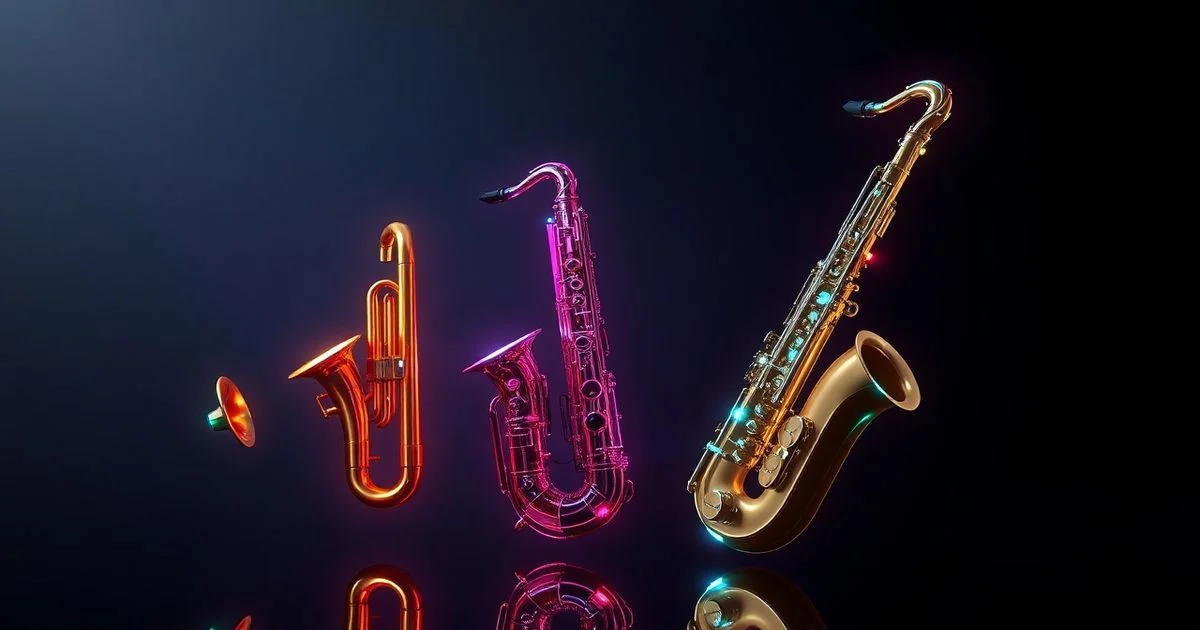
Adolphe Sax’s invention was a hybrid of woodwind and brass. Its ability to mimic the human voice with high "dynamic range" made it the preferred CPU for jazz soloists. From the smooth "cache" of Paul Desmond to the "high-bandwidth" sheets of sound from John Coltrane, the saxophone evolved alongside jazz, becoming more expressive as techniques for "overblowing" and "multiphonics" were developed.
The Drum Kit: A Multi-Threaded Instrument
The modern drum kit was essentially "invented" by jazz drummers. In early jazz, percussion was handled by multiple people. The invention of the bass drum pedal and the hi-hat stand allowed a single "user" to manage four different rhythmic threads simultaneously—left foot, right foot, and both hands—creating a multi-threaded rhythmic output.
The Computational Side of Improvisation
To a tech-savvy reader, jazz improvisation looks a lot like algorithmic generation. A jazz musician is essentially running a real-time script based on a set of parameters:
- Input: The melody, the chord changes, and the current rhythm of the band.
- Processing: Applying "patterns" (pre-learned licks) and "permutations" (variations on those licks).
- Output: A unique melodic line that resolves back into the underlying harmonic structure.
This is not random; it is highly structured. Musicians analyze "ii-V-I" progressions (the most common logic gate in jazz) and learn to navigate them using specific scalar pathways. When a musician "plays outside," they are intentionally introducing "glitches" into the harmonic system for artistic effect, before resolving back into the "stable" key.
Real-World Applications: Jazz in the Digital Age
Today, the influence of jazz styles extends far beyond the genre itself. We see the "jazz methodology" applied in various modern sectors:
1. Software Development:
Agile and Scrum methodologies mirror the "collective improvisation" of a jazz quartet. There is a basic plan (the lead sheet), but the team must adapt to real-time feedback and "pivot" as necessary to meet the project's goals.
2. Artificial Intelligence:
Researchers are currently using the data from a century of jazz recordings to train Generative AI. Projects like Google’s Magenta are learning to "improvise" by analyzing the probabilistic patterns of jazz soloists, attempting to replicate the human "spark" through silicon.
3. Urban Design:
The concept of a "Jazz City" involves creating flexible spaces that allow for spontaneous "human improvisation," much like a jazz club facilitates interaction between players. It is about building systems that support emergence rather than strict control.
Pros and Cons of Stylistic Shifts
As the evolution of jazz music styles progressed, each era brought significant trade-offs in terms of accessibility, complexity, and social impact.
The Swing Era:
- Pros: High accessibility, massive commercial success, social cohesion through dance.
- Cons: Low individual creative freedom for band members, rigid arrangements.
The Bebop Era:
- Pros: High artistic expression, technical breakthrough, "open source" innovation.
- Cons: Artistic elitism, loss of mainstream audience, high "barrier to entry" for listeners.
The Fusion Era:
- Pros: Integration of new technology, expanded sound palette, global reach into rock audiences.
- Cons: Potential loss of the "acoustic" soul of jazz, criticized as "selling out" by traditionalists.
Frequently Asked Questions
Q: What are the main eras of jazz evolution?
A: Jazz evolved through several distinct phases: Ragtime and Blues (pre-1910), New Orleans/Dixieland (1910s), Swing/Big Band (1930s), Bebop (1940s), Cool/Modal Jazz (1950s), Free Jazz (1960s), and Fusion (1970s-present).
Q: Why is jazz often compared to technology or software?
A: Jazz uses structured frameworks—like a "lead sheet"—which act as an operating system. Musicians then "program" their solos in real-time using established rules of harmony and rhythm, much like an iterative software update.
Q: Is jazz music still evolving today?
A: Yes, jazz continues to evolve by integrating modern technologies like AI, live electronic processing, and global musical influences (Global Jazz), often referred to as "Hyper-Jazz" or "Modern Creative" music.
Further Reading & Resources
- Jazz History Overview - Smithsonian Institution
- The Physics of Sound and Instruments - Wikipedia
- Miles Davis Official Website - Exploration of Eras
- The Evolution of Rhythm - National Endowment for the Arts
Conclusion
From the syncopated "assembly code" of Ragtime to the high-bandwidth "electronic synthesis" of Fusion, The Evolution of Jazz Music Styles is a testament to human creativity and its interaction with technology. Jazz has consistently pushed the boundaries of what is possible with sound, moving from simple social utility to complex intellectual exploration.
Whether you are a developer looking for a soundtrack for a coding sprint or a music lover seeking emotional depth, jazz offers a recursive landscape of discovery. As we move further into the 21st century, the core tenets of jazz—improvisation, collaboration, and constant iteration—remain more relevant than ever. The style may change, the instruments may become digital, but the underlying "operating system" of jazz will continue to power musical innovation for generations to come.