Trump & Xi Meet: High-Stakes Summit in Beijing Shapes Global Future
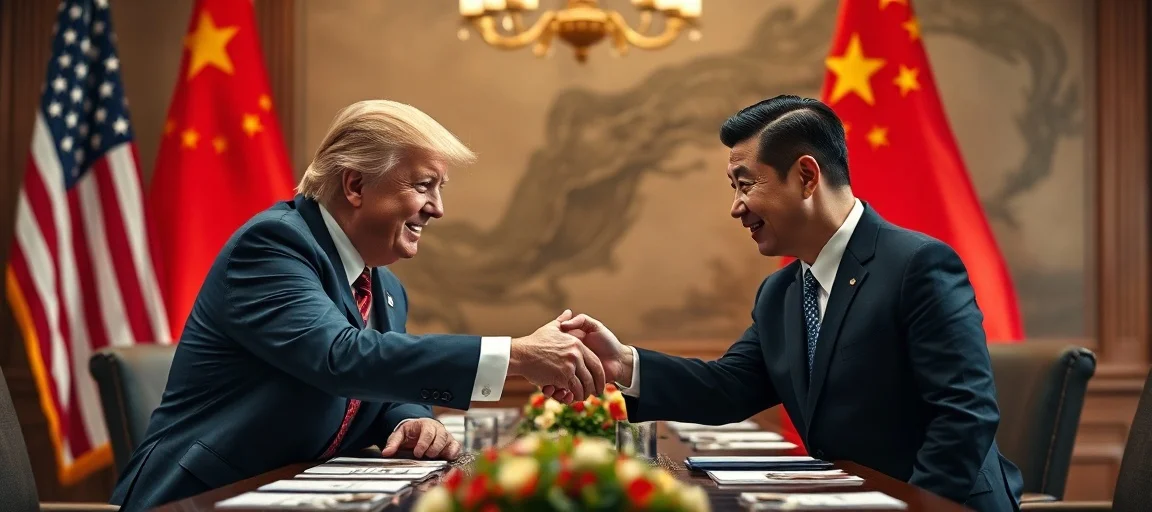
The world watches with bated breath as the highly anticipated Trump & Xi Meet: High-Stakes Summit in Beijing unfolds, promising to be a pivotal moment in 21st-century geopolitics. This significant gathering in the Chinese capital brings together two of the globe's most influential leaders to tackle a complex agenda, the outcomes of which are poised to shape global economic stability, diplomatic relations, and technological advancement for years to come. The summit underscores the intricate and often challenging relationship between the United States and China, with discussions expected to span critical issues from trade imbalances and technological competition to regional security and climate change, all against a backdrop of intense international scrutiny.
The Geopolitical Chessboard: A Background to the Summit
The relationship between the United States and China has long been characterized by a delicate balance of cooperation and competition, a dynamic that has intensified significantly over the past decade. Understanding this complex history is crucial to appreciating the gravity of the current summit. Tensions between the two nations have introduced new challenges, especially related to economic and defense issues.
Historical Context of US-China Relations
The foundation of modern US-China relations was laid in the 1970s, leading to diplomatic recognition and a period of increasing economic engagement. This era saw China's rise as a global manufacturing hub, deeply intertwined with the American consumer market. However, this economic interdependence also brought new challenges, particularly concerns over trade deficits, intellectual property theft, and market access for American companies.
The Trump administration's approach to China marked a significant shift, moving from engagement to a more confrontational stance. This was notably characterized by the imposition of tariffs on Chinese goods, initiating a trade war aimed at addressing long-standing grievances regarding unfair trade practices and forced technology transfers. The administration also took a firmer line on issues such as the South China Sea, Taiwan, and China's human rights record, particularly concerning Xinjiang and Hong Kong. American policymakers, propelled by a conviction that previous American policy on China had failed, aimed to slow China's progress and pressure its leaders to respond to American priorities.
Lingering Issues and Escalating Tensions
Despite changes in US leadership, many of these fundamental points of contention have persisted, evolving into multi-faceted challenges. Economically, discussions around trade balances, industrial subsidies, and the protection of intellectual property remain central. The US has a $202 billion trade deficit in goods with China, its largest with another country, though it is the lowest it has been in two decades. Technologically, the competition for global leadership in critical sectors like semiconductors, artificial intelligence, and 5G infrastructure has intensified, raising national security concerns for both nations. The US has expanded restrictions on access to extreme ultraviolet (EUV) lithography machines and high-end GPUs, effectively limiting China's ability to produce cutting-edge chips domestically.
Geopolitically, the Taiwan Strait continues to be a major flashpoint, with the United States reaffirming its commitment to Taiwan's defense capabilities while China maintains its "One China" principle and asserts sovereignty over the island. Regional influence in the Indo-Pacific, including China's growing military presence and its claims in the South China Sea, also forms a significant part of the broader strategic competition between the two powers. The summit in Beijing therefore represents a critical juncture for these global titans to navigate their differences and potentially find common ground amidst a deeply complex and often adversarial relationship.
The Agenda: Key Issues at the Trump & Xi Meet in Beijing
The discussions at the Trump & Xi Meet: High-Stakes Summit in Beijing are expected to cover a comprehensive range of issues, reflecting the breadth and depth of the US-China relationship. Each point on the agenda carries significant implications for both nations and the wider international community.
Economic and Trade Relations
Foremost among the discussion points will be the ongoing economic and trade relationship. The specter of past trade wars looms large, and both sides are keen to prevent a relapse into escalating tariffs that harm global supply chains and economic growth.
- Tariffs and Market Access: Reviewing existing tariffs and exploring pathways to reduce trade barriers will be a priority. The US will likely press for greater market access for its businesses in China, particularly in financial services and technology sectors. In 2025, a series of increasing tariffs led to the US imposing a 145% tariff on Chinese goods, with China retaliating with a 125% tariff on American goods.
- Intellectual Property Protection: Washington has consistently raised concerns about intellectual property theft and forced technology transfers. The summit could see renewed efforts to establish stronger enforcement mechanisms and legal frameworks to protect American innovations.
- Supply Chain Resilience: The COVID-19 pandemic highlighted vulnerabilities in global supply chains. Both nations may discuss strategies to diversify supply chains and ensure stability for critical goods, potentially exploring areas of limited cooperation to prevent future disruptions. China has also restructured its export controls on critical materials, impacting global supply chains.
- Currency and Subsidies: The value of the yuan and China's state-backed industrial subsidies are perennial issues. The US could seek commitments on fair currency practices and a reduction in subsidies that it views as distorting global markets.
Technology and Innovation Rivalry
The competition for technological supremacy has become a defining feature of US-China relations. This segment of the discussions will likely be highly contentious, given the strategic importance of these sectors.
- Semiconductors: The global semiconductor industry is at the heart of the tech rivalry. Discussions might involve export controls, access to advanced manufacturing technologies, and efforts by both nations to achieve self-sufficiency in chip production. China's semiconductor self-sufficiency rate was only 16% in 2020 and its share of global production capacity was around 15% by 2022, still lagging behind major players in advanced chip production.
- Artificial Intelligence (AI) and 5G: The race for leadership in AI and the deployment of 5G networks will undoubtedly feature. Concerns over data security, surveillance capabilities, and ethical guidelines for AI development could be on the agenda. The US has restricted Nvidia's sale of degraded AI chips to China, and is considering further legislation to limit China's access to high-tech tools for semiconductors crucial to AI.
- Cybersecurity: Both countries face significant cybersecurity challenges. Cyber security issues have led to multiple conflicts between China and the United States, presenting a highly competitive and confrontational posture. While often a source of friction due to accusations of state-sponsored hacking, there could be a narrow opening for dialogue on establishing norms and reducing cyber espionage, especially concerning critical infrastructure. China is engaging in sustained cyber operations targeting US critical infrastructure to lay the foundation for future disruption.
Geopolitical Stability and Regional Security
Beyond economics and technology, the summit will address critical geopolitical flashpoints that threaten regional and global stability.
- Taiwan Strait: The status of Taiwan remains perhaps the most sensitive issue. Tensions in the Taiwan Strait are escalating due to intensified military drills, nationalist rhetoric, and increased arms support. Discussions will likely revolve around maintaining peace and stability in the Strait, with each side reiterating its long-standing positions while potentially seeking assurances against unilateral actions. The US policy of strategic ambiguity has long sought to deter China from attacking Taiwan while maintaining unofficial ties.
- South China Sea: China's expansive territorial claims and military build-up in the South China Sea have been a source of tension. The US will likely push for freedom of navigation and adherence to international law, while China will assert its sovereignty. This area of friction is central to the intensifying cyber threat landscape between the two countries.
- North Korea: While not directly bilateral, North Korea's nuclear program is a regional concern where US-China cooperation has been historically crucial, though often difficult. The leaders might explore renewed diplomatic efforts or coordinated sanctions enforcement.
- Indo-Pacific Strategy: The US will likely articulate its vision for a free and open Indo-Pacific, emphasizing alliances and partnerships, which China views with suspicion as containment strategies.
Global Challenges: Climate Change and Health Security
Despite their differences, certain global challenges necessitate a degree of cooperation.
- Climate Change: Both the US and China are the world's largest emitters of greenhouse gases. There have been periods of intense collaboration, notably leading up to the 2015 Paris Agreement. Discussions could explore potential areas for collaboration on renewable energy technologies, carbon reduction targets, and adaptation strategies, despite past disagreements on the urgency and responsibility of climate action.
- Global Health Security: The experience of the COVID-19 pandemic highlighted the need for international cooperation on public health. Dialogue could focus on pandemic preparedness, vaccine distribution, and information sharing to prevent future global health crises.
Insights from Experts and Political Analysts
The lead-up to the Trump & Xi Meet: High-Stakes Summit in Beijing has been met with a flurry of analysis and speculation from political scientists, economists, and former diplomats. Their perspectives offer valuable insights into the potential outcomes and inherent challenges of such a high-level meeting.
Anticipated Outcomes and Sticking Points
Experts generally agree that the summit's success will be measured not by immediate breakthroughs, but by the tone set and the establishment of channels for future dialogue. "Both leaders come to Beijing with strong domestic mandates and non-negotiable red lines," notes Dr. Eleanor Vance, a senior fellow at the Council on Foreign Relations. The Trump administration's foreign policy has been characterized by a transactional approach, focused on maximizing tangible benefits to the United States, particularly in trade. For Xi Jinping, "major-country diplomacy" prioritizes a more assertive China, safeguarding sovereignty and challenging US hegemony.
Trade remains a critical and potentially volatile area. "While a full-blown trade war might be avoided, expect tough negotiations on tariffs and market access," states Mr. David Chen, an economist specializing in US-China trade at the Peterson Institute for International Economics. "China will likely offer some concessions, but fundamental structural issues, such as state subsidies, will be much harder to resolve quickly." The US Supreme Court recently struck down some of Trump's emergency act tariffs, impacting certain reciprocal tariffs on Chinese goods. However, the bulk of the US-China trade war tariffs remain in place.
The Taiwan Dilemma
The Taiwan issue is frequently highlighted as the most dangerous flashpoint. "Any perceived deviation from the 'One China' policy by the US could quickly derail the summit and escalate tensions dramatically," warns Dr. Michael Green, an Asia security expert at the Center for Strategic and International Studies. "Both sides will walk a very fine line, with the US seeking assurances of peaceful resolution while upholding its commitments to Taiwan's self-defense." Cross-strait tensions have escalated in recent years due to China's rapidly ramped-up military capabilities and more intrusive operations near the island.
Technology: A Defining Battleground
On technology, analysts predict a continuation of the strategic rivalry rather than outright cooperation. "The competition in semiconductors and AI isn't going away; it's a zero-sum game for strategic advantage," says Dr. Sarah Kim, a technology policy analyst. "The best we can hope for is an agreement on certain guardrails to prevent accidental escalation, especially in areas like cyber warfare." The US policy of strategic denial is designed to slow military AI advancement by constraining access to compute. This tech competition is seen as fragmenting the global economy into competing technological blocs.
The Role of Personal Diplomacy
Many experts also emphasize the role of personal chemistry, or lack thereof, between the two leaders. "Trump's transactional approach to diplomacy could either yield surprising deals or lead to sharp disagreements," observes Ambassador Richard Haass, a veteran diplomat. "Xi, on the other hand, operates within a more institutionalized system but is known for his firm resolve. The dynamic between these two strong personalities will be crucial."
Potential Impact and Global Repercussions
The reverberations of the Trump & Xi Meet: High-Stakes Summit in Beijing are expected to be felt across the globe, influencing everything from financial markets to international alliances. The outcomes, whether breakthroughs or stalemates, will reshape the contours of 21st-century geopolitics.
Economic Implications
A successful summit, marked by de-escalation of trade tensions and progress on market access, could trigger a positive response in global financial markets. Reduced uncertainty would encourage investment, stabilize supply chains, and potentially boost global economic growth. Conversely, a breakdown in talks or a return to protectionist measures could lead to renewed market volatility, increased business costs, and a chilling effect on international trade.
Beyond tariffs, any agreements or disagreements on intellectual property rights and technology transfer will have profound implications for multinational corporations operating in both countries. Clarity on these fronts could either foster greater cross-border investment or accelerate the trend of supply chain decoupling, particularly in critical sectors like technology. The long-term impact on global innovation and the pace of technological development will also be significantly influenced by the level of cooperation or competition established at this summit.
Geopolitical Shifts and Alliances
The summit's results will inevitably influence the strategic calculations of other nations. Allies of the United States, particularly in Asia and Europe, will closely monitor the level of commitment to existing security alliances and the approach taken on issues like Taiwan and the South China Sea. Any perceived shift in US policy could prompt a re-evaluation of their own foreign policy stances. Taiwan is seen as a geographic pivot point for maintaining a free and open Indo-Pacific.
For China, the summit is an opportunity to assert its growing global influence and demonstrate its capacity for constructive engagement, even with its primary strategic competitor. Outcomes could either strengthen Beijing's position in multilateral forums or further isolate it on certain contentious issues. Xi Jinping's "major-country diplomacy" doctrine has replaced earlier "low profile" approaches, legitimizing a more active global role for China. The trajectory of global power dynamics, including the balance between democratic and authoritarian models, will be under intense scrutiny.
Technological Advancement and Regulation
The discussions on technology could set precedents for how nations approach critical issues like data governance, artificial intelligence ethics, and the responsible development of emerging technologies. While full agreement is unlikely, even incremental steps towards establishing international norms could prevent a complete balkanization of the digital world. The outcome will particularly impact the future of global tech companies, their market access, and their ability to innovate across borders. The US and China are engaged in a "chip war" over semiconductors, AI, and rare earth processing.
Furthermore, the summit's impact on climate change efforts cannot be overstated. As the two largest emitters, any renewed commitment to climate action, even if limited, could inject much-needed momentum into global environmental initiatives. Conversely, a lack of progress could further set back international efforts to address the climate crisis. The global energy transition is an arena where strategic rivalry and shared interests coexist.
Looking Ahead: The Path After Beijing
The Trump & Xi Meet: High-Stakes Summit in Beijing is not merely a single event but a crucial step in an ongoing, complex relationship. Regardless of the immediate outcomes, the discussions held and the groundwork laid will define the trajectory of US-China relations for the foreseeable future. The world will be watching to see if this high-stakes encounter paves the way for a more stable and cooperative global environment or if it signals a deepening of strategic rivalry.
The commitment to sustained dialogue, even on the most contentious issues, will be paramount. Future engagements, whether at ministerial levels or through working groups, will be essential to flesh out any agreements reached and to manage inevitable disagreements. The global community remains hopeful that the leaders' discussions contribute to a pathway for responsible competition and, where possible, constructive collaboration on shared global challenges. The success of the Trump & Xi Meet: High-Stakes Summit in Beijing will ultimately be judged by its long-term impact on peace, prosperity, and stability worldwide.
Frequently Asked Questions
Q: What are the primary goals for the US and China at this summit?
A: The US aims to address long-standing concerns regarding trade imbalances, protect intellectual property, and ensure regional stability, particularly in the Indo-Pacific. China seeks to safeguard its national sovereignty, advance its technological agenda, and assert its role as a global power while managing strategic tensions.
Q: Which specific economic issues are expected to dominate discussions?
A: Key economic points on the agenda will likely include a review of existing tariffs, calls for greater market access for US businesses in China, addressing intellectual property theft concerns, and strategies for global supply chain resilience. Discussions on currency practices and state-backed industrial subsidies are also anticipated.
Q: How might the summit impact geopolitical stability in the Indo-Pacific region?
A: Discussions will critically address flashpoints like the Taiwan Strait and China's activities in the South China Sea. The summit's outcomes could significantly influence US alliances in the region, shape China's growing military and economic influence, and impact the broader balance of power, potentially leading to either de-escalation or increased strategic rivalry.