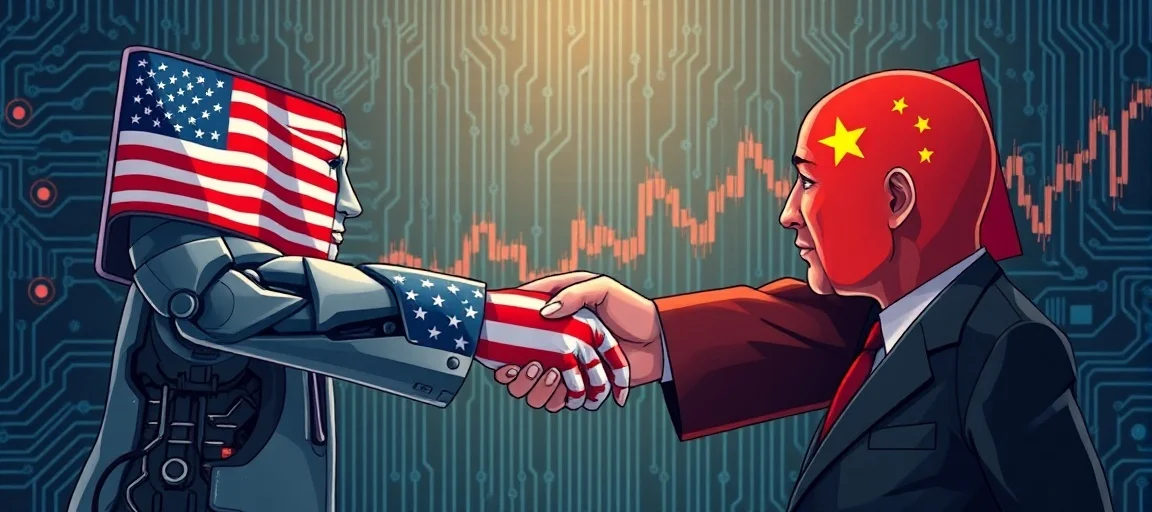
China AI: Reshaping Global Power and Innovation
China's swift ascent in artificial intelligence (AI) is not merely a technological phenomenon; it's a profound force that is fundamentally reshaping global power dynamics and driving innovation across virtually every sector. The nation's strategic focus on AI has propelled it to the forefront of this transformative technology, challenging existing world orders and setting new benchmarks for development. This comprehensive look into China AI will explore its current trajectory, the geopolitical implications of its rise, and the ethical considerations that accompany such rapid advancement.
The Rise of China AI: A Global Imperative
China has unequivocally designated artificial intelligence as a strategic national priority, aiming to become the world's primary AI innovation center by 2030. This ambition is underpinned by substantial government investment and a market-oriented approach that encourages private sector participation. The country's "New Generation AI Development Plan," launched in 2017, outlined a three-stage strategy to achieve world leadership in AI theory, technology, and applications by the end of the decade. By 2025, China aims for its AI industry to reach a world-leading level in some fields, with the core AI industry exceeding 150 billion RMB and related industries surpassing 1 trillion RMB. For a deeper dive into how global AI strategies are shaping the future, read our analysis.
This national imperative is reflected in the rapid growth of China's AI ecosystem. As of May 2026, the country has made significant strides in various AI domains, from large language models (LLMs) to robotics and smart city applications. Premier Li Qiang's "AI+ Initiative," launched in March 2024, explicitly seeks to integrate AI into China's real economy, underscoring the technology's role in industrial upgrading and economic transformation.
Historical Context and Government Initiatives
China's journey toward AI dominance began long before the current boom. The "National Medium and Long-Term Technology Development Plan" in 2006 first identified intelligent computing as a top research priority, laying a foundational groundwork. This was followed by the "Internet Plus" national strategy in 2015, which explicitly recognized AI as a strategic emerging industry. These early initiatives culminated in the ambitious 2017 "New Generation AI Development Plan," which set clear targets for China's AI ascendancy.
The government's approach is characterized by a "system layout" that leverages the socialist system to concentrate resources on major AI projects, alongside a "market-dominant" principle that fosters commercialization and competition among private companies. This dual strategy has led to significant public funding, including an $8.2 billion National AI Industry Investment Fund launched in January 2025, specifically to support the growing AI startup ecosystem.
Beyond financial support, China has also focused on talent development, recognizing the persistent shortage of qualified AI workers despite a rapidly expanding talent pool. Efforts are underway to bridge skill mismatches and promote open-source sharing and collaboration between industry and academia.
Key Areas of Advancement
China's AI advancements are broad and impactful, spanning various critical sectors:
1. Large Language Models (LLMs) and Generative AI:
Chinese companies are rapidly developing sophisticated LLMs, with 117 generative AI models approved by the government by April 2024. Leading players like Baidu AI Cloud, SenseTime, and Zhipu AI hold significant market share in China's LLM sector. Notably, DeepSeek's DeepSeek-R1 model, launched in January 2025, has surprised the Western world with its performance, comparable to leading U.S. models even with minimal hardware. Other prominent firms include Alibaba with its Qwen family of models, Tencent with Hunyuan, Baichuan, Zhipu AI, Moonshot AI, MiniMax, and 01.AI, often referred to as China's "new AI Tigers". ByteDance, the parent company of TikTok, has also launched AI video-generation tools to rival global competitors and consumer-focused AI apps like Doubao.
2. Robotics and Automation:
China has made robotics a core component of its 15th Five-Year Plan (2026-2030), aiming to pivot its AI research towards physical applications with robots driving economic growth. The country already boasts an operational stock of approximately 2 million industrial robots, deploying 54% of all industrial robots worldwide annually. While mass adoption of humanoid robots in factories or households is projected for the end of the 15th Five-Year Plan period, widespread integration of AI with traditional industrial robotics is expected within the next five to ten years.
3. Healthcare:
AI is profoundly transforming China's healthcare system, addressing challenges like population pressure and resource gaps. The market for AI in healthcare is projected to grow from 18.88 billion by 2030, with a Compound Annual Growth Rate (CAGR) of 42.5%. Applications include automated pathology, rare disease screening, intelligent triage, and AI-generated medical documentation. Tsinghua University's "Agent Hospital" features 42 AI doctors across 21 specialties, capable of treating 10,000 patients with 93% accuracy in days. DeepSeek models are also embedded in over 260 hospitals across China, assisting physicians while ensuring patient data privacy. Government initiatives aim for AI-assisted diagnosis and treatment to be standard in primary-level institutions for 900 million citizens by 2030, with an investment of $2-3 billion over the next five years.
4. Smart Cities and Surveillance:
China has created a vertically integrated pipeline that draws data from smart cities, social platforms, and healthcare systems for AI modeling and governance. This includes the widespread use of facial recognition, sound recognition, and drone technologies by companies like SenseTime, iFlytek, Cloudwalk, and DJI. These AI solutions focus on broad urban applications, contributing to a sophisticated AI-powered surveillance state that utilizes predictive policing and biometric data-tracking.
Geopolitical Implications of China's AI Dominance
The rapid advancements in China's AI programs pose significant geopolitical implications, threatening the existing rules-based global order and impacting international power structures. By 2030, China aims to dominate AI industries, influencing global economic and political landscapes.
Impact on Global Power Dynamics
China's AI strategy is deeply intertwined with its broader foreign policy ambitions and national security goals. President Xi Jinping views AI through the lenses of national security and geopolitics, prioritizing resilience and geopolitical objectives over pure economic growth. This state-driven approach ensures that AI development reinforces, rather than disrupts, the Chinese Communist Party's (CCP) dominance.
The export of Chinese AI technology, particularly through initiatives like the Belt and Road Initiative, facilitates state surveillance and social control in authoritarian regimes and influences governance in developing countries. This raises concerns about the emergence of new power structures outside existing governance and accountability frameworks. For insights into the ethics of AI surveillance, explore our recent report. China has been actively promoting its "Global AI Governance Initiative" (GAIGI) since 2023, and released an "Action Plan for Global Artificial Intelligence Governance" in July 2025. This plan emphasizes infrastructure development, sectoral application, data quality and security, and international cooperation, while also seeking to shape global AI governance amid intensifying technological competition. China has also proposed establishing a global AI cooperation organization, potentially headquartered in Shanghai, to foster international collaboration and prevent monopolistic control by a few countries.
The militarization of AI is another critical aspect, with the People's Liberation Army (PLA) rapidly developing AI-powered autonomous warfare systems, cyberwarfare capabilities, and intelligence analysis tools. This push for "leapfrog technology" aims to shift the military balance of power and create an overwhelming advantage.
Ethical Considerations and International Standards
With the accelerated development of AI, ethical considerations have become paramount. China has introduced a robust regulatory framework to address risks related to AI-generated content, data privacy, algorithmic bias, and national security. Key legislation includes the Cybersecurity Law (2016), Data Security Law (2021), Personal Information Protection Law (2021), and the Generative AI Regulation (2023).
New administrative measures for the Ethical Review and Services of Artificial Intelligence Science and Technology (Trial), introduced in April 2026, mark a significant step towards professionalizing and institutionalizing AI ethics governance. These measures require all universities, research institutions, and companies engaged in AI development to establish ethics committees and integrate ethical requirements throughout the entire AI development process. Ethical review committees are now mandated to assess AI research and development activities, especially those posing ethical risks in areas like life and health, ecological environment, and public order.
While China's AI regulations share similarities with global frameworks, they also reflect its unique political and social context, integrating AI governance with national security and social stability goals. This approach contrasts with, for example, the EU's AI Act, which emphasizes EU values. China's efforts aim to ensure that AI products and services are free from discrimination and prejudice and that technological interventions do not compromise fairness. The country also plans to contribute to the development of over 20 international standards to support global AI governance.
Innovation and Economic Transformation Driven by China AI
China's commitment to AI is deeply rooted in its vision for economic development and industrial upgrading. The "AI+ Action Plan," issued in August 2025, prioritizes AI deployment in six areas: science and technology development, industrial utilization, consumer services, public welfare, governance and security, and international collaborations. The country aims to achieve 70% AI penetration in key sectors by 2027 and 90% by 2030, with a long-term vision of a fully AI-powered economy and society by 2035.
Domestic Applications and Market Growth
The domestic market for AI applications in China is experiencing explosive growth. Major tech and internet companies are rapidly launching AI products and services across diverse fields, from electric vehicles and robotics to health care and biotechnology. Baidu AI Cloud, for instance, holds China's largest LLM market share, demonstrating the scale of domestic adoption.
Chinese AI applications are dominating in terms of reach, with six of the ten largest AI companies by scale globally being China-based, including Baidu, ByteDance, DeepSeek, Meitu, Zuoyebang, and Alibaba. These applications are integrated into everyday touchpoints like search, photo galleries, short video, and documents, making AI less of a spectacle and more of an operational capability that endures and scales.
Beyond the prominent tech giants, a vibrant ecosystem of AI startups is emerging. Companies like fxis.ai, Simform, DataPyramid, and TechnoYuga are providing AI-driven solutions for content creation, automation, data engineering, and specialized AI models. Mobvoi specializes in Chinese voice recognition and natural language processing, while Bitmain focuses on semiconductors for blockchain and AI applications. Digua Robotics, a spinoff of Horizon Robotics, is developing infrastructure for consumer and industrial robotics.
International Collaboration and Competition
China's AI strategy also extends to international collaboration and competition. The country is keen on promoting an open and inclusive AI ecosystem, supporting dialogues among national standards bodies, and leveraging international standards-setting organizations. However, this push for international influence comes amidst intensifying technological competition, particularly with the United States.
While Chinese AI models are closing the performance gap with top U.S. models, challenges remain. U.S.-led export controls on AI chips and semiconductor manufacturing equipment limit the compute available to Chinese AI developers, forcing them to make trade-offs between near-term progress and long-term resilience. Learn more about semiconductor technology and geopolitics. Despite these hurdles, China's AI industrial policy, with its support for research, talent, subsidized compute, and applications, is expected to accelerate its progress and maintain its position as a close second to the United States in AI development.
China's engagement in international forums, such as co-hosting the "Group of Friends for International Cooperation on AI Capacity-building" at the UN, reflects its ambition to shape global AI standards and ensure the involvement of Global South countries in governance efforts. This dual approach of domestic innovation and international engagement positions China as a critical player in the ongoing global AI landscape.
Conclusion
The profound impact of China AI is undeniable, marking a pivotal moment in global technological and geopolitical evolution. From ambitious government plans and massive investments to a flourishing ecosystem of innovative companies, China is rapidly advancing its capabilities across all facets of artificial intelligence. This progress is not only transforming its domestic economy and society, from healthcare to smart cities, but also significantly influencing international power dynamics and the very discourse on AI governance. As China continues to push the boundaries of AI, its trajectory will remain a critical focus for global observers, shaping the future of technology and international relations for decades to come.
Frequently Asked Questions
Q: What is China's primary AI ambition?
A: China aims to become the world's leading AI innovation center by 2030. This goal is backed by significant government investment, strategic plans, and a market-oriented approach to foster private sector participation across diverse AI domains.
Q: How does China regulate AI?
A: China has established a robust regulatory framework to address AI risks. Key legislation includes the Cybersecurity Law, Data Security Law, Personal Information Protection Law, and the Generative AI Regulation, coupled with mandatory ethics committees for AI development.
Q: What are the geopolitical effects of China's AI growth?
A: China's rapid AI growth profoundly influences global power dynamics, enabling the export of surveillance technology, and actively seeking to shape international AI governance through initiatives like the Global AI Governance Initiative. This challenges existing global orders.
Further Reading & Resources
- How China is rapidly reshaping the global AI landscape
- China’s Artificial Intelligence Strategy: An Overview
- The Geopolitics of Artificial Intelligence: China and the AI Revolution
- The Chinese Government's Approach to AI: Implications for U.S.-China Competition
- China’s AI Revolution and Its Global Implications