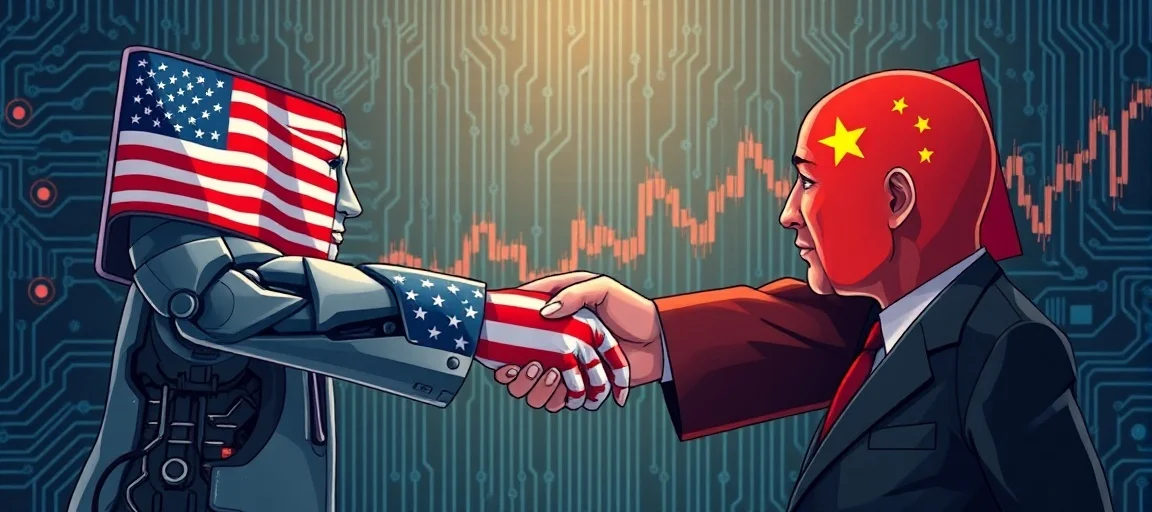
China Prioritizes Basic Research for Tech Dominance – A Global Race

In a strategic move poised to reshape the global technological landscape, China is increasingly prioritizing basic research to secure tech dominance. This ambitious national endeavor, driven by both economic aspirations and geopolitical realities, marks a significant shift from its historical focus on applied research and manufacturing. The nation is pouring substantial resources into foundational scientific inquiry, recognizing it as the bedrock for future innovation and a crucial lever in the ongoing international competition for technological leadership. This concerted effort aims to cultivate a robust indigenous innovation ecosystem, ensuring self-sufficiency and pushing the boundaries of scientific discovery across critical sectors.
Background Context & Strategic Imperative
China's pivot towards basic research is not merely an academic pursuit; it is a critical component of a broader national strategy to achieve technological self-reliance and global leadership. For decades, China's economic miracle was largely built on manufacturing and the adaptation of existing technologies. However, recent geopolitical tensions, particularly regarding access to advanced technologies like semiconductors, have underscored the vulnerabilities inherent in relying on foreign innovation. This realization has catalyzed a profound re-evaluation of its scientific strategy, placing fundamental research at the forefront.
Historical Reliance and the Push for Self-Sufficiency
Historically, China's innovation model often involved reverse engineering, technology transfer, and incremental improvements on foreign designs. While this approach propelled rapid industrialization, it left the nation exposed to external pressures and reliant on critical components and intellectual property originating elsewhere. The "chokepoint" strategy employed by some Western nations, restricting access to key technologies, particularly in areas like advanced chip manufacturing, served as a powerful catalyst for China to double down on indigenous innovation. The push for self-sufficiency, known as "dual circulation," emphasizes domestic demand and technological independence as core pillars of economic growth.
The Geopolitical Landscape and Tech Competition
The current geopolitical climate is characterized by intense competition for technological supremacy. Nations recognize that leadership in cutting-edge fields such as artificial intelligence, quantum computing, biotechnology, and advanced materials will dictate future economic power and national security. China views its investment in basic research as a non-negotiable step to not only overcome external restrictions but also to establish itself as a global standard-setter and innovator. This long-term vision aims to shift China from being a technology consumer to a technology producer and leader, ensuring its place at the vanguard of future technological revolutions. The strategic imperative is clear: basic research is the foundation upon which future tech dominance will be built.
Pillars of China's Basic Research Drive for Tech Dominance
China's strategy to bolster basic research is multi-faceted, encompassing massive financial investment, ambitious talent cultivation programs, and strategic focus on key technological frontiers. This comprehensive approach aims to create an environment where fundamental scientific breakthroughs can flourish and be rapidly translated into practical applications, thus ensuring China Prioritizes Basic Research for Tech Dominance.
Massive Funding and Investment
The financial commitment to basic research in China has seen an unprecedented surge. The nation's expenditure on research and development (R&D) has steadily increased, with a growing proportion allocated specifically to basic science. In 2022, China's total R&D spending reached 3.09 trillion yuan (approximately $430 billion), with basic research accounting for 6.3% of that figure, or 195.1 billion yuan. While still lower than the percentage invested by some developed nations (e.g., the U.S. basic research spending as a percentage of R&D is higher), the sheer scale of China's overall R&D budget means its absolute investment in basic research is substantial and rapidly growing. The government has outlined plans to increase the share of basic research in total R&D expenditure to 8% by 2025. This commitment extends to establishing large-scale national laboratories and funding ambitious long-term projects designed to push the boundaries of scientific knowledge.
Cultivating Top Talent and Research Institutions
Recognizing that scientific advancement is fundamentally driven by human capital, China has implemented aggressive strategies to attract, train, and retain top scientific talent. This includes:
- Expanded Higher Education: Significant expansion of STEM programs at universities, aiming to produce a large pool of highly skilled researchers and engineers.
- Talent Recruitment Programs: Initiatives like the "Thousand Talents Program" (though rebranded and less publicized recently due to international scrutiny) offered lucrative incentives to lure overseas Chinese scientists and leading international experts back to China.
- World-Class Research Facilities: Investment in state-of-the-art research infrastructure at universities and national laboratories, providing scientists with cutting-edge tools and environments.
- Emphasis on Doctoral and Postdoctoral Training: Policies supporting advanced degrees and postdoctoral research to deepen expertise in critical fields.
The goal is to cultivate a new generation of scientists capable of leading groundbreaking research, reducing reliance on foreign expertise, and establishing China as a global hub for scientific discovery.
International Collaboration (and its challenges)
While the focus is on indigenous innovation, China also recognizes the value of international scientific collaboration. Researchers actively participate in global scientific projects, publish in international journals, and attend conferences. However, this aspect of the strategy faces increasing scrutiny and challenges due to geopolitical tensions and concerns over intellectual property theft, forced technology transfer, and the potential dual-use nature of certain research outcomes for national security. Some countries have scaled back scientific exchanges with China, leading to a complex dynamic where China seeks both cooperation and independence simultaneously. This growing tension not only complicates global scientific endeavors but has also further intensified China's internal drive for self-reliance in fundamental research, potentially isolating parts of its scientific community while accelerating domestic capabilities.
Strategic Focus Areas
China's basic research efforts are not diffused broadly but are strategically concentrated on fields deemed critical for future technological dominance. These include:
- Artificial Intelligence (AI): Significant investment in foundational AI research, including machine learning algorithms, neural networks, natural language processing, and computer vision, aiming to lead in all aspects of AI development.
- Semiconductors: Beyond manufacturing, there's a deep dive into fundamental materials science, advanced chip architectures, and novel fabrication techniques to overcome current dependencies.
- Biotechnology and Medicine: Research in gene editing, synthetic biology, pharmaceuticals, and precision medicine is a national priority, driven by both economic potential and public health needs.
- Quantum Computing: A field with transformative potential, China is heavily investing in quantum entanglement, quantum communication, and quantum computing hardware and algorithms.
- New Materials: Research into advanced ceramics, composites, superconductors, and other novel materials is crucial for innovation across multiple high-tech industries.
- Aerospace and Deep Sea Exploration: Fundamental research supports ambitious goals in space exploration, satellite technology, and understanding marine environments.
Key Initiatives and Milestones
China's commitment to basic research is manifest in several high-profile initiatives and tangible milestones, demonstrating the actionable nature of its strategic priorities.
National Labs and "New Whole-Nation System"
Central to China's strategy is the establishment of a network of national laboratories designed to tackle major scientific and technological challenges. These labs, often operating with significant autonomy and funding, are intended to be world-class research hubs. Examples include the Hefei National Laboratory for Physical Sciences at the Microscale and the Peng Cheng Laboratory, focusing on areas like AI and cyberspace.
Furthermore, China has revived and adapted the "new whole-nation system" (新型举国体制), a top-down, centralized approach to mobilizing resources and talent for national strategic objectives. This system allows the government to coordinate academia, industry, and state-owned enterprises towards specific scientific and technological breakthroughs, often bypassing market inefficiencies to accelerate progress in critical areas like advanced semiconductors and AI. This approach ensures that research priorities align with national strategic goals and receive coordinated support.
Recent Breakthroughs and Policy Announcements
In recent years, China has announced numerous significant scientific achievements that underscore its growing capabilities in basic research:
- Quantum Supremacy Claims: Chinese scientists have reported breakthroughs in quantum computing, notably with their photon-based quantum computer, Jiuzhang, which demonstrated quantum computational advantage.
- CRISPR Gene Editing: Advances in gene-editing technologies have been prominent, although some applications have raised ethical debates globally.
- Space Exploration: Successful missions to the Moon (Chang'e program) and Mars (Tianwen-1) have demonstrated advanced capabilities in planetary science and deep space communication, built upon fundamental physics and engineering research.
- Fusion Energy Research: Significant contributions to international fusion projects like ITER and domestic advancements in tokamak devices, pushing the boundaries of clean energy science.
These achievements are often highlighted as proof of the efficacy of China's investment in basic research and its potential to translate foundational knowledge into tangible scientific and technological leadership.
Challenges and Criticisms
Despite its ambitious goals and significant investments, China's drive for basic research dominance faces several inherent challenges and criticisms, both internally and from the international community.
Innovation Culture vs. Top-Down Approach
A persistent challenge for China is fostering a truly innovative culture within its scientific institutions. While the "new whole-nation system" can efficiently direct resources and achieve specific goals, critics argue that a highly centralized, top-down approach can sometimes stifle independent thought, creativity, and the serendipitous discoveries often associated with less constrained basic research environments. The emphasis on metrics, publications, and pre-defined national priorities may inadvertently discourage risk-taking and novel, unconventional research pathways that don't immediately align with state objectives. Balancing centralized direction with academic freedom remains a delicate act.
Brain Drain and Talent Retention
While China has made strides in attracting talent, retaining its top scientists, especially those trained abroad, remains an ongoing issue. Factors such as academic freedom, the prevalence of political influence in research funding, work-life balance, and perceived limitations on open intellectual discourse can significantly influence a scientist's decision to return or stay in China long-term. Despite efforts to provide competitive salaries and world-class facilities, some leading researchers still opt for careers in Western institutions, where they may perceive greater autonomy, less bureaucratic interference, and seamless access to a broader international research community. Addressing this brain drain requires not just financial incentives but also fostering an environment that champions independent inquiry, diverse perspectives, and robust academic freedom, all crucial for sustained basic research leadership.
Ethical Considerations and Data Privacy
As China pushes the boundaries in fields like biotechnology and artificial intelligence, ethical considerations and concerns over data privacy become increasingly prominent. Research in areas such as gene editing, facial recognition, and large-scale data analysis raises questions about societal impact, individual rights, and global norms. The lack of robust independent ethical oversight bodies, compared to some Western counterparts, can lead to international scrutiny and criticism, particularly when research outcomes are perceived to be linked to state surveillance or other controversial applications. Navigating these ethical landscapes responsibly is vital for China's long-term reputation as a global scientific leader.
Global Implications and Future Outlook
China's aggressive prioritization of basic research for tech dominance carries profound implications for global geopolitics, economics, and the future of scientific collaboration. This strategic shift is not merely about domestic progress but about reshaping the international order.
Redefining Global Tech Leadership
Should China succeed in its ambitious basic research agenda, it could fundamentally redefine global tech leadership. The traditional dominance of Western nations in foundational scientific discoveries might be challenged, leading to a more multipolar world in terms of technological innovation. This would mean that future global standards, intellectual property, and cutting-edge technologies could increasingly originate from China. For other nations, this implies a need to either intensify their own basic research efforts or adapt to a world where technological dependency dynamics are altered. The race for quantum computing supremacy and advanced AI is a clear indicator of this unfolding competition.
The Race for Standards and IP
Technological dominance goes hand-in-hand with setting global standards and controlling intellectual property (IP). As China makes more fundamental scientific breakthroughs, it will be in a stronger position to influence and establish international norms and standards in emerging technologies. This extends from communication protocols to ethical guidelines for AI. Controlling IP allows for significant economic leverage and the ability to dictate terms in global supply chains. China's growing patent applications and scientific publications already reflect this push to become a significant IP holder and standard-setter in critical fields. The future competition will not just be about who invents first, but who can effectively standardize and commercialize their inventions globally.
Conclusion
China Prioritizes Basic Research for Tech Dominance, a strategic imperative driven by both economic ambition and geopolitical necessity. By significantly increasing investment, cultivating talent, and focusing on key technological frontiers, Beijing aims to achieve self-sufficiency and establish global leadership in critical scientific domains. While challenges such as fostering an open innovation culture, retaining top talent, and navigating ethical complexities persist, the commitment to foundational science is unwavering. The global implications of this national drive are monumental, potentially ushering in a new era of multipolar technological leadership and intensifying the race for international standards and intellectual property. The world watches as China's foundational scientific efforts continue to accelerate, promising to reshape the future of technology and global power dynamics for decades to come.
Frequently Asked Questions
Q: Why is China prioritizing basic research for tech dominance now?
A: China is shifting focus to basic research to achieve technological self-reliance and global leadership, driven by past reliance on foreign tech and increasing geopolitical pressures, particularly regarding advanced semiconductors.
Q: Which key technological areas are China's basic research efforts concentrating on?
A: China is strategically investing heavily in fields such as Artificial Intelligence (AI), semiconductors, biotechnology, quantum computing, and new materials, all deemed critical for future technological supremacy.
Q: What are the main challenges China faces in its pursuit of basic research dominance?
A: Key challenges include fostering a genuinely innovative culture, retaining top scientific talent against international competition, and navigating ethical considerations, particularly in cutting-edge fields like gene editing and AI.