White House Dinner Shooting: Trump Unharmed Amid Chaos
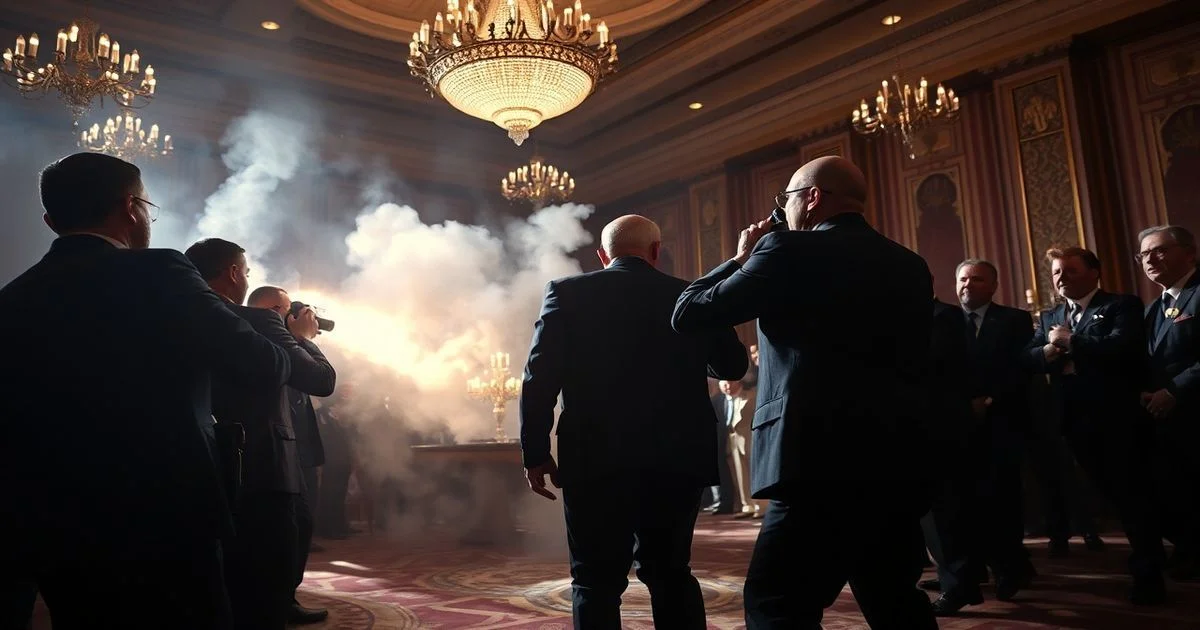
A stunning security breach unfolded at a high-profile White House dinner on Saturday night, as a man armed with guns and knives stormed the lobby of the Washington Hilton, resulting in a chaotic scene that saw President Donald Trump unharmed. The swift and decisive actions of Secret Service agents ensured the safety of the President and other senior U.S. leaders in attendance, evacuating them as gunshots were reported. This incident, centered around a White House Dinner Shooting: Trump Unharmed, has ignited immediate concerns about presidential security protocols and the rising political tensions in the nation.
- The Incident Unfolds: A Breach of Security
- Immediate Response and Evacuation Protocols
- Aftermath and Ongoing Investigation
- National and International Reactions
- Historical Context of White House Security Incidents
- The White House Dinner Shooting: A Catalyst for Enhanced Security Protocols
- Conclusion
- Frequently Asked Questions
- Further Reading & Resources
The Incident Unfolds: A Breach of Security
The annual White House Correspondents' Dinner, a gathering typically marked by political satire and celebrity appearances, transformed into a scene of alarm when an assailant attempted to breach the event's security perimeter. Reports indicate that the individual, identified as Cole Tomas Allen, 31, of Torrance, California, confronted security personnel in the hotel lobby, leading to an exchange of gunfire. While the exact sequence of events leading to the shots remains under investigation, the immediate priority was the protection of the President and other dignitaries. The swiftness with which the situation escalated underscored the ever-present dangers in an increasingly volatile political climate.
The Washington Hilton ballroom, where hundreds of prominent journalists, politicians, and celebrities were awaiting President Trump's remarks, plunged into confusion. Guests described hearing loud commotions and gunshots, prompting many to take cover under tables. The Secret Service's Presidential Protection Division, responsible for safeguarding the nation's highest office holders, executed an immediate evacuation of President Trump, First Lady Melania Trump, and other protected individuals, swiftly moving them to a secure location. This rapid response minimized exposure and ensured presidential continuity.
Immediate Response and Evacuation Protocols
The Secret Service's response was a textbook example of high-stakes protective operations. As soon as the threat became apparent, agents formed a protective cordon around President Trump and his immediate family, guiding them out of the ballroom. This rapid evacuation is a core component of Secret Service training, which emphasizes getting protectees to safety within seconds of an incident. The precision of their actions likely prevented a far worse outcome, showcasing years of rigorous drills and preparation for such unforeseen crises.
Simultaneously, law enforcement agencies converged on the scene. Metropolitan Police Department officers, U.S. Park Police, and FBI agents quickly established a perimeter around the hotel, securing the area and initiating a thorough sweep for any additional threats. The National Guard was also mobilized, taking up positions inside the building as guests were systematically allowed to leave. The swift coordination between these agencies underscored the robust, multi-layered security infrastructure designed to respond to threats against the President and national security events, highlighting the importance of inter-agency cooperation in critical situations.
Deconstructing White House Security
The White House and its associated events are protected by extensive measures, a layered defense system that has evolved significantly over time. This includes physical barriers, advanced surveillance technologies, and highly trained personnel from multiple agencies, primarily the United States Secret Service. These evolving presidential protection strategies are constantly reviewed and updated.
Physical Barriers and Detection Systems:
The White House complex itself features reinforced fences, pressure pads, and infrared sensors designed to detect intruders even in darkness. Streets around the White House have been closed and bollards added over the years to prevent vehicle attacks, demonstrating a continuous adaptation to evolving threats. For events held off-site, like the Correspondents' Dinner, a temporary but equally stringent security perimeter is established, involving extensive background checks for all attendees and multiple checkpoints using magnetometers and other screening technologies.
Personnel and Training:
Secret Service agents undergo rigorous training, including specialized skills for close-quarters protection, threat assessment, and emergency evacuation procedures. They are supported by counter-assault teams and snipers positioned strategically, whose primary role is intelligence gathering and providing real-time information to ground teams, with their rifles serving as a last resort. The methodology involves "concentric rings of protection," starting from the protectee and expanding outwards, ensuring comprehensive 360-degree coverage and redundancy in protective measures.
Aftermath and Ongoing Investigation
In the immediate aftermath, law enforcement confirmed that the suspect, Cole Tomas Allen, was taken into custody. Authorities recovered multiple weapons from the scene, including the guns and knives he was reportedly carrying. Federal agencies, including the FBI and the Secret Service, have launched a joint investigation to determine the suspect's motive, whether he acted alone, and how he managed to penetrate the initial security screenings. Early reports suggest the suspected shooter may have been a guest staying at the hotel, raising serious questions about internal hotel security protocols and how he bypassed initial checks to approach the ballroom area. The investigation will also scrutinize any potential lapses in intelligence gathering leading up to the event.
President Trump addressed the nation shortly after the incident, expressing relief that he and the First Lady were safe but also acknowledging the seriousness of the event. He characterized the incident as a direct attack, highlighting the "dangerous profession" of the presidency and calling for national unity in the face of escalating political violence. The President also noted that the First Lady was "rattled" but "very cognizant" of what had transpired, praising the swift and professional actions of her protective detail.
National and International Reactions
The White House dinner shooting, where President Donald Trump remained unharmed, swiftly garnered condemnation from both national and international leaders. House Speaker Mike Johnson and House Democratic Leader Hakeem Jeffries both issued statements, emphasizing the need to end violence and chaos in America and urging a return to civility in the current state of political discourse. Many lawmakers expressed gratitude for the Secret Service's exemplary performance.
Globally, heads of state expressed their shock and relief at the President's safety. Leaders from Canada, Mexico, the United Kingdom, France, India, and Israel were among those who condemned the act of violence and praised the Secret Service for their rapid response. British Prime Minister Keir Starmer and French President Emmanuel Macron both took to social media to express their relief and denounce political violence, underscoring the universal concern for democratic stability. Indian Prime Minister Modi extended wishes for the President's continued safety, stating that "Violence has no place in a democracy and must be unequivocally condemned." Israeli Prime Minister Benjamin Netanyahu similarly expressed his and his wife's shock and relief, sending wishes for the speedy recovery of any injured police officers and saluting the Secret Service.
The incident has opened a broader conversation about the climate of political discourse and the potential for such rhetoric to inspire violent acts. Many commentators noted the somber mood that descended upon Washington, DC, a stark contrast to the often boisterous nature of the correspondents' dinner itself.
Historical Context of White House Security Incidents
While Saturday's event was deeply unsettling, the White House and its occupants have been targets of security breaches and threats throughout history. The Secret Service's protective mission formally began in 1901 following the assassination of President William McKinley, recognizing the critical need for dedicated presidential protection. Past White House security breaches have often led to significant reforms.
Historically, the White House has seen numerous attempts at intrusion, ranging from fence jumpers to aerial incursions and even direct gunfire. These incidents have consistently informed and shaped security protocols.
- In 1974, a stolen helicopter landed on the South Lawn, and later that year, a man rammed his car into a gate, claiming to have explosives.
- In 1994, a stolen Cessna 150 crashed onto the South Lawn, hitting a wall just below President Clinton's bedroom, revealing vulnerabilities in airspace control.
- Perhaps most notoriously, in 2014, an intruder scaled the fence and managed to enter the East Room of the White House before being apprehended. This particular incident led to a significant overhaul of White House security protocols and a change in Secret Service leadership.
- More recently, in 2011, shots were fired at the White House, damaging the building, though the incident went unnoticed for several days until a housekeeper found bullet holes.
These incidents, alongside numerous others involving individuals attempting to gain access, highlight the constant vigilance required by the Secret Service and other law enforcement agencies. The nature of threats has evolved, encompassing physical attacks, cyber threats, and even chemical and biological weapons, necessitating continuous adaptation of protective measures. The goal remains to prevent incidents before they occur, utilizing meticulous advance work and comprehensive threat assessments.
The White House Dinner Shooting: A Catalyst for Enhanced Security Protocols
The White House Dinner Shooting: Trump Unharmed, despite its fortunate outcome for the President, will undoubtedly lead to an intensive review of security measures for presidential appearances outside the immediate White House complex. Experts anticipate a re-evaluation of how high-profile events are vetted, particularly concerning hotel guests and multi-purpose venues. The incident may prompt discussions on establishing even deeper perimeters and enhancing coordination with local law enforcement and venue security teams, potentially involving pre-emptive screening of all individuals within a certain radius of the event.
Future security enhancements could include the broader adoption of AI-powered threat detection systems, utilizing advanced facial recognition and behavioral analysis to flag potential risks in crowds. Drone surveillance might also become a more integrated component of perimeter security, offering real-time aerial intelligence. Furthermore, the incident underscores the persistent challenge of addressing "lone wolf" attackers, who are often harder to detect through traditional intelligence channels. This will necessitate an increased focus on intelligence sharing among federal, state, and local agencies, as well as a more robust public awareness campaign encouraging reporting of suspicious activities. Balancing presidential accessibility with the paramount need for security in an increasingly unpredictable world remains a complex, ongoing challenge. While technology and protocols evolve, human vigilance and adaptive training remain the cornerstone of presidential protection.
Conclusion
The security incident at the White House Correspondents' Dinner, which resulted in President Donald Trump being unharmed, served as a stark reminder of the persistent threats faced by leaders and the critical role of dedicated protective services. The swift action of the Secret Service in evacuating the President and securing the venue prevented a potential catastrophe and showcased their unwavering commitment to presidential safety. As investigations continue, this event will undoubtedly shape future security strategies for high-profile gatherings, reinforcing the commitment to safeguarding the nation's leaders against all forms of aggression. The White House Dinner Shooting: Trump Unharmed, though unsettling, ultimately demonstrated the resilience of the security apparatus in place to protect the highest office.
Frequently Asked Questions
Q: Was President Trump injured in the White House dinner shooting?
A: President Donald Trump was confirmed unharmed during the incident at the Washington Hilton. The Secret Service swiftly evacuated him and other protected individuals from the venue, ensuring his safety amidst the chaos.
Q: Who was the assailant involved in the security breach?
A: The assailant was identified as Cole Tomas Allen, 31, of Torrance, California. He was apprehended by law enforcement at the scene, and authorities confirmed he was carrying multiple weapons.
Q: What security measures are in place for presidential events?
A: Presidential events employ a multi-layered security approach, including robust physical barriers, advanced surveillance technologies, highly trained Secret Service agents, and close coordination with various local and federal law enforcement agencies to ensure comprehensive protection.