Thousands Protest Spanish PM Sanchez in Madrid Over Amnesty
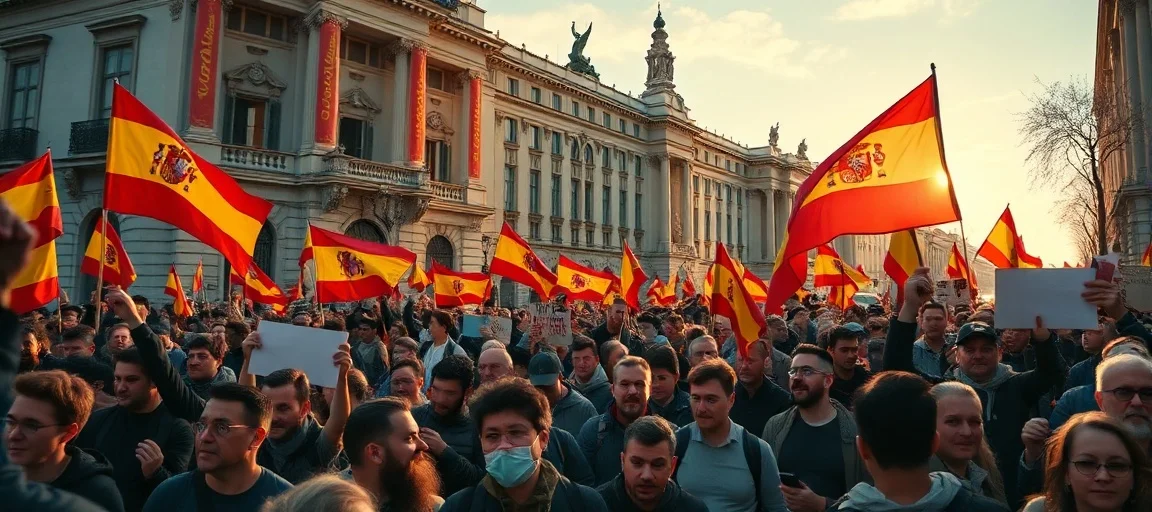
Thousands of citizens have once again gathered in the streets of Madrid, making their discontent heard in a significant demonstration against Spanish Prime Minister Pedro Sanchez and his government's recent policies. This latest wave of protests, under the banner "Thousands Protest Spanish PM Sanchez in Madrid", reflects deep-seated public opposition, particularly concerning the controversial amnesty law and the formation of a new coalition government. The demonstrations underscore a growing political polarization within Spain, as various opposition groups and civil society organizations voice their objections to the direction the nation is taking.
- Widespread Discontent as Thousands Protest Spanish PM Sanchez in Madrid
- Key Grievances Fueling the Demonstrations
- Opposition Voices and Political Landscape
- Historical Context of Protests in Spain
- Impact and Future Implications
- Conclusion: A Nation Divided
- Frequently Asked Questions
- Further Reading & Resources
Widespread Discontent as Thousands Protest Spanish PM Sanchez in Madrid
The recent protests against Spanish Prime Minister Pedro Sanchez have drawn significant numbers, highlighting widespread public dissatisfaction with his government's decisions, particularly the highly contentious amnesty law. This legislation, intended to grant clemency to those involved in the Catalan independence bid, has ignited a firestorm of criticism across Spain. Demonstrators, encompassing a broad spectrum of society from conservative groups to those concerned about the rule of law, argue that the amnesty undermines judicial independence and national unity. The sheer scale of these gatherings in Madrid serves as a powerful indicator of the profound divisions currently gripping the country.
The Genesis of the Protests: Amnesty Law and Coalition Deals
The core catalyst for the ongoing protests lies in the Socialist (PSOE) government's decision to pursue an amnesty law for Catalan separatists. This move was a crucial component of the negotiations required for Pedro Sanchez to secure the parliamentary support needed to form a new government following the inconclusive general elections in July 2023. Sanchez's Socialist Workers' Party (PSOE) entered into agreements with Catalan nationalist parties, including Junts per Catalunya and ERC, promising an amnesty in exchange for their votes to re-elect him as Prime Minister.
Opponents of the amnesty argue it grants impunity for serious offenses, including embezzlement and sedition, and sets a dangerous precedent for the rule of law in Spain. Critics contend that the law is a political maneuver designed solely to maintain Sanchez in power, rather than a genuine effort towards reconciliation or justice. The People's Party (PP) and the far-right Vox party have been particularly vocal in their condemnation, organizing and supporting many of the recent demonstrations. They assert that the amnesty sacrifices the principles of equality before the law for political expediency, weakening the democratic institutions of the country.
Key Grievances Fueling the Demonstrations
The grievances extending beyond the amnesty law contribute to the fervent atmosphere seen in Madrid. Many protestors express concerns about the integrity of Spain's democratic institutions and the future of the nation's judicial system.
Rule of Law and Judicial Independence
A primary concern among protestors is the perceived assault on the rule of law and judicial independence. The amnesty law, by absolving individuals previously convicted or facing charges related to the 2017 Catalan independence referendum, is seen by many as a direct interference with the judiciary. Critics argue that such a measure politicizes justice and undermines the separation of powers, a cornerstone of any democratic state. Legal associations, judges' unions, and former high-ranking judicial officials have also publicly voiced their alarm regarding the implications of the law, suggesting it could erode public trust in the justice system. The selective application of clemency, they contend, creates an uneven playing field, where political considerations can supersede legal judgments.
National Unity and Constitutional Concerns
Another significant point of contention revolves around national unity and adherence to the Spanish Constitution. Opponents of the amnesty law frequently invoke the unity of Spain, arguing that the concessions made to Catalan separatist parties threaten the country's territorial integrity. They point to the 2017 illegal referendum and subsequent declaration of independence as direct challenges to the constitutional order, which the amnesty now appears to retroactively legitimize or excuse. The constitution, which declares Spain an indivisible nation, is seen by these protestors as being undermined by policies that cater to secessionist demands. The perception that the government is yielding to separatist pressure for political gain further exacerbates fears about the long-term stability and cohesion of the Spanish state.
Economic Policies and Cost of Living
While the amnesty law remains the central point of contention, underlying economic anxieties also contribute to the broader discontent. Many citizens are grappling with persistent inflation, rising cost of living, and concerns about the nation's economic outlook. Although not directly related to the amnesty, these economic pressures often fuel general dissatisfaction with the incumbent government. Protestors frequently carry banners referencing economic hardship alongside their political demands, linking the perceived instability of the government with their personal financial struggles. The perception that the government is prioritizing political deals over the economic well-being of ordinary citizens further inflames public anger. Housing costs, in particular, have become a major challenge for many Spaniards, especially in large cities like Madrid, leading to related protests against rising rents and home prices, a recurring topic explored in our article on Urban Housing Crises in Europe.
Opposition Voices and Political Landscape
The conservative People's Party (PP) and the far-right Vox party have been at the forefront of organizing and mobilizing these protests. Their leaders have consistently called for Sanchez's resignation and new elections, framing the amnesty law as an illegitimate act that betrays the Spanish people.
Role of Opposition Parties
The leader of the People's Party, Alberto Núñez Feijóo, has been a prominent figure in the anti-Sanchez movement, frequently attending and speaking at the demonstrations. He has accused Sanchez of prioritizing his own political survival over the interests of the nation and of dismantling the rule of law. Feijóo and the PP argue that the amnesty represents an unconstitutional power grab, calling for a robust defense of democratic institutions. Vox, led by Santiago Abascal, has adopted an even more strident tone, accusing the government of being a "coup against the nation" and calling for civil disobedience. The party has leveraged the protests to rally its base and present itself as the uncompromising defender of Spanish sovereignty and constitutional principles. Both parties have utilized their parliamentary platforms and media presence to amplify the protest messages and to challenge the government's legitimacy.
Civil Society Engagement
Beyond political parties, numerous civil society organizations have played a crucial role in mobilizing citizens. Groups advocating for judicial independence, constitutional defense, and victims of terrorism have joined forces, underscoring the broad-based opposition to the amnesty law. These organizations often provide a non-partisan veneer to the protests, attracting individuals who may not align with specific political parties but share common concerns about the government's actions. Their active participation demonstrates that the discontent runs deeper than mere partisan politics, reflecting a genuine apprehension among a significant portion of the Spanish population. One such recent protest on May 23, 2026, was called by a group of over 150 civic associations called Sociedad Civil Española and backed by the PP and Vox, reflecting a broader trend in Spain's Growing Civic Activism.
Historical Context of Protests in Spain
Spain has a rich history of public demonstrations, reflecting its vibrant democratic tradition and periods of significant social and political change. Understanding this context helps to situate the current protests within a broader framework.
Precedents of Mass Mobilization
Throughout its democratic history, Spain has witnessed numerous large-scale protests, often driven by significant political events or social grievances. The "Indignados" movement of 2011, for instance, saw widespread demonstrations against austerity measures and political corruption, highlighting public frustration with the political establishment. Similarly, protests related to Catalan independence have been a recurring feature of the political landscape for over a decade, with both pro-independence and pro-unity demonstrations drawing massive crowds. These historical precedents illustrate the Spanish public's willingness to take to the streets when they feel their fundamental rights or the nation's democratic principles are at stake.
The Role of Madrid as a Protest Hub
Madrid, as the capital city, frequently serves as the focal point for national protests. Its central location and symbolic importance make it a natural gathering place for citizens from across the country who wish to express their views on national issues. The Plaza de Cibeles, Puerta del Sol, and other iconic locations in Madrid have been the backdrop for countless demonstrations, becoming synonymous with expressions of public sentiment. For example, a protest organized by a group linked to the Vox party in Plaza de Colón in October 2023 saw an attendance of 100,000 people according to government sources, a demonstration detailed further in our piece on Madrid's Iconic Protest Locations. Another large demonstration in November 2023 drew approximately 170,000 people in Madrid, marking it as the largest protest against the amnesty law at that time. The choice of Madrid for these latest protests against Prime Minister Sanchez underscores the national scope of the opposition and the protestors' desire to make their voices heard at the heart of the Spanish government.
Impact and Future Implications
The sustained protests against Pedro Sanchez's government carry significant implications for Spain's political future, potentially shaping electoral outcomes and policy directions.
Government Response and Political Stalemate
The Sanchez government has largely dismissed the protests as politically motivated, characterizing them as an attempt by the opposition to destabilize the executive. Government officials and ministers have reiterated the necessity of the amnesty law for national reconciliation and stability in Catalonia, arguing it is a legitimate political tool to resolve a long-standing conflict. They maintain that the agreements reached with Catalan parties are constitutional and essential for governing. This divergence in interpretation has created a deep political stalemate, with little common ground between the government and its critics, intensifying the political polarization in the country. The government's firm stance suggests it has no intention of reversing course on the amnesty, setting the stage for continued confrontation.
Erosion of Trust and Political Polarization
The ongoing protests and the government's response risk further eroding public trust in political institutions. When large segments of the population feel unheard or believe their concerns are being dismissed, it can lead to increased disillusionment with the democratic process. The intense polarization evident in the streets of Madrid is reflected in parliamentary debates and public discourse, making consensus-building increasingly difficult. This division could have long-term consequences for Spain's political stability and its capacity to address other pressing national challenges effectively. The deep chasm between the government and its opposition threatens to complicate future legislative efforts and national cohesion. Recent corruption allegations against figures close to the government, including former Prime Minister Jose Luis Rodriguez Zapatero and members of Sanchez's own family, have also fueled public distrust and added to the calls for his resignation.
Potential Electoral Impact
The sustained public demonstrations could significantly influence future electoral outcomes. The conservative opposition hopes to capitalize on the widespread discontent, translating protest votes into electoral gains in upcoming regional and national elections. The image of Thousands Protest Spanish PM Sanchez in Madrid consistently appearing in national and international media could sway undecided voters and energize the opposition's base. Conversely, the Socialist party and its allies will aim to consolidate their support by emphasizing the stability and progress achieved under their administration, framing the protests as partisan attacks. The ultimate impact will depend on how effectively each side can mobilize its supporters and articulate its vision for Spain's future. Opinion polls released in July and August 2025 indicated a drop in support for the Socialist Party to around 25%, while the People's Party maintained around 32-33%, and Vox saw its support rise to 16-17%.
Conclusion: A Nation Divided
The powerful images of Thousands Protest Spanish PM Sanchez in Madrid continue to underscore the profound divisions gripping Spain. The controversial amnesty law and the broader political landscape have ignited a passionate opposition, reflecting deep concerns about the rule of law, national unity, and the direction of the country. As the Sanchez government navigates these turbulent waters, the sustained public outcry highlights a nation grappling with its political identity and the fundamental principles of its democracy. The path forward remains uncertain, but the voices from Madrid's streets serve as a potent reminder of the challenges facing Spain's political future.
Frequently Asked Questions
Q: What is the primary reason for the protests against Spanish PM Sanchez?
A: The main catalyst for the protests is the controversial amnesty law proposed by Sanchez's government for Catalan separatists. Opponents argue that this law undermines judicial independence, threatens national unity, and is primarily a political maneuver to secure Sanchez's power.
Q: Which political parties are leading the opposition to Sanchez's government?
A: The conservative People's Party (PP) and the far-right Vox party have been at the forefront of organizing and supporting these demonstrations. Their leaders consistently call for Sanchez's resignation and new elections, framing the amnesty law as an illegitimate act.
Q: How has the Spanish government responded to these protests?
A: The Sanchez government has largely dismissed the protests as politically motivated attempts by the opposition to destabilize the executive. Government officials maintain that the amnesty law is constitutional, a necessary tool for national reconciliation, and crucial for stability in Catalonia.