T. Rex Blood Vessels Rewrite Science: A Glimpse into Dinosaur Biology
The realm of paleontology was fundamentally reshaped by a monumental discovery that defied long-held scientific assumptions. For decades, it was widely believed that soft tissues—the delicate structures like blood vessels, nerves, and muscles—could not survive the immense span of millions of years required for fossilization. Yet, a groundbreaking finding of preserved T. Rex blood vessels rewrite science, offering an unprecedented glimpse into the biology of these ancient giants. This remarkable revelation has opened new avenues for understanding dinosaur life and challenged conventional wisdom about how organisms decay and fossilize over deep time.
- The Conventional View of Fossilization: A Hardened Reality
- The Groundbreaking Discovery: When T. Rex Blood Vessels Rewrite Science
- The Mechanisms of Soft Tissue Preservation in Deep Time
- Implications for Paleontology and Beyond
- Navigating the Debates and Skepticism
- The Enduring Impact of T. Rex Blood Vessels Rewrite Science
- Frequently Asked Questions
- Further Reading & Resources
The Conventional View of Fossilization: A Hardened Reality
For centuries, our understanding of fossils was based on the premise that only hard tissues—bones, teeth, and shells—could withstand the ravages of time and geological processes. When an animal died, its soft tissues were thought to quickly decompose, either consumed by scavengers or broken down by bacteria and environmental factors within weeks or months. What remained would be the skeletal framework, which, over millions of years, would gradually be replaced by minerals from the surrounding sediment, effectively turning bone into rock. This process, known as permineralization, created the stone replicas we typically see in museums and textbooks.
This "hard parts only" paradigm meant that paleontologists focused primarily on skeletal anatomy to infer details about dinosaur physiology, movement, and behavior. Reconstructing the lives of creatures like the Tyrannosaurus rex, a formidable predator that roamed the Earth approximately 68 to 66 million years ago during the late Cretaceous period, largely depended on interpreting the mineralized remains of its formidable skeleton. The absence of soft tissues meant that many questions about dinosaur biology, such as the exact nature of their circulatory systems, the composition of their muscles, or even the possibility of original proteins, were considered largely unanswerable, lost to the depths of geological time.
Scientists, therefore, carefully excavated fossils, meticulously preserving them and often treating them with glues and other chemicals to maintain their integrity. The idea of intentionally dissolving a fossil in acid to examine its interior was largely unthinkable, as it contradicted the core principle of preserving these rare and irreplaceable specimens. This established methodology, while crucial for studying skeletal structures, inadvertently limited the scope of potential discoveries, leaving an entire dimension of ancient life unexplored.
The Groundbreaking Discovery: When T. Rex Blood Vessels Rewrite Science
The scientific community was jolted in 2005 when paleontologist Dr. Mary Schweitzer, then at North Carolina State University, announced a truly astonishing find. Working with a Tyrannosaurus rex femur (specifically, MOR 1125, an adolescent specimen nicknamed "B. rex") unearthed from Montana's Hell Creek Formation, Dr. Schweitzer and her team performed an unconventional experiment. To study the bone's microstructure, they placed fragments in a weak acid solution to demineralize them, a process that should have dissolved any remaining rock if the fossil were entirely mineralized.
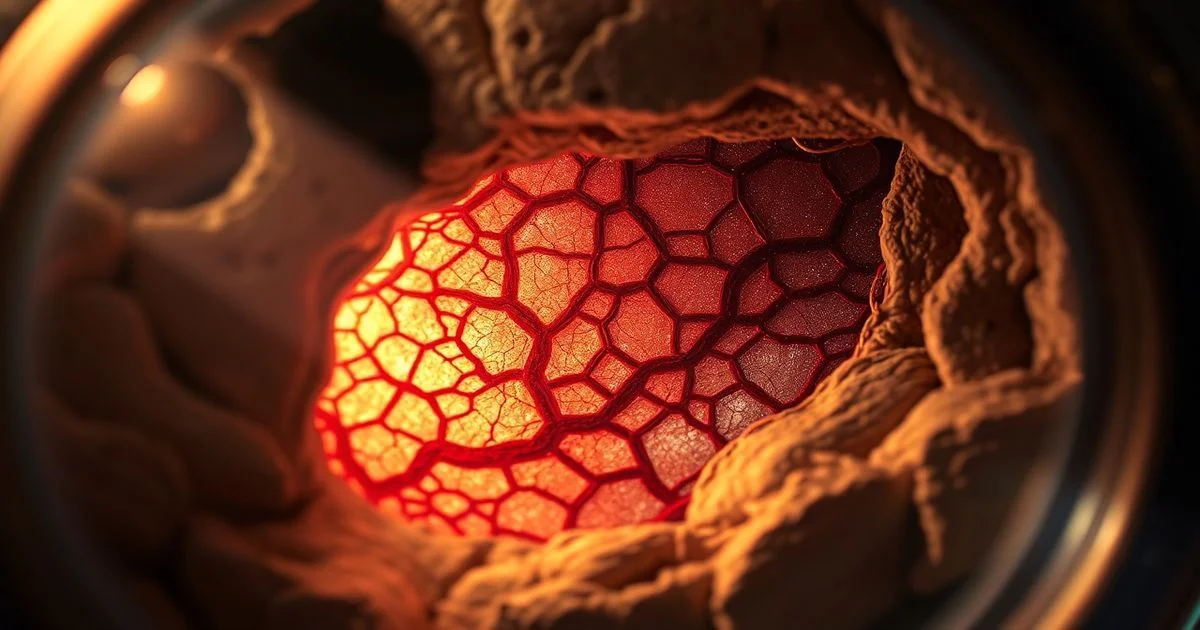
To their profound surprise, the acid bath did not result in complete dissolution. Instead, the process left behind a pliable, elastic material that looked unmistakably like soft tissue. Further examination revealed what appeared to be branching blood vessels, bone matrix, and even structures morphologically consistent with osteocytes—the bone-building cells—and red blood cells. The vessels were flexible and resilient, retaining their original shape even when stretched. This seemingly impossible preservation, within a fossil dated at approximately 68 million years old, directly challenged the long-held dogma that soft tissues could not survive for such vast stretches of geological time.
The initial report, published in the journal Science, described "flexible vascular tissue that demonstrated great elasticity and resilience". Subsequent analyses confirmed the presence of collagen, the primary structural protein in animal connective tissues, within the T. rex remains. The collagen sequences even showed similarities to bird collagen, which aligns with the evolutionary understanding that modern birds are descendants of theropod dinosaurs like T. rex. This specific finding provided molecular evidence to support phylogenetic relationships, moving beyond mere anatomical comparisons.
Further validating these types of discoveries, an independent study in 2025 on "Scotty," another large Tyrannosaurus rex specimen, utilized synchrotron imaging to reveal an extensive, three-dimensional network of mineralized blood vessels within its rib bone. These vessels, composed of iron minerals like pyrite, hematite, and goethite, were not just background structures but appeared to be associated with a healing injury, providing insights into the dinosaur's recovery process. Such findings underscored that soft tissue preservation, in various forms, was not an isolated fluke but a phenomenon demanding serious scientific investigation.
The Mechanisms of Soft Tissue Preservation in Deep Time
The discovery immediately begged the question: how could such delicate structures survive for tens of millions of years when conventional wisdom suggested they should degrade in less than a million? Dr. Schweitzer and her colleagues embarked on years of research to uncover the underlying mechanisms, leading to several compelling hypotheses.
One of the most widely accepted explanations points to the role of iron, an abundant element in the body, particularly in blood hemoglobin. Upon an animal's death, iron atoms are released from hemoglobin. These highly reactive iron atoms, in the presence of oxygen, create free radicals—highly unstable oxygen molecules. These free radicals then interact with other biomolecules like proteins, fats, carbohydrates, and even DNA, causing them to "cross-link" or form stable bonds with one another. This cross-linking process essentially acts like a natural fixative, similar to how formaldehyde preserves tissues in a laboratory setting. By linking these molecules together, the iron helps stabilize their structure, making them far more resistant to decay by microbes and environmental factors. Experiments simulating this process with modern ostrich blood vessels showed significant preservation when soaked in iron-rich blood cells, compared to rapid degradation in plain water.
Another critical factor identified is the environment of fossilization itself. Rapid burial in porous sediments, such as sandstone, can quickly isolate the remains from scavengers and many decomposition-causing bacteria. The porosity of sandstone may also wick away reactive enzymes that would otherwise accelerate degradation. Furthermore, the observation that many soft-tissue-containing specimens are articulated (their bones are still connected) suggests swift burial, offering additional protection to delicate internal structures.
More recent research from institutions like MIT has also delved into the inherent stability of certain proteins. A 2024 study focused on collagen, a protein found in abundance in bones and connective tissues. It revealed a special atomic-level interaction within collagen's triple-helical structure that actively defends its peptide bonds from being broken down by water through a process called hydrolysis. This inherent water-resistant quality of collagen could significantly extend its survival time far beyond the previously estimated half-life of its peptide bonds (around 500 years), potentially explaining its persistence in fossils as old as 195 million years, as suggested by findings in Lufengosaurus. This explanation complements the iron-mediated cross-linking, providing a multi-faceted understanding of how ancient biomolecules can endure even in conditions thought previously impossible.
Implications for Paleontology and Beyond
The ability of T. Rex blood vessels to rewrite science has profound implications across multiple scientific disciplines. For paleontology, it opens up an entirely new field: molecular paleontology. Instead of solely studying gross anatomy, scientists can now potentially examine molecular data directly from ancient organisms. This shift allows for:
- Rethinking Fossilization: The discovery forces a re-evaluation of how fossilization occurs and under what rare conditions soft tissues can endure. It encourages paleontologists to look for such preservation in other fossils, potentially using less destructive methods.
- Dinosaur Physiology and Evolution: Access to original proteins like collagen can provide direct insights into the physiology of dinosaurs, including their metabolic rates and internal biology. Comparing dinosaur proteins to those of modern animals, especially birds, strengthens evolutionary links and can help settle debates, such as whether dinosaurs were warm-blooded or cold-blooded.
- Biomolecular Research: The mechanisms of long-term biomolecule preservation have implications for astrobiology (the search for life beyond Earth) and the study of ancient life forms in other extreme environments. Understanding these natural preservation processes could also inform new approaches in materials science or conservation.
- New Dating Techniques (Potential): While not for dating the age of the fossil itself (which is reliably determined by radiometric dating), the decay rates and chemical alterations of preserved biomolecules could offer unique insights into the conditions of preservation or even refine our understanding of molecular degradation over vast timescales.
The possibility of recovering more types of ancient biomolecules, including amino acids, lipids, and even fragments of DNA (though DNA is far more fragile and its long-term survival is still highly debated and less likely over such vast periods), excites researchers. While the dream of a "Jurassic Park" scenario remains firmly in the realm of science fiction due to the extreme degradation of genetic material over millions of years, the newfound access to ancient proteins provides an unprecedented molecular window into extinct life.
Navigating the Debates and Skepticism
Such a paradigm-shifting discovery naturally encountered significant scientific scrutiny and debate. Initially, some researchers expressed skepticism, questioning whether the soft tissues were truly endogenous (belonging to the dinosaur) or if they were the result of bacterial biofilms or contamination from later sources. This skepticism is a healthy and necessary part of the scientific process, driving rigorous re-examination and validation.
Dr. Schweitzer's team and other researchers responded by conducting extensive chemical analyses, including mass spectrometry and immunohistochemistry, to confirm the presence and identity of dinosaur proteins like collagen. These analyses provided strong evidence that the recovered materials were indeed original to the dinosaur. For instance, the identification of hydroxyproline, a key collagen-associated amino acid, using liquid chromatography-tandem mass spectrometry (LC-MS/MS) and specific collagen peptides matching those from other dinosaurs further solidified the claims. However, debates have persisted, with some studies in 2017 suggesting that certain protein sequences initially identified could be modern contaminants from laboratory animals like ostriches and alligators. This highlights the extreme challenges and the necessity for robust authentication criteria when dealing with such ancient and delicate biomolecular evidence.
Beyond scientific debate, the discovery also became a point of contention with young-Earth creationists. They often misinterpret the findings as evidence that dinosaur fossils cannot be millions of years old, claiming the presence of soft tissue proves a recent creation. However, this argument is firmly refuted by multiple, independent radiometric dating techniques that consistently place the T. rex fossils at around 65 to 68 million years old, a timeline robustly supported by nuclear physics and geological evidence. Scientists emphasize that the discovery does not challenge the age of the Earth or the validity of evolutionary theory, but rather refines our understanding of decay and preservation processes over vast timescales.
The Enduring Impact of T. Rex Blood Vessels Rewrite Science
The remarkable finding that T. Rex blood vessels rewrite science continues to be a vibrant area of research, pushing the boundaries of what is considered possible in paleontology. It underscores a fundamental scientific principle: our understanding of the natural world is constantly evolving, and even long-held beliefs can be overturned by unexpected evidence. The initial shock and skepticism surrounding the discovery have gradually given way to a more nuanced appreciation of the complex taphonomic processes (the processes of decay and fossilization) that can preserve biological materials over deep time.
The ongoing research into the specific chemical mechanisms, such as iron-mediated cross-linking and the inherent stability of collagen, provides compelling explanations for how these delicate structures could survive for so long. These studies are not just about dinosaurs; they are about understanding the fundamental chemistry of life and death, decay and preservation, on geological timescales.
As scientists continue to develop advanced analytical techniques, the potential for discovering even more detailed biological information from ancient fossils grows. This could include a deeper understanding of dinosaur physiology, their immune systems, how they healed from injuries, and their precise evolutionary relationships to modern species. Each new piece of soft tissue evidence contributes to a richer, more vibrant picture of prehistoric life, reminding us that even in the hardened remains of a fossil, the echoes of ancient biology can still be heard. The journey from skeletal reconstruction to molecular insights is a testament to scientific curiosity and the enduring mysteries hidden within the Earth's ancient layers.
Frequently Asked Questions
Q: How is it possible for soft tissues like blood vessels to survive for millions of years?
A: Scientists propose several mechanisms. Iron, released from hemoglobin after death, acts as a natural preservative by cross-linking biomolecules. Rapid burial in certain sediments also protects tissues from decay. Additionally, some proteins like collagen have inherent stability, resisting degradation by water for extended periods.
Q: Does the discovery of soft tissues in T. Rex fossils challenge the age of dinosaurs or Earth?
A: No, the scientific consensus, supported by extensive radiometric dating, maintains that T. Rex fossils are approximately 65-68 million years old. The soft tissue discovery refines our understanding of rare preservation processes, not the age of the fossils themselves.
Q: What are the most significant implications of this discovery for paleontology?
A: This discovery opens the field of molecular paleontology, allowing direct study of ancient proteins and providing new insights into dinosaur physiology, metabolism, and evolutionary links to modern birds. It also forces a re-evaluation of fossilization processes and encourages new analytical techniques.