China's Liaoning Carrier Conducts Drills in Pacific, Raising Tensions
China's Liaoning Carrier Conducts Drills in Pacific, Raising Tensions
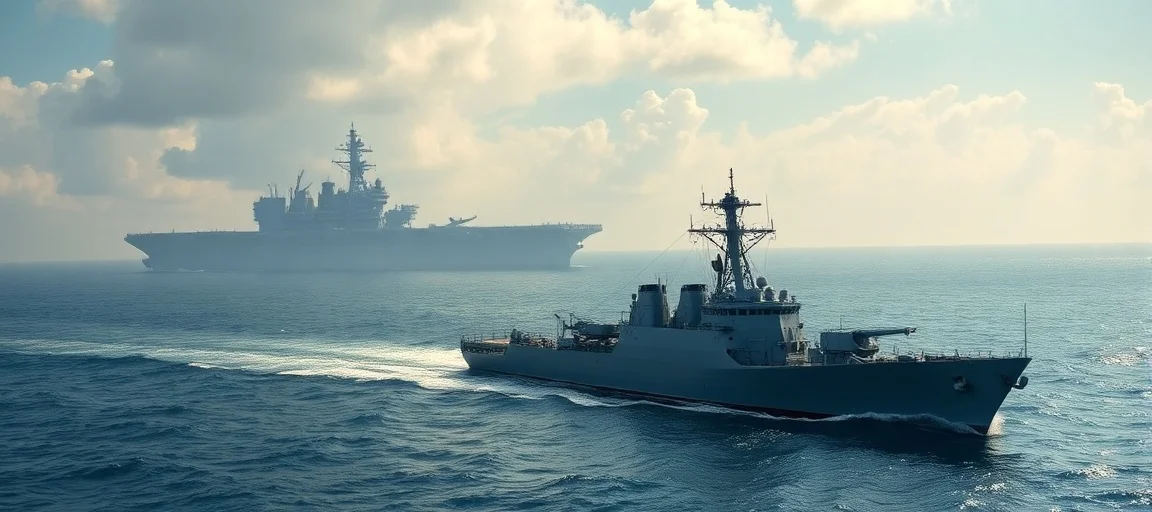
The Chinese People's Liberation Army (PLA) Navy's aircraft carrier, the Liaoning, has recently conducted a series of drills in the Pacific Ocean, sparking concerns over regional stability and the country's growing naval presence. China's Liaoning Carrier Conducts Drills in Pacific as part of its efforts to assert its claims in the disputed South China Sea and to demonstrate its military capabilities to a wider international audience, including rivals and allies alike. These exercises are meticulously observed by international intelligence agencies, providing crucial insights into China's evolving naval doctrine and operational proficiency.
- Background Context of China's Naval Expansion
- Strategic Context of China's Liaoning Carrier Drills in Pacific
- Expert Opinion and Geopolitical Analysis
- Impact on Regional Stability and the Indo-Pacific
- Broader Implications for Global Maritime Geopolitics
- Frequently Asked Questions
- Further Reading & Resources
Background Context of China's Naval Expansion
The Liaoning, China's first aircraft carrier, was commissioned in 2012, marking a pivotal moment in the PLA Navy's ambitious modernization efforts. Acquired as the unfinished Soviet-era Varyag from Ukraine in 1998, the vessel underwent extensive refitting and customization, transforming it into a fully operational training and combat platform. Its entry into service symbolized China's strategic shift from a predominantly coastal defense force to one capable of "far seas" operations and global power projection. The carrier has since been a key component of China's naval modernization efforts, aimed at expanding its military footprint across the Asia-Pacific region and beyond, reflecting Beijing's growing geopolitical aspirations.
Previous Drills and Exercises
The Liaoning has undertaken numerous drills and exercises since its commissioning, each designed to test and refine the PLA Navy's carrier strike group capabilities. A particularly notable exercise occurred in late 2016, when the Liaoning and its escort flotilla sailed through the Taiwan Strait and then into the Western Pacific, a move widely interpreted as a direct message to Taiwan and its allies, underscoring China's claims over the self-governed island. These early deployments were crucial for developing the operational synergy among carrier-borne aircraft, surface combatants, and submarines. More recently, the carrier has been involved in several joint military exercises with other strategic partners, including Russia and Pakistan, enhancing interoperability and demonstrating China's growing network of defense relationships. Such exercises serve multiple purposes, from improving tactical coordination to showcasing China's increasing comfort and proficiency in complex maritime operations.
Strategic Context of China's Liaoning Carrier Drills in Pacific
The recent deployment of China's Liaoning Carrier Conducts Drills in Pacific is not merely a routine exercise but carries significant strategic weight. These drills involved a comprehensive series of military exercises, including sophisticated air defense simulations, anti-submarine warfare training, and intensive air and sea maneuvers. The Liaoning was typically accompanied by a formidable escort fleet, often comprising cutting-edge warships such as Type 055 Renhai-class destroyers, Type 052D Luyang III-class destroyers, and advanced submarines. This formation, known as a carrier battle group (CBG), is designed to provide robust offensive and defensive capabilities, enabling sustained operations far from home ports. The drills were meticulously aimed at testing the carrier's full operational capabilities, from flight deck readiness for continuous launch and recovery operations to the intricate coordination between various units of the PLA Navy, including logistical support and electronic warfare components. The geographic scope of these drills, extending deep into the Pacific, underscores China's ambition to operate effectively in strategically vital international waters.
Military Capabilities and Carrier Group Composition
The Liaoning, while primarily a training carrier, is nonetheless a potent warship equipped with a range of advanced military capabilities. Its air wing is formidable, predominantly featuring the J-15 "Flying Shark" fighter jets, China's carrier-based multirole aircraft derived from the Soviet Su-33. These jets are crucial for air superiority, ground attack, and anti-ship missions. The carrier also deploys Z-18 helicopters for anti-submarine warfare (ASW) and airborne early warning (AEW) roles, providing critical intelligence and defense perimeters for the CBG. With a displacement of over 60,000 tons and a capacity for a crew exceeding 1,000 personnel, the Liaoning is a substantial naval asset. While its ski-jump launch system (STOBAR) limits the take-off weight and payload of its aircraft compared to the catapult-assisted take-off (CATOBAR) systems used by the US Navy, it provides invaluable experience for China's naval aviators and planners. The accompanying Type 055 destroyers, for example, are among the world's most advanced, equipped with extensive vertical launch systems for anti-air, anti-ship, and land-attack missiles, further amplifying the CBG's lethality and defensive resilience.
Expert Opinion and Geopolitical Analysis
The Liaoning's recent Pacific drills have ignited widespread discussion among defense analysts and policymakers regarding regional stability and the broader implications for US-China relations. Experts largely agree that these exercises are a clear demonstration of China's burgeoning military capabilities and its unequivocal willingness to assert its territorial and maritime claims, often challenging established international norms.
Dr. Andrew Erickson, a prominent China military expert at the US Naval War College, commented, "The Liaoning's drills in the Pacific Ocean are a clear message from China to the US and other regional players that it is a major military power that will not be ignored. The drills are also a demonstration of China's growing naval capabilities and its ability to project power in the region, extending its operational reach well beyond its immediate territorial waters." Other analysts, such as Dr. Sheila Smith of the Council on Foreign Relations, emphasize the psychological and political dimensions, noting that "these drills serve to normalize Chinese naval presence in areas historically dominated by the US and its allies, gradually shifting perceptions of the regional power balance." The exercises are seen as a vital component of China's "grey zone" tactics, incrementally expanding its influence without immediately crossing red lines that would trigger direct military confrontation. Furthermore, they provide invaluable data on how various naval assets perform in diverse ocean environments, refining doctrines for potential future contingencies.
Impact on Regional Stability and the Indo-Pacific
The recent drills have predictably amplified concerns over regional stability and the potential for heightened tensions, particularly in sensitive areas like the South China Sea, the East China Sea, and around Taiwan. The very presence of a Chinese carrier group operating in the Western Pacific sends a strong signal to nations like Japan, the Philippines, and Australia, who have long relied on the US-led security architecture. These nations often perceive such drills as coercive displays of force, compelling them to re-evaluate their own defense postures and deepen security cooperation with allies. The potential for miscalculation or accidental encounters between Chinese and foreign naval vessels or aircraft is an ever-present risk, raising fears of inadvertent escalation. Maintaining freedom of navigation and overflight in international waters remains a critical concern for many nations in the region, a principle that China's growing military assertiveness frequently tests.
US-China Relations and Strategic Competition
The drills have inevitably exacerbated existing tensions in US-China relations, which are already strained by disputes over trade, human rights, technology, and geopolitical influence. In response to China's growing naval capabilities and its expansive claims, the US Navy has consistently increased its presence and freedom of navigation operations (FONOPs) in the Indo-Pacific. This tit-for-tat dynamic creates a complex web of strategic competition, where each nation's military maneuvers are closely scrutinized and often reciprocated. The US, alongside its allies in groups like the Quad (United States, Japan, India, Australia) and AUKUS (Australia, United Kingdom, United States), aims to uphold a "free and open Indo-Pacific," directly contrasting with what they perceive as China's revisionist ambitions. The increasing frequency and sophistication of China's long-range naval operations, epitomized by the Liaoning's Pacific forays, underscore the intensifying strategic rivalry between Washington and Beijing, making effective diplomatic channels and crisis management protocols more crucial than ever.
Broader Implications for Global Maritime Geopolitics
Beyond the immediate region, the Liaoning's deployments in the Pacific have broader implications for global maritime geopolitics. They symbolize a significant shift in the global balance of naval power, challenging the unipolar dominance that the United States has enjoyed for decades. As China continues to develop and deploy more advanced carriers, such as the CATOBAR-equipped Fujian (Type 003), its ability to project power globally will only grow. This development influences not only military strategies but also economic considerations, as major trade routes and critical chokepoints become subject to new spheres of influence. Other nations, both aspiring naval powers and established ones, are observing China's trajectory keenly, potentially prompting similar naval modernization efforts in a new global arms race. The long-term contest for influence in the Indo-Pacific, therefore, is not just a regional phenomenon but a crucial indicator of the future international order, with maritime capabilities at its core.
Frequently Asked Questions
Q: What is the significance of the Liaoning's Pacific drills?
A: These drills demonstrate China's growing naval power and its ambition to project force beyond its immediate coastline. They signal China's increasing capability to operate in distant waters, testing new operational doctrines and crew proficiency in complex, integrated naval maneuvers.
Q: How do these drills impact US-China relations?
A: The drills heighten existing tensions between the US and China, particularly concerning territorial claims and military presence in the Indo-Pacific. They challenge US naval dominance and provoke responses from Washington, often in the form of increased deployments or joint exercises with allies, creating a cycle of strategic competition.
Q: What are China's long-term goals for its aircraft carrier program?
A: China aims to establish a blue-water navy capable of global power projection, protecting its extensive economic interests, and asserting sovereignty in disputed areas. The carrier program is central to these strategic objectives, providing a critical platform for air superiority and offensive capabilities far from Chinese shores.
Further Reading & Resources
- Liaoning (aircraft carrier) - Wikipedia
- China’s Aircraft Carriers: The Liaoning and the Shandong - CSIS
- US Military Assessment of China's Naval Expansion - U.S. Department of Defense
- China's 'New Era' Naval Ambitions: An Analysis - Naval Technology
- Impact of China's Naval Growth on Indo-Pacific Security - Lowy Institute