New Lunar & Martian Missions Propel Global Space Race
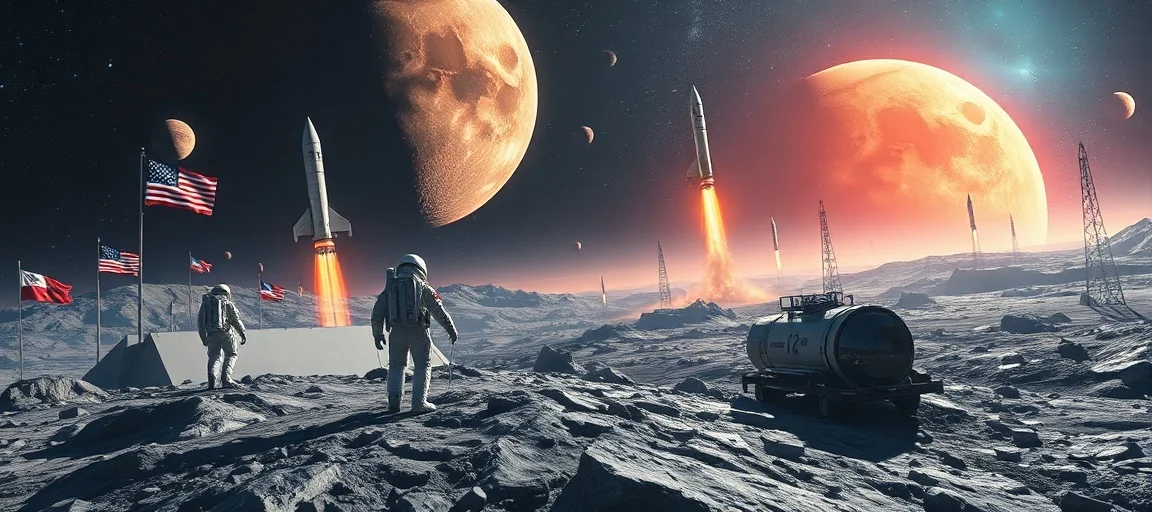
The 21st century is witnessing an unprecedented surge in space exploration, marked by ambitious endeavors to revisit the Moon and establish a human presence on Mars. This era, characterized by both national agency initiatives and burgeoning private sector involvement, sees New Lunar & Martian Missions Propel Global Space Race, reigniting competition and fostering remarkable technological advancements. As nations and commercial entities vie for celestial dominance and scientific breakthroughs, the journey to extend humanity's footprint beyond Earth is accelerating, promising a future shaped by off-world capabilities and a deeper understanding of our solar system.
- Resurgence of Lunar Exploration: A Stepping Stone to Deep Space
- The Martian Frontier: Red Planet Ambitions
- New Lunar & Martian Missions Propel Global Space Race: Key Players and Collaborations
- Technological Innovations Driving the New Era
- Economic and Geopolitical Implications
- Conclusion: A New Era of Exploration
- Frequently Asked Questions
- Further Reading & Resources
Resurgence of Lunar Exploration: A Stepping Stone to Deep Space
The Moon, long considered a stepping stone for deeper space exploration, is once again at the forefront of international ambitions. Recent and upcoming lunar missions are not merely about planting flags, but about establishing sustainable outposts and harnessing valuable resources.
NASA's Artemis Program: Paving the Way for Human Return
NASA's Artemis program stands as a cornerstone of the renewed lunar push, aiming to return humans to the Moon for the first time since the Apollo era and establish a permanent lunar base. The program leverages the powerful Space Launch System (SLS) rocket and the Orion spacecraft, alongside commercial partners for human landing systems.
Artemis I, an uncrewed test flight, successfully sent an Orion spacecraft to lunar orbit in November 2022. This was followed by Artemis II, which in April 2026, successfully sent four astronauts on a lunar flyby, marking the first crewed flight beyond low Earth orbit since 1972. Future missions are already planned:
- Artemis III: Scheduled for late 2027, this mission is planned to test a Human Landing System (HLS) in Earth orbit, initially envisioned as a lunar landing, but revised after a March 2026 reshuffle.
- Artemis IV: Targeted for early 2028, this mission is currently slated to be the first crewed lunar landing of the Artemis program since Apollo, delivering crew to the Moon's surface via a commercial lunar lander.
- Artemis V: Expected by late 2028, this mission aims to be the second lunar landing and initiate the construction of a permanent Moon base, with subsequent annual lunar landings planned thereafter.
These missions are crucial for demonstrating the technologies and procedures necessary for a sustained human presence on the Moon, ultimately preparing for journeys to Mars.
China's Ambitious Lunar Program: Chang'e Missions
China's National Space Administration (CNSA) is also making significant strides with its Chang'e lunar exploration program, named after the Chinese moon goddess. This multi-phase program has seen a series of robotic missions:
- Chang'e 1 and 2: Orbited the Moon, surveying potential landing sites in 2007 and 2010.
- Chang'e 3 and 4: Achieved lunar landings in 2013 and 2019, with Chang'e 4 making the world's first soft-landing on the far side of the Moon.
- Chang'e 5 and 6: Successfully returned lunar samples to Earth in 2020 and 2024, respectively, with Chang'e 6 making history by returning samples from the Moon's far side.
Looking ahead, China plans Chang'e 7 (late 2026) and Chang'e 8 (2028) to explore the lunar south pole for water ice and test in-situ resource utilization (ISRU) technologies. Furthermore, China has announced plans for a crewed lunar landing by 2030, aiming to establish an International Lunar Research Station (ILRS) at the lunar south pole in collaboration with Roscosmos and other nations from 2031 onwards.
Private Ventures and International Collaborations
Beyond national agencies, private companies are increasingly playing a pivotal role in lunar exploration. Companies like Intuitive Machines, Astrobotic, and Blue Origin are developing lunar landers and rovers, often under contracts with NASA's Commercial Lunar Payload Services (CLPS) program.
- Intuitive Machines, following its Odysseus spacecraft landing in February 2024, plans IM-3 for the second half of 2026.
- Astrobotic's Griffin lander, initially planned to carry NASA's VIPER rover, is now scheduled for July 2026, with the VIPER rover moved to a later mission. Astrobotic is also involved in NASA's Moon Base II mission, planned for later in 2026, delivering the Astrolab FLIP rover.
- Blue Origin's Blue Moon Mark 1 pathfinder mission is set for early 2026, aiming to take its first shot at the Moon. Blue Origin is also involved in NASA's Moon Base I mission, targeted for fall 2026.
The European Space Agency (ESA) is also contributing significantly, providing components like the European Service Module for NASA's Orion spacecraft and developing its own Argonaut class of landers for cargo delivery to the Moon. ESA's Moonlight program aims to establish navigation and communication services around the Moon. India's ISRO, while primarily focused on the Gaganyaan human spaceflight program for low Earth orbit, has long-term aspirations for crewed lunar landings.
The Martian Frontier: Red Planet Ambitions
The allure of Mars, with its potential for past or present life and as a future home for humanity, continues to drive ambitious exploration programs.
Perseverance and Mars Sample Return
NASA's Perseverance rover, which landed in Jezero crater in February 2021, continues to collect and cache Martian rock and soil samples in titanium tubes. These samples are intended to be returned to Earth for extensive analysis, a critical step in understanding the Red Planet's habitability and preparing for human missions.
The Mars Sample Return (MSR) campaign, a joint initiative between NASA and ESA, has faced significant challenges and cost overruns. After being "paused" in November 2023 due to an $11 billion cost estimate and a projected return date in the 2040s, NASA is exploring new, more fiscally feasible mission profiles with industry partners. A decision on the mission profile is expected by mid-2026, with an earliest launch date for ESA's Earth Return Orbiter in 2030 and samples potentially returning to Earth as early as 2035.
Other Martian Endeavors
While the MSR program is being re-evaluated, other nations are also eyeing Mars:
- China's Tianwen-3: China has announced plans for its own Mars sample-return mission, Tianwen-3, with a proposed launch in late 2028 and samples expected back on Earth by July 2031.
- ESA's ExoMars: ESA, in cooperation with Roscosmos (though the cooperation status might be impacted by geopolitical events not covered in the search results), has had the ExoMars program focused on searching for life and developing landing and roving technologies on Mars. ESA's "Explore 2040" strategy aims to prepare for Europe's role in the first historic human voyage to Mars, including establishing a communication and navigation network around Mars with the LightShip program.
These efforts underscore a collective scientific drive to unravel the mysteries of Mars and prepare for future human expeditions.
New Lunar & Martian Missions Propel Global Space Race: Key Players and Collaborations
The intensifying competition and cooperation in space reflect a fundamental shift in the global space landscape. The players include traditional national space agencies, emerging space powers, and a rapidly growing private sector.
National Space Agencies
Leading the charge are established agencies such as:
- NASA (USA): Spearheading the Artemis program for lunar return and a key partner in the Mars Sample Return initiative.
- CNSA (China): Advancing its comprehensive Chang'e lunar program and planning a Mars sample return mission.
- ESA (Europe): Contributing to Artemis, developing its own lunar landers, and a critical partner in the Mars Sample Return mission.
- Roscosmos (Russia): Collaborating with China on the International Lunar Research Station.
- ISRO (India): Focused on its Gaganyaan human spaceflight program to low Earth orbit, with long-term goals for lunar and interplanetary missions. ISRO's first uncrewed Gaganyaan test flight, G1, is planned for 2026, with the first crewed flight, H1, scheduled for 2027.
- JAXA (Japan): A partner in the Artemis program.
The renewed space race is characterized by a blend of national ambition and strategic international partnerships, often driven by shared scientific goals and the immense financial and technical challenges of deep space missions.
Private Sector Dominance and Innovation
The role of private companies has dramatically expanded, transforming the economics and pace of space exploration. Companies like SpaceX, Blue Origin, and Intuitive Machines are no longer just contractors but innovators driving new capabilities.
- SpaceX: Critical for NASA's Artemis program with its Starship Human Landing System (HLS). SpaceX's reusable rockets have also significantly lowered launch costs.
- Blue Origin: Developing the Blue Moon lander and actively participating in NASA's commercial lunar payload services.
- Intuitive Machines: Successfully landed its Odysseus spacecraft on the Moon in February 2024 and plans further lunar missions.
- Astrobotic: Engaged in delivering payloads to the Moon and developing rovers.
These private entities are fostering a dynamic ecosystem, introducing agile development cycles, and pushing the boundaries of what is possible in space. The emergence of these private players has drastically reduced the cost of space travel and accelerated mission timelines.
Technological Innovations Driving the New Era
The current wave of lunar and Martian missions is fueled by cutting-edge technological advancements, making previously impossible feats attainable.
In-Situ Resource Utilization (ISRU)
A game-changing strategy, In-Situ Resource Utilization (ISRU), involves collecting, processing, and using materials found on extraterrestrial bodies to support missions and reduce reliance on Earth-based supplies. This includes:
- Lunar Water Ice: Significant deposits of water ice in the Moon's polar regions are considered crucial for future lunar bases, providing drinking water, breathable oxygen through electrolysis, and rocket propellant (hydrogen and oxygen). Missions like NASA's VIPER (now integrated into later missions or revised) and China's Chang'e 7 are focused on characterizing these resources. Companies like Lockheed Martin and Ethos Space Resources are exploring concepts for utilizing lunar water ice and regolith to produce propellants and construction materials.
- Martian Atmosphere: NASA's Mars Oxygen In-Situ Resource Utilization Experiment (MOXIE) on the Perseverance rover has successfully demonstrated the production of oxygen from the Martian atmosphere's carbon dioxide, a vital step for future human missions for both breathing and propellant.
ISRU promises to lower mission costs, extend mission durations, and enable the vision of long-term human settlements beyond Earth.
Advanced Propulsion and Landing Systems
Innovative propulsion and landing systems are central to reaching lunar and Martian destinations efficiently and safely:
- Space Launch System (SLS): NASA's heavy-lift rocket, a foundational element of the Artemis program, designed to launch the Orion spacecraft and heavy payloads.
- Starship: SpaceX's fully reusable launch and landing system, envisioned to play a critical role as a human landing system for Artemis missions to the Moon and eventually for Mars missions.
- Commercial Lunar Landers: A new generation of robotic landers developed by private companies (e.g., Blue Moon, Nova-C) capable of delivering scientific instruments and cargo to the lunar surface.
Robotics and AI
Advanced robotics and artificial intelligence are essential for exploration, especially in hazardous or distant environments. Rovers like Perseverance and upcoming lunar rovers will conduct scientific investigations, map resources, and prepare sites for human arrival. AI and autonomous systems are increasingly being integrated into mission planning and operations, reducing the need for constant human intervention.
Economic and Geopolitical Implications
The global space race is not just a scientific endeavor but a significant driver of economic growth and a complex arena for geopolitical competition.
Growth of the Space Economy
The space economy is experiencing rapid expansion, projected to grow significantly in the coming years. Estimates suggest the global space economy could surge from approximately 1.8 trillion by 2035, and potentially $2 trillion by 2040. This growth is fueled by:
- Commercial Innovation: Decreasing launch costs and increased private investment are driving new business models, including satellite constellations, space tourism, and in-space manufacturing.
- Resource Extraction: The potential for lunar resource extraction, particularly water ice, could establish a fuel-based economy for deep-space transportation, significantly reducing costs for future missions.
- New Industries: Orbital leisure facilities, zero-gravity manufacturing, and lunar flybys are emerging segments of the space economy.
Governments are increasingly becoming customers of the burgeoning private space industry, leveraging commercial innovation to achieve national objectives.
Geopolitical Competition and International Cooperation
The "New Lunar & Martian Missions Propel Global Space Race" is inherently a geopolitical phenomenon, echoing the Cold War era but with new complexities.
- National Prestige and Security: Space capabilities are vital components of national power and security, with implications for communication, economics, and military strategy. Control over key orbital paths and celestial bodies like the Moon and Mars is seen as strategically important.
- Spheres of Influence: As more countries become spacefaring nations, rivalries and alliances from Earth are extending into space, leading to discussions about "spheres of influence" and even potential claims on territory.
- Governance and Regulations: The absence of universally agreed-upon rules for regulating competition in space sets the stage for potential disagreements. International bodies are working towards establishing legal frameworks for space activities, particularly regarding resource utilization.
- Collaborative Ventures: Despite competition, numerous international collaborations demonstrate the benefits of shared scientific goals and pooled resources. The Artemis Accords, led by NASA, establish a framework for peaceful and transparent exploration, while China's ILRS also seeks international partners. These partnerships, such as those between NASA and ESA for Mars Sample Return, showcase a model of cooperation in complex missions.
The geopolitical landscape of space is dynamic, balancing competition for strategic advantage with the necessity of international cooperation for the monumental tasks of lunar and Martian exploration.
Conclusion: A New Era of Exploration
The current wave of New Lunar & Martian Missions Propel Global Space Race into an exhilarating and transformative era. With ambitious programs from major spacefaring nations and the rapidly growing involvement of private companies, humanity is poised to achieve unprecedented milestones in space exploration. The focus on establishing sustainable lunar outposts, unlocking the secrets of Mars, and developing revolutionary technologies like ISRU underscores a long-term vision for human expansion beyond Earth. This journey is not without its challenges, encompassing immense technical hurdles, significant financial investments, and complex geopolitical dynamics. However, the collective pursuit of scientific discovery, economic opportunity, and national prestige continues to drive humanity further into the cosmos, promising a future where the Moon and Mars are not just distant dreams but accessible frontiers. As we look ahead, the collaboration and competition among global players will undoubtedly shape the future of our species as a multi-planetary civilization.
Frequently Asked Questions
Q: What are the main goals of new lunar and Martian missions?
A: New missions aim to establish sustainable lunar outposts, unlock Mars' secrets regarding past or present life, and develop in-situ resource utilization (ISRU). These goals prepare for long-term human expansion beyond Earth and also drive scientific discovery, economic growth, and national prestige.
Q: Which countries are leading the global space race?
A: Major players include the USA, primarily through NASA's Artemis program for lunar return and its role in Mars Sample Return, and China with its ambitious Chang'e lunar program and Tianwen Mars missions. Europe, via ESA, also plays a critical role with contributions to both lunar and Martian endeavors, alongside nations like India, Russia, and Japan.
Q: How are private companies contributing to space exploration?
A: Private entities such as SpaceX, Blue Origin, and Intuitive Machines are crucial innovators. They develop and operate reusable rockets, lunar landers, and human landing systems, which significantly reduce launch costs and accelerate mission timelines. Their agile development cycles are transforming the pace and economics of space exploration.