India Hosts BRICS Amidst Global Policy Debates: A New Geopolitical Chapter
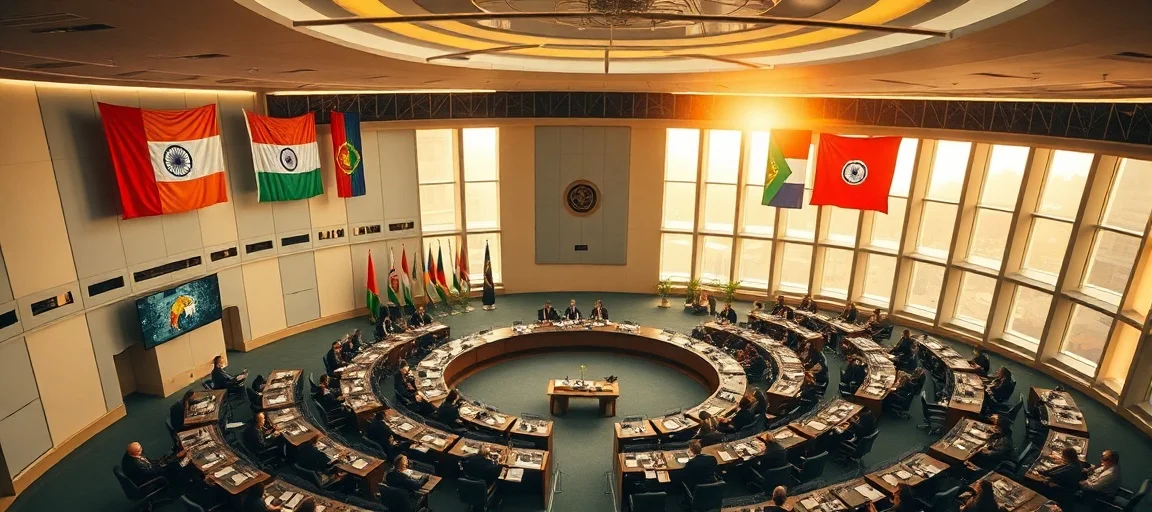
The global geopolitical landscape is undergoing a profound transformation, and at its heart lies the evolving influence of the BRICS grouping. As India Hosts BRICS Amidst Global Policy Debates in 2026, the nation takes center stage in navigating these complex discussions, aiming to forge a new geopolitical chapter for the Global South. This year's summit, scheduled for September 12 and 13 in New Delhi, presents a pivotal moment for the expanded bloc to address critical issues ranging from economic cooperation to global governance reform. India's chairmanship, guided by the theme "Building for Resilience, Innovation, Cooperation and Sustainability," underscores a commitment to a people-centric and humanity-first approach to international relations.
India's Chairmanship and the 18th BRICS Summit
India officially assumed the BRICS chairmanship on January 1, 2026, setting the stage for a year of intensive diplomatic engagements and the highly anticipated 18th BRICS Summit. External Affairs Minister S. Jaishankar unveiled the official logo and theme for India's presidency on January 13, 2026, signaling the formal commencement of preparations. The choice of "Building for Resilience, Innovation, Cooperation and Sustainability" as the overarching theme highlights India's vision for a more stable, technologically advanced, collaborative, and environmentally conscious global future. This theme, articulated by Prime Minister Narendra Modi at the 2025 BRICS Summit in Rio, aims to redefine the grouping's focus towards tangible outcomes and development.
Throughout its presidency, India is responsible for organizing numerous ministerial and working-group meetings leading up to the leaders' summit in New Delhi. These preparatory discussions are crucial for building consensus among the diverse member states on a wide array of issues that will shape the final agenda and declarations of the summit. The in-person gathering in New Delhi is expected to draw leaders and senior officials from all BRICS member countries and partner nations, providing a vital platform for high-level dialogue and decision-making amidst a turbulent global environment.
A Brief History and Evolution of BRICS
The concept of BRIC (Brazil, Russia, India, China) was first coined in 2001 by Jim O'Neill of Goldman Sachs, highlighting the growing economic power of these four emerging economies. The group began formal diplomatic cooperation in 2006, holding its first full-scale summit in Yekaterinburg, Russia, in 2009. The original focus was on improving the global economic situation and reforming financial institutions in the wake of the Great Recession, advocating for a new, diverse global reserve currency.
The bloc expanded for the first time in 2010 with the inclusion of South Africa, officially becoming BRICS. This expansion brought a significant African voice to the table, further diversifying the group's geographical and economic representation. A major milestone in its institutional development was the launch of the New Development Bank (NDB) in 2014, aimed at mobilizing resources for infrastructure and sustainable development projects in BRICS and other emerging economies, serving as a complement to existing international financial institutions. The NDB has since extended over $39 billion across 120 projects, focusing on areas like clean energy, water and sanitation, and transport.
The most recent wave of expansion occurred at the 15th BRICS summit in Johannesburg in August 2023, where invitations were extended to six new countries: Argentina, Egypt, Ethiopia, Iran, Saudi Arabia, and the United Arab Emirates. While Argentina later withdrew its membership application due to a change in government, Egypt, Ethiopia, Iran, Saudi Arabia, and the UAE officially became full members on January 1, 2024, followed by Indonesia in early 2025. This expansion significantly increased the bloc's global footprint, informally leading to the term "BRICS+" or "BRICS Plus". The expanded BRICS now comprises eleven countries, representing nearly half of the world's population and approximately one-third of global GDP.
Key Global Policy Debates: India Hosts BRICS Agenda
The 2026 BRICS Summit under India's leadership is taking place amidst a period of unprecedented global instability, marked by armed conflicts, technological disruptions, trade fragmentation, and intense competition over global governance rules. These complex challenges form the backdrop for the critical policy debates that BRICS nations are actively engaged in.
Reforming Global Governance and Multilateralism
A core objective of BRICS since its inception has been to advocate for a more equitable, representative, and democratic international system. This includes pushing for reforms in established global institutions such as the United Nations, the World Trade Organization (WTO), the International Monetary Fund (IMF), and the World Bank. India, as a significant voice within the Global South, views BRICS as a crucial platform to amplify the interests of developing economies and challenge Western-dominated narratives. Discussions during India's chairmanship are expected to focus on revitalizing multilateralism, especially in light of the weakening of international norms and institutions. The BRICS nations aim to ensure that global governance structures are more inclusive and reflect the multipolar realities of the 21st century. The ongoing push for WTO reform, particularly the restoration of its Appellate Body and addressing protectionist trade policies, remains a key agenda item. For further insights into the broader context of these transformations, explore the article on The Shifting Tides of Global Governance.
Economic Cooperation and De-dollarization
Economic and financial cooperation remains a cornerstone of BRICS collaboration. The bloc is actively exploring ways to enhance intra-BRICS trade, promote the use of national currencies in bilateral trade, and reduce dependence on the U.S. dollar. This "de-dollarization" push is seen as a way to insulate member economies from external financial volatility and assert greater economic sovereignty. The New Development Bank plays a pivotal role in this, providing alternative financing mechanisms for infrastructure and sustainable development projects without the conditionalities often associated with Western-led financial institutions. India's trade with BRICS nations has shown strong growth, reaching $416 billion in 2025, but a widening trade deficit, particularly with China, poses a significant policy challenge. India's agenda emphasizes leveraging the grouping to secure more balanced trade terms and diversify supply chains, especially in critical sectors like energy. The 2026 summit will likely explore new mechanisms for financial cooperation, potentially including expanding the BRICS Contingent Reserve Arrangement and exploring cross-border payment systems to facilitate trade in local currencies. Understanding India's economic position is key to understanding its BRICS strategy, as detailed in India's Economic Landscape: Growth and Challenges.
Climate Change and Sustainable Development
Sustainable development and climate action are central to India's BRICS agenda. The theme "Building for Resilience, Innovation, Cooperation and Sustainability" explicitly addresses these concerns. BRICS nations are committed to accelerating collective efforts toward climate action, green finance, and energy transitions, aligning with national and global priorities. They advocate for climate financing that supports developing countries and work towards achieving the UN Sustainable Development Goals (SDGs).
Discussions will likely cover strategies for building climate resilience, promoting green industrialization programs for the Global South, and expanding funding for climate finance through institutions like the NDB. India, with its strong pharmaceutical base, can lead efforts in health security, linking regional and multinational vaccine manufacturing hubs, as highlighted by the BRICS Vaccine R&D Centre.
Digital Transformation and Technology Governance
Innovation, particularly in digital transformation and technology, is another key pillar of India's chairmanship. BRICS countries recognize the importance of strengthening cooperation in areas like digital public infrastructure, artificial intelligence (AI), and fintech. India has successfully implemented digital public infrastructure, such as the India Stack, and seeks to share these models with BRICS members and partners to reduce digital asymmetry and promote inclusivity.
The debates surrounding AI governance are particularly timely. As artificial intelligence rapidly evolves, BRICS nations aim to establish common understandings and potentially coordinated policies to ensure responsible development and deployment of AI technologies, preventing a widening of the global digital divide. Promoting technology transfer for innovation and encouraging exchanges in science and technology are also on the agenda.
India's Strategic Imperatives and Challenges
India's decision to host this BRICS summit and its active role in shaping its agenda reflect deep strategic imperatives. As an emerging power, India leverages BRICS to advance its foreign policy goals, which include promoting a multipolar world order and safeguarding its strategic autonomy. India views BRICS as a vital platform to amplify the voice of developing countries without being forced into rigid geopolitical alignments.
However, India's leadership comes with its own set of challenges. The expanded BRICS, while collectively powerful, also brings greater diversity in political and economic interests among its members. This diversity can complicate reaching consensus on significant political and strategic issues, especially given existing bilateral disputes, such as those between India and China. India's approach emphasizes functional cooperation on practical issues like health, climate finance, and trade, rather than ideological confrontation, to manage internal contradictions.
Moreover, the BRICS bloc often faces external pressures and a narrative from some Western powers that portrays it as an "anti-Western" alliance. India's leadership will aim to address these misperceptions and outline a positive agenda for BRICS that promotes growth and development, advances reforms in global governance, and responds effectively to contemporary challenges. India's ability to act as a "bridge-builder" between the Global South and Western economies will be crucial for the bloc's overall effectiveness and global standing.
Impact on the Global Order
The 2026 BRICS Summit in India is not merely a diplomatic gathering; it is a strategic event poised to exert significant influence on the evolving global order. With its expanded membership, BRICS now accounts for an even larger share of the world's population and economic output, giving it considerable heft in international discussions. The bloc's continued advocacy for reforming international financial and governance institutions challenges the long-standing Western dominance and pushes for a more inclusive international architecture.
The commitment to de-dollarization and the strengthening of alternative financial mechanisms, such as the NDB, reflects a growing desire among member states to diversify their economic partnerships and reduce vulnerabilities to global financial shocks. This pursuit of strategic autonomy and a multipolar world order by BRICS nations could lead to a more fragmented yet potentially more balanced global system. For an in-depth look at the broader implications of these shifts, consider The Rise of a Multipolar World Order.
The outcome of the New Delhi summit will be closely watched by nations worldwide, as it will signal the direction and cohesion of this influential grouping. Its ability to find common ground on critical global policy debates, despite internal differences, will determine its success in shaping a new chapter for international cooperation and global governance.
Conclusion
As India Hosts BRICS Amidst Global Policy Debates in September 2026, the world looks to New Delhi for leadership in navigating an increasingly complex international landscape. India's chairmanship, anchored in the theme of "Building for Resilience, Innovation, Cooperation and Sustainability," offers a clear vision for advancing a people-centric and sustainable future. The expanded BRICS grouping represents a formidable force for change, advocating for a more equitable global order, reformed multilateral institutions, and robust South-South cooperation. While internal divergences and external pressures present significant challenges, India's strategic approach of fostering practical cooperation and acting as a bridge-builder positions it to guide BRICS towards substantive outcomes that benefit its members and contribute to a more balanced and inclusive world. The success of this summit will undoubtedly redefine the bloc's trajectory and its impact on the geopolitical landscape for years to come.
Frequently Asked Questions
Q: What is the central theme of India's BRICS chairmanship for 2026?
A: India's chairmanship for the 2026 BRICS Summit is guided by the theme "Building for Resilience, Innovation, Cooperation and Sustainability." This theme underscores India's commitment to a people-centric, humanity-first approach, focusing on a stable, technologically advanced, collaborative, and environmentally conscious global future for the bloc.
Q: Which countries recently joined the BRICS bloc, expanding its global footprint?
A: At the 15th BRICS summit in August 2023, Egypt, Ethiopia, Iran, Saudi Arabia, and the United Arab Emirates officially joined as full members on January 1, 2024, followed by Indonesia in early 2025. Argentina withdrew its application, making the expanded BRICS now an eleven-country grouping.
Q: What is the primary role of the New Development Bank (NDB) within BRICS?
A: The New Development Bank (NDB), established in 2014, serves as a crucial financial institution for BRICS. Its primary role is to mobilize resources for infrastructure and sustainable development projects within BRICS and other emerging economies, offering an alternative financing mechanism to traditional Western-led institutions.