Cuba Warns US Amid Rising Tensions, Drone Buildup in Caribbean
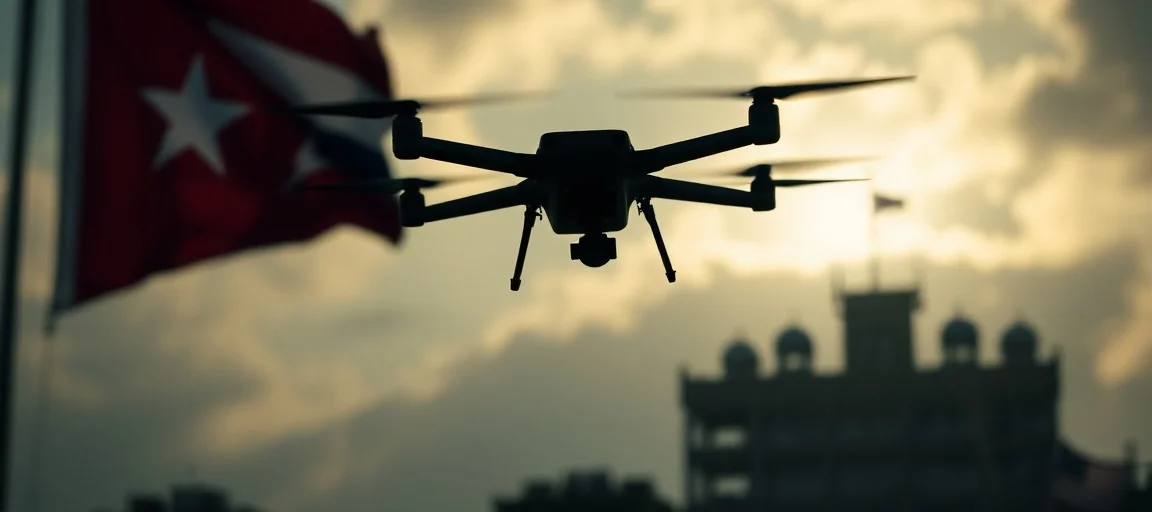
Amidst rising tensions and reports of a significant drone buildup in the Caribbean, Cuba has issued a stark warning to the US, declaring that any U.S. military action would lead to a "bloodbath" with "incalculable consequences" for regional stability. These pronouncements come amidst an escalation of rhetoric and classified U.S. intelligence reports suggesting that Cuba has acquired a substantial arsenal of military drones, further exacerbating already rising tensions between the two long-standing adversaries. The alleged drone buildup has sparked alarm in Washington, with officials citing concerns over Havana's growing military ties with Russia and Iran and alleged discussions about potential strikes on American interests. This intricate situation involving Cuba warns US amid rising tensions, drone buildup marks a dangerous new phase in the contentious relationship between the island nation and the United States.
- Historical Context of US-Cuba Relations
- Cuba Warns US Amid Rising Tensions, Drone Buildup
- The Role of Drone Technology in Modern Geopolitics
- International Reactions and Regional Stability
- Looking Ahead: Pathways to De-escalation or Further Conflict?
- Frequently Asked Questions
- Further Reading & Resources
Historical Context of US-Cuba Relations
The relationship between the United States and Cuba has been characterized by decades of deep-seated distrust and antagonism, fundamentally shaped by the Cold War era. Following the 1959 Cuban Revolution, which brought Fidel Castro to power, the U.S. severed diplomatic ties in 1961 and imposed a comprehensive trade embargo in 1960 that remains largely in effect today. This embargo restricts nearly all commercial, economic, and financial activity between the two nations, aiming to isolate the communist-led island economically and diplomatically.
From Cold War Hostility to Brief Thaw
Throughout the latter half of the 20th century, U.S.-Cuba relations were defined by pivotal events like the Bay of Pigs Invasion in 1961 and the Cuban Missile Crisis in 1962, both of which brought the world to the brink of nuclear conflict. For decades, successive U.S. administrations maintained policies aimed at isolating Cuba. A brief period of normalization occurred between 2015 and 2017 under U.S. President Barack Obama and then-Cuban leader Raúl Castro, an effort known as the "Cuban thaw". This included restoring full diplomatic ties, reopening embassies, and easing some travel and trade restrictions.
Renewed Strain Under Recent Administrations
However, this thaw proved short-lived. The Trump administration, upon returning to office, largely reversed course, reinstating a hard-line stance against Cuba. This shift involved imposing a raft of new sanctions, intensifying an economic blockade, and redesignating Cuba as a state sponsor of terrorism. These measures have led to significant economic challenges for Cuba, including severe fuel shortages and frequent power outages, which have sparked protests on the island. The current U.S. administration has described Cuba as "a country about to collapse" and has continued to exert pressure for internal transformations within Cuba.
Cuba Warns US Amid Rising Tensions, Drone Buildup
The current diplomatic crisis intensified dramatically following a recent report by Axios, which cited classified U.S. intelligence assessments alleging that Cuba has acquired more than 300 military drones from Russia and Iran since 2023. The report further claimed that Cuban officials have discussed possible plans to use these drones against U.S. targets, including the naval base at Guantánamo Bay, American military vessels, and potentially even Key West, Florida, located just 90 miles from Havana.
Havana's Vehement Rejection and Warnings
Cuban officials have vehemently rejected these allegations, accusing the United States of fabricating a "fraudulent case" to justify intensified economic sanctions and potential military intervention. Cuban Foreign Minister Bruno Rodríguez stated unequivocally that Cuba "neither threatens nor desires war". He asserted that, like any sovereign nation, Cuba possesses "the absolute and legitimate right to defend itself against a military onslaught" and against "external aggression in the exercise of the right to legitimate self-defense recognized by the UN Charter".
Cuban President Miguel Díaz-Canel echoed these sentiments, publicly warning that any U.S. military action against the island would result in a "bloodbath with incalculable consequences" for regional peace and stability. He emphasized that Cuba "poses no threat" and has no "aggressive plans or intentions against any country," including the U.S.. These strong statements underscore Havana's perception that the U.S. is manufacturing a pretext for escalating pressure against the communist government.
US Intelligence Concerns and Actions
The U.S. intelligence community, as reported by Axios, has expressed growing concern over Cuba's expanding drone capabilities and the alleged presence of Iranian military advisers in Havana. Senior U.S. officials reportedly view these developments as an "increasingly serious regional security threat involving multiple state and non-state actors". The concern is heightened by the proximity of Cuba to U.S. shores and the proven effectiveness of Iranian-made drones in recent global conflicts.
Adding to the complexity, CIA Director John Ratcliffe reportedly made a rare high-level visit to Havana, where he warned Cuban leaders against serving as a platform for U.S. adversaries. U.S. officials indicated that Ratcliffe's message was that Cuba "can no longer be a safe haven for adversaries" and urged them to dismantle the communist government to end sanctions. Furthermore, reports emerged that the U.S. Justice Department is preparing a possible indictment against former Cuban leader Raúl Castro related to the 1996 shootdown of two civilian planes operated by the humanitarian group Brothers to the Rescue, an action that could significantly escalate tensions. This aligns with what the current U.S. administration considers a "maximum pressure" strategy against Havana.
The Role of Drone Technology in Modern Geopolitics
The alleged drone buildup in Cuba highlights the increasing prominence of unmanned aerial vehicles (UAVs) in modern geopolitical strategies. Drones have revolutionized warfare and surveillance, offering capabilities ranging from reconnaissance and intelligence gathering to precision strikes, often at a lower cost and risk to human life compared to traditional military assets.
Surveillance and Border Security
For nations like Cuba, acquiring advanced drone technology, especially from partners like Russia and Iran, could be perceived as a means to bolster their defensive capabilities and enhance border security. Drones can provide crucial surveillance of maritime borders and airspace, offering an eye-in-the-sky perspective that can detect potential incursions or unauthorized activities. However, when such capabilities are introduced into a highly sensitive geopolitical flashpoint like the U.S.-Cuba relationship, their use can quickly be viewed as provocative or threatening by the opposing side. The U.S. views the presence of "those types of technologies being that close, and a range of bad actors from terror groups to drug cartels to Iranians to the Russians" as "concerning" and a "growing threat".
Potential for Miscalculation and Escalation
The deployment and alleged discussions surrounding the use of military drones near U.S. interests carry a significant risk of miscalculation and escalation. The ambiguity surrounding drone operations, particularly their origin and intent, can quickly lead to heightened alert levels and reactive measures. In a volatile environment with deep historical mistrust, even defensive deployments could be misinterpreted as offensive preparations, triggering a dangerous cycle of responses. Cuba's foreign minister explicitly stated that the country is "preparing itself to confront external aggression", which, from Havana's perspective, is a legitimate act of self-defense but could be seen as further militarization by the U.S.
The presence of alleged Iranian military advisers in Havana and Cuba's purported study of Iranian resistance tactics further amplify U.S. concerns. This convergence of advanced military technology with alliances seen as adversarial to the U.S. in the Caribbean region presents a complex security challenge.
International Reactions and Regional Stability
The escalating tensions between the U.S. and Cuba, exacerbated by the drone allegations, have drawn international attention and raise concerns about broader regional stability. The Caribbean, a strategically vital area, has historically been a focal point of superpower rivalries.
Calls for Diplomacy
While direct international mediation has not been prominently reported concerning the immediate drone allegations, there are underlying calls for diplomacy. Cuba's President Miguel Díaz-Canel has indicated a willingness to engage in "serious and responsible dialogue" with the U.S. based on "sovereign equality, mutual respect, principles of international law, reciprocal benefit, noninterference in internal affairs, and full respect for our independence". Similarly, the U.S. has reportedly engaged in limited diplomatic discussions even amidst escalating rhetoric. However, the U.S. position often emphasizes "fundamental changes" within Cuba as a precondition for significant engagement, including the release of political prisoners.
China, a key ally of Cuba, has voiced support for Havana, urging the U.S. to "stop the blockade, sanctions, and coercion of all forms against Cuba at once, and act in ways conducive to regional peace and stability". These international perspectives highlight the perceived imbalance of power and the humanitarian consequences of the ongoing U.S. embargo. The deteriorating economic conditions in Cuba, including widespread blackouts and shortages, are frequently cited by Havana and its allies as direct consequences of U.S. pressure.
Looking Ahead: Pathways to De-escalation or Further Conflict?
The current standoff between the United States and Cuba appears to be at a critical juncture. The highly charged rhetoric and military allegations underscore a deep lack of trust that has plagued relations for over six decades. The path forward is fraught with potential for both de-escalation and further conflict.
One scenario involves a continued escalation of pressure from the U.S., potentially including new sanctions or even legal actions like the rumored indictment of Raúl Castro, which could be seen by Cuba as a direct provocation. Such actions would likely be met with further defiance and defensive posturing from Havana, potentially drawing in its allies, Russia and Iran, to a greater degree in the Caribbean.
Alternatively, a pathway to de-escalation would require a renewed commitment to dialogue, perhaps through back channels or international mediation. Cuba has expressed a willingness to talk, albeit with preconditions of mutual respect and non-interference. For any significant breakthrough, the U.S. might need to reconsider aspects of its "maximum pressure" strategy, acknowledging the humanitarian impact of sanctions and exploring avenues that do not demand immediate regime change as a prerequisite for engagement. The current climate, however, with the Trump administration's firm stance and the specific allegations about Cuba's drone capabilities, makes such a diplomatic shift appear challenging. The ongoing economic crisis in Cuba further complicates any attempts at negotiation, as the Cuban government remains under immense internal and external pressure.
The use of drones by various state and non-state actors globally has undeniably reshaped strategic considerations, and their alleged presence and potential deployment near U.S. shores add a new, urgent dimension to the U.S.-Cuba dynamic. The challenge for both nations will be to navigate these complex waters without triggering a confrontation that neither ostensibly desires, yet both appear to be preparing for.
In conclusion, the escalating rhetoric and military posturing underscore the profound instability in the U.S.-Cuba relationship. Havana's fierce denial of aggressive intent, coupled with its firm stance on self-defense, directly confronts Washington's alarm over alleged drone threats. The core issue remains that Cuba warns US amid rising tensions, drone buildup, a situation that could have far-reaching and unpredictable consequences for the Caribbean region and beyond. It is a precarious moment, demanding cautious diplomacy and a clear understanding of the risks inherent in the current trajectory of their fraught interactions.
Frequently Asked Questions
Q: What are the primary reasons for the current tensions between the US and Cuba?
A: Tensions stem from historical distrust, the longstanding U.S. trade embargo, Cuba's alliances with Russia and Iran, and recent U.S. intelligence reports alleging Cuba's acquisition of military drones and discussions of potential strikes against American interests.
Q: What is Cuba's stance on the drone allegations and US warnings?
A: Cuba vehemently denies the allegations, accusing the U.S. of fabricating a pretext for intervention. Cuban officials assert their sovereign right to self-defense and warn of "incalculable consequences" for regional stability if the U.S. initiates military action.
Q: How has drone technology changed geopolitical dynamics in the U.S.-Cuba relationship?
A: The alleged drone buildup introduces a new, urgent dimension by enhancing Cuba's perceived defensive capabilities while raising U.S. concerns about surveillance and potential offensive use, increasing the risk of miscalculation and escalation in an already volatile region.