Europe on Edge: Russian Drone Crashes in Romania, Injuring Civilians
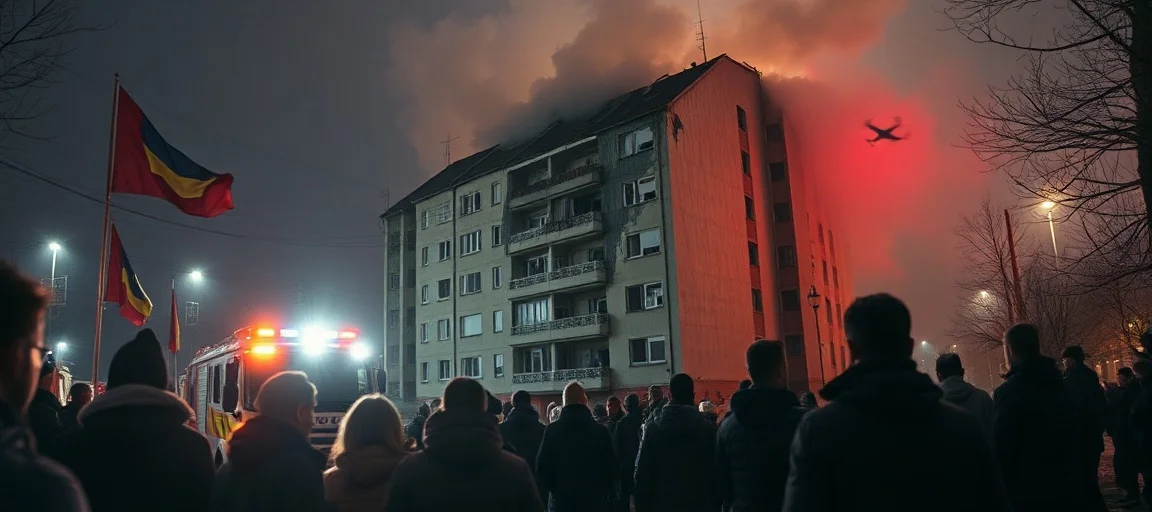
A chilling escalation of the war in Ukraine has sent shivers across the continent, thrusting Europe on Edge: Russian Drone Crashes in Romania, a NATO member state, and inflicting civilian casualties. The unprecedented incident, which saw a Russian drone strike a residential apartment building in the eastern Romanian city of Galati, marks a grave turning point in the conflict. Occurring during an overnight assault on Ukrainian targets, the drone's errant trajectory ended with an explosion on the roof of a 10-story block, injuring two people and sparking a fire, according to Romanian authorities. This serious incursion into NATO territory has prompted swift and widespread condemnation from international bodies, highlighting the perilous proximity of the conflict and the urgent need for reinforced defensive measures along the alliance's eastern flank.
- An Unprecedented Violation: The Galati Incident
- Romania's Immediate Response and Calls for Action
- NATO and EU Condemnation: A United Front
- Moscow's Ambiguous Stance and Broader Russian Tactics
- The Geopolitical Ramifications: Europe on Edge After Russian Drone Crash in Romania
- Strengthening Defenses: A Collective Imperative
- Conclusion: Europe on Edge, A Call for Vigilance
- Frequently Asked Questions
- Further Reading & Resources
An Unprecedented Violation: The Galati Incident
The tranquil night of May 28-29, 2026, was shattered in Galati, Romania, a city strategically located on the Danube River near the borders of Ukraine and Moldova. A Russian Geran-2 drone, a variant of the Iranian-designed Shahed, veered off course during an extensive overnight attack launched by Russia against civilian and infrastructure targets in neighboring Ukraine. The drone was tracked by radar as it entered Romanian airspace before ultimately slamming into the roof of an apartment building in a densely populated urban area of Galati.
The impact triggered a significant fire and caused structural damage to the residential block. Emergency services swiftly responded, evacuating residents and tending to two individuals who sustained minor injuries, including a 53-year-old woman and a 14-year-old boy, requiring hospitalization for burns. This incident stands out as particularly alarming because, while drone fragments have previously landed on Romanian territory on multiple occasions since Russia's full-scale invasion of Ukraine in February 2022, this is the first recorded instance of a Russian drone causing injuries in a major urban area within a NATO member state. Previous incidents, including those in Galati in April of the same year, typically involved fragments found in remote areas without casualties. The nature of this strike, hitting a residential building and injuring civilians, has amplified concerns about the deliberate or accidental spillover of the conflict onto Allied soil.
Romania's Immediate Response and Calls for Action
In the immediate aftermath of the crash, Romanian authorities reacted with urgency and grave concern. President Nicușor Dan convened an emergency meeting of the country's supreme council of national defense to discuss the profound implications of what he unequivocally described as "the worst incident to hit the national territory" since the onset of Russia's full-scale invasion of Ukraine. President Dan directly attributed the incident to Russia, emphasizing that Romania, as a NATO member, would not tolerate the war being transferred onto its citizens.
The diplomatic repercussions were swift. Romania's Foreign Ministry summoned Russia's ambassador in Bucharest and subsequently declared the Russian consul in the Black Sea port city of Constanta persona non grata, ordering the closure of the consulate there. These decisive actions underscored Romania's condemnation of the airspace violation and the resulting civilian harm.
Furthermore, in response to the latest incursion, Romania formally requested that NATO accelerate the transfer of anti-drone capabilities to its military. This appeal reflects a pressing need to enhance the country's defensive posture against the persistent threat posed by drones originating from the conflict zone. The Romanian military had scrambled two F-16 fighter jets and a helicopter during the incident, authorized to engage targets, and issued alert messages to residents. However, the aircraft did not engage the drone. Explaining why the drone was not shot down, Defence Ministry spokesman Cristian Popovici highlighted the complexities and risks involved. Brigadier General Gheorghe Maxim further elaborated, citing legal restrictions against opening fire in a way that could affect a neighboring country's airspace and the extremely short detection-to-impact time of only four minutes, making engagement difficult without risking further harm in populated areas. Romania has, in fact, adopted legislation allowing its army to shoot down drones as a last resort, but maintains caution due to the risks involved in populated areas.
NATO and EU Condemnation: A United Front
The drone crash in Galati ignited a chorus of strong condemnations from across NATO and the European Union, underscoring the collective alarm at Russia's actions. NATO Secretary General Mark Rutte, after speaking with Romanian President Nicușor Dan, publicly accused Russia of "reckless behavior" and reaffirmed the alliance's unwavering commitment to its collective defense. Rutte explicitly stated that NATO "stands ready to defend every inch of Allied territory," a powerful declaration aimed at reassuring member states along the eastern flank. While Article 5, the mutual defense clause, was not explicitly invoked, discussions around accelerating anti-drone capabilities and strengthening eastern flank defenses highlight the seriousness with which NATO views the incident. A senior NATO official later confirmed that the drone that crashed was indeed "of Russian origin," despite initial denials from Moscow.
European Commission President Ursula von der Leyen also voiced strong condemnation, stating that Russia's "war of aggression has crossed yet another line." She emphasized that the incident struck "EU territory" and reiterated the European Union's full solidarity with Romania. Von der Leyen further announced that the EU would continue to strengthen security along its eastern border and was actively drafting a 21st set of sanctions against Russia, signaling a hardening stance from Brussels.
Other European leaders echoed these sentiments. Estonian Foreign Minister Margus Tsahkna linked the increased risk of such incidents to "Putin's increasing nervousness, driven by military setbacks." Ukrainian President Volodymyr Zelenskyy offered Kyiv's support to Romania and called for robust EU sanctions against Russia. The unified response from international partners demonstrates the shared understanding of the threat posed by Russia's ongoing aggression and the collective resolve to bolster European security. The incident has intensified calls within NATO for reviewing and enhancing current air defense strategies, particularly in vulnerable border regions.
Moscow's Ambiguous Stance and Broader Russian Tactics
In the wake of the drone crash, Russia's response has been characterized by a mix of denial and defiant rhetoric, consistent with its approach to previous incidents involving the spillover of the conflict. Russian President Vladimir Putin questioned the origin of the drone, stating it was "too soon to say" it was Russian and demanding objective data and evidence before assessing what happened. This stance contrasts sharply with NATO's confirmation of the drone's Russian origin.
Adding to the diplomatic friction, Russia's Foreign Ministry vowed a proportional response to Romania's decision to declare a Russian consul persona non grata and close the Constanta consulate, signaling a further deterioration in bilateral relations. Meanwhile, Dmitry Medvedev, deputy chair of Russia's Security Council, issued a stark warning to European leaders, suggesting that drones would continue to enter their countries and prevent their populations from "sleeping peacefully." Medvedev attempted to justify such actions by claiming that European drones and weapons were being used in attacks on Russia, resulting in civilian casualties there.
This incident occurred within the broader context of Russia's ongoing campaign of drone and missile attacks against Ukrainian cities and critical infrastructure, particularly ports on the Danube River, which are often in close proximity to the Romanian border. Since the summer of 2023, Russia has intensified its use of drones in these attacks. Romania has repeatedly confirmed the discovery of drone fragments on its territory since the war began, highlighting a persistent pattern of airspace violations and unintended consequences of the conflict. The repeated nature of these incidents, even if unintentional, underscores Moscow's disregard for the sovereignty and security of neighboring NATO states.
The Geopolitical Ramifications: Europe on Edge After Russian Drone Crash in Romania
The Russian drone crash in Galati carries significant geopolitical ramifications, fundamentally raising the stakes for regional stability and for the NATO alliance as a whole. The incident has sharply escalated tensions between NATO and Moscow, intensifying fears that Russia's war of aggression against Ukraine could inadvertently or intentionally spill over into the territory of a NATO member state. As a member of NATO, Romania is covered by the commitment to collective security under Article 5, which stipulates that an attack against one member is considered an attack against all. While this direct incident did not trigger Article 5, it undeniably tests the alliance's resolve and its deterrence capabilities.
The incident further spotlights the vulnerability of NATO's eastern flank, a region that has been on high alert since the full-scale invasion of Ukraine. Countries bordering Ukraine and Russia, including Romania, Poland, and the Baltic states, face the daily threat of stray munitions, airspace violations, and potential hybrid warfare tactics. The damage and injuries in Galati transform what were previously abstract threats into tangible dangers for civilian populations within the alliance.
The calls from Romania and other allies for faster transfers of anti-drone capabilities and enhanced air defense systems illustrate a recognition of existing gaps and the urgent need to bolster defenses. The strategic importance of Romania, a key Black Sea nation, in safeguarding NATO's southeastern flank is undeniable. Any perceived weakness or hesitation in responding to such incursions could embolden further reckless actions. The situation demands a carefully calibrated yet firm response from NATO to deter future incidents while avoiding a direct military confrontation with Russia that could escalate the conflict further.
Strengthening Defenses: A Collective Imperative
The drone crash in Galati has reinforced the collective imperative for NATO and its member states to significantly strengthen their defenses, particularly against the evolving threat posed by unmanned aerial vehicles. NATO officials have indicated that while Article 5 was not triggered, the alliance would focus on bolstering eastern flank defenses and improving drone interception capabilities. Discussions are underway regarding potential additional defensive measures to be considered for deployment to Romania and other frontline states.
Romania's own efforts to enhance its air defense capabilities have been ongoing. Lawmakers adopted legislation in the past year allowing the army to shoot down drones entering its airspace as a last resort. However, as highlighted by Romanian military officials, the decision not to engage the drone in Galati underscored the complex challenges of drone interception, especially in populated areas where collateral damage is a significant concern. The short detection time and the need to avoid harming civilians mean that advanced, rapid-response anti-drone systems are crucial.
Investments in cutting-edge radar systems, particularly those capable of detecting small, slow-moving targets, electronic warfare capabilities to disrupt drone navigation, and short-range air defense (SHORAD) systems are vital to protect critical infrastructure and civilian populations. The integration of these Counter-UAS (C-UAS) systems into a comprehensive, layered air defense network is paramount, as is the development of robust command and control mechanisms that allow for rapid decision-making in high-pressure scenarios. Furthermore, closer coordination and intelligence sharing among NATO allies are essential to anticipate and respond to such threats effectively, ensuring a harmonized and agile defensive posture across the entire eastern flank. The incident serves as a stark reminder that modern warfare, characterized by the extensive use of drones, blurs traditional borders and necessitates adaptive defense strategies. The alliance must continue to adapt its posture and capabilities to address the persistent and unpredictable nature of Russia's aggression.
Conclusion: Europe on Edge, A Call for Vigilance
The Russian drone crash in Galati, Romania, represents a dangerous escalation of the conflict in Ukraine, bringing the war's destructive potential directly into a NATO member state and injuring civilians. This unprecedented incident has sent ripples of concern across the continent, highlighting the precarious security situation and putting Europe on Edge: Russian Drone Crashes in Romania. The strong condemnations from Romania, NATO, and the EU, coupled with immediate diplomatic and defensive actions, underscore the gravity of the situation.
As Russia continues its aggressive campaign in Ukraine, the risk of accidental or deliberate spillover into neighboring countries remains a critical concern. The incident in Galati serves as a stark reminder of the urgent need for robust air defenses, enhanced deterrence, and unwavering solidarity among Allied nations. Moving forward, a firm, coordinated, and proportionate response from the international community will be crucial to de-escalate tensions, hold Russia accountable for its reckless actions, and ultimately safeguard the security and stability of Europe. The lessons learned from this incident will undoubtedly shape future defense strategies and cooperation efforts, as nations strive to protect their citizens from the unpredictable nature of modern conflict.
Frequently Asked Questions
Q: What happened in Galati, Romania?
A: A Russian Geran-2 drone crashed into a residential apartment building in Galati, Romania, during an overnight attack on Ukrainian targets. It caused structural damage, a fire, and injured two civilians, marking a significant escalation as it occurred within a NATO member state.
Q: How has NATO responded to the drone crash?
A: NATO Secretary General Mark Rutte condemned Russia's "reckless behavior" and reaffirmed NATO's commitment to collective defense. The alliance is discussing accelerating anti-drone capabilities and strengthening defenses along its eastern flank, though Article 5 was not explicitly invoked.
Q: Why is this incident considered an escalation?
A: This is the first recorded instance of a Russian drone causing injuries in a major urban area within a NATO member state. Previous incidents involved fragments in remote areas without casualties, making this a direct and tangible threat to Allied civilian populations and sovereignty.