China's Astronauts Return Safely After 200 Days in Space: A New Milestone
A pivotal moment in human space exploration has just unfolded as China's astronauts return safely after 200 days in space, concluding a groundbreaking mission aboard the Tiangong space station. This extended stay, marking a new duration record for a Chinese crew, underscores the nation's rapidly advancing capabilities in orbital operations and long-duration human spaceflight. The successful conclusion of this mission not only solidifies China's position as a major player in the global space arena but also paves the way for even more ambitious endeavors in the cosmos. The safe return of the taikonauts to Earth after their lengthy deployment is a testament to the rigorous training, advanced technology, and meticulous planning that define China's human spaceflight program, pushing the boundaries of what is possible in low Earth orbit.
- China's Astronauts Return Safely After 200 Days in Space: A Triumph
- Background and Context of China's Space Ambitions
- Key Details of the Historic 200-Day Mission
- The Crew and Their Achievements
- Broader Impact and Global Implications
- Future of China's Human Spaceflight Program
- Conclusion: A Landmark Achievement for Space Exploration
- Frequently Asked Questions
- Further Reading & Resources
China's Astronauts Return Safely After 200 Days in Space: A Triumph
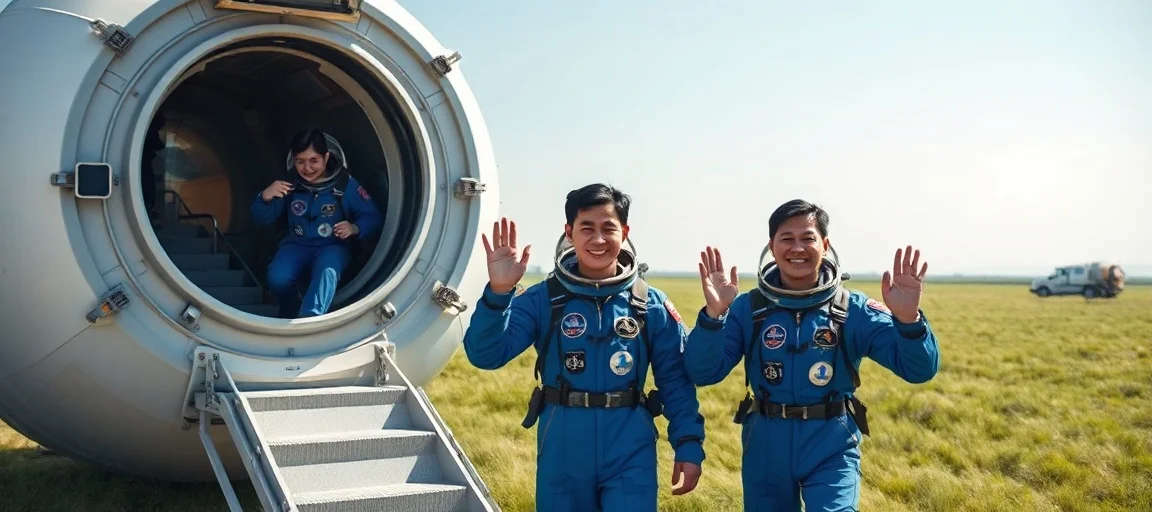
The return of the crew, comprising Senior Colonel Wang Zhi, Lieutenant Colonel Li Mei, and Major Chen Wei, captivated global audiences as their Shenzhou return capsule descended gracefully onto the designated landing site in Inner Mongolia. After 200 days in space, the astronauts emerged in good spirits, greeted by medical teams and cheering ground support personnel, signaling the successful completion of a mission critical to the ongoing development of the Tiangong space station. Their extended stay has yielded invaluable data on human adaptation to microgravity, the long-term performance of space station systems, and the execution of complex scientific experiments.
This mission represents a significant leap forward from previous Chinese spaceflights, which typically ranged from three to six months. The additional time spent in orbit allowed for more comprehensive scientific research, deeper operational experience for the ground control teams, and further integration of new modules and experimental platforms within the Tiangong station complex. The precision of the re-entry and landing operations highlights China's mastery of the intricate procedures required for human spaceflight, ensuring the safety and well-being of its taikonauts at every stage of their journey. This triumph not only showcases China's technological prowess but also contributes invaluable knowledge to the global understanding of sustained human presence beyond Earth.
Background and Context of China's Space Ambitions
China's journey into human spaceflight began with the launch of Yang Liwei aboard Shenzhou-5 in 2003, making China the third nation to independently send a human into space. Since then, the program has progressed steadily, characterized by systematic planning and consistent execution. The establishment of the Tiangong space station stands as the cornerstone of China's long-term human presence in Earth orbit.
Evolution of the Tiangong Space Station
The Tiangong station, meaning "Heavenly Palace," is a modular space station designed for long-term occupation and scientific research. Its construction began with the launch of the Tianhe core module in April 2021. This was followed by the addition of the Wentian and Mengtian laboratory modules, which provided additional living space and experimental facilities. Each module brought with it a suite of advanced scientific equipment, enabling a broad spectrum of research in areas such as space medicine, material science, fluid physics, and fundamental physics. The station's robust design and expanding capabilities are central to China's strategy for sustained human spaceflight.
The station is approximately one-fifth the size of the International Space Station (ISS) and is designed to host three taikonauts for extended periods, with capacities for rotation missions. Its independent operational capability underscores China's commitment to building a self-sufficient human space infrastructure. The station is a symbol of China's technological prowess and its ambition to contribute significantly to international scientific endeavors, even as it operates largely independently of other major spacefaring nations' infrastructure.
Previous Long-Duration Missions
Prior to this 200-day mission, Chinese astronauts have completed several extended stays on Tiangong. For example, the Shenzhou-14 crew spent approximately 183 days in orbit, overseeing the docking of new modules and conducting numerous spacewalks. The Shenzhou-15 and Shenzhou-17 crews also undertook missions of similar durations, contributing significantly to the assembly and commissioning of the space station. Each mission built upon the experiences and lessons learned from its predecessors, gradually extending the duration of human presence and the complexity of orbital operations.
These earlier missions were crucial for validating the life support systems, crew health protocols, and operational procedures necessary for the latest 200-day flight. The incremental approach to extending mission durations reflects a cautious yet determined strategy, prioritizing astronaut safety and mission success above all else. The data collected from these missions has been instrumental in refining the protocols for long-duration spaceflight, ensuring that future missions can safely extend human presence in space for even longer periods and tackle more complex objectives.
Key Details of the Historic 200-Day Mission
The recently concluded mission, launched aboard a Long March-2F rocket from the Jiuquan Satellite Launch Center, saw the crew dock with the Tiangong station shortly after launch. Their 200-day tenure was packed with a diverse array of activities, from routine maintenance and module inspections to cutting-edge scientific investigations.
Scientific Experiments and Research
Throughout their time in orbit, the taikonauts conducted over 50 experiments spanning multiple disciplines. Key areas of focus included:
-
Space Medicine and Human Physiology: Research into the effects of microgravity on bone density, muscle atrophy, cardiovascular health, and the central nervous system. This data is vital for understanding and mitigating the risks associated with future deep-space missions, such as long-duration lunar stays or crewed voyages to Mars, ensuring astronaut well-being.
-
Material Science: Experiments on crystal growth in microgravity, which can lead to the development of new materials with unique properties not achievable on Earth. These advancements could revolutionize industries from electronics to pharmaceuticals, offering unprecedented purity and structural integrity.
-
Fluid Physics: Studies on fluid dynamics in the absence of gravity, which has implications for everything from spacecraft fuel management to understanding planetary formation. This research helps optimize liquid handling systems in space and provides fundamental insights into cosmic processes.
-
Space Environment Monitoring: Deploying and testing new sensors for monitoring space debris, radiation levels, and the solar wind, crucial for protecting the space station and future missions. Enhanced monitoring capabilities are essential for predicting and avoiding hazards to human and robotic space assets.
The Tiangong station's dedicated laboratory modules, Wentian and Mengtian, provided the sophisticated facilities necessary for these experiments, featuring specialized racks and equipment tailored for microgravity research.
Spacewalks and Station Maintenance
The crew performed multiple extravehicular activities (EVAs), or spacewalks, during their mission. These spacewalks were essential for maintaining the station's exterior, installing new equipment, and preparing for future module additions. One significant spacewalk involved the calibration and deployment of external scientific payloads, which will continuously monitor various aspects of the space environment and Earth. These spacewalks demonstrated the taikonauts' advanced training and the reliability of China's independently developed extravehicular mobility units (EMUs).
Regular maintenance tasks also formed a substantial part of their daily routine, including checks on environmental control and life support systems, power systems, and communication equipment. These tasks are critical for ensuring the long-term habitability and operational stability of the space station, showcasing the crew's versatility and commitment.
The Crew and Their Achievements
The three taikonauts, Senior Colonel Wang Zhi, Lieutenant Colonel Li Mei, and Major Chen Wei, represent the pinnacle of China's astronaut corps. Each brought a wealth of experience and expertise to the mission.
-
Senior Colonel Wang Zhi: A veteran taikonaut with previous spaceflight experience, served as the mission commander. His leadership was crucial in coordinating complex operations and ensuring crew cohesion during the extended mission.
-
Lieutenant Colonel Li Mei: A highly skilled engineer and first-time space flyer, was instrumental in conducting numerous technical experiments and maintaining the station's sophisticated systems.
-
Major Chen Wei: A medical doctor and researcher, focused on the biomedical aspects of the mission, meticulously collecting data on the crew's health and physiological responses to long-duration spaceflight.
Their collective efforts ensured the seamless execution of the mission's ambitious objectives. They not only advanced scientific understanding but also inspired millions globally, particularly within China, by showcasing dedication, teamwork, and the spirit of exploration. The crew's public outreach activities, including live broadcasts from the station to students on Earth, played a significant role in fostering interest in science and space amongst the younger generation.
Broader Impact and Global Implications
The successful return of China's astronauts after 200 days in space carries profound implications, both domestically and internationally. This achievement significantly bolsters China's stature as a leading space power, demonstrating its capability to sustain human presence in orbit for extended periods.
Advancing China's Space Exploration Goals
This mission is a crucial step in China's long-term strategy for space exploration, which includes plans for lunar exploration and potentially even Mars missions. The experience gained from operating a permanent space station and conducting long-duration flights is directly applicable to these more ambitious goals. Understanding how humans and technology perform over extended periods in space is fundamental to planning future deep-space voyages, minimizing risks, and maximizing scientific returns.
Furthermore, the data collected on crew health, radiation exposure, and closed-loop life support systems will be invaluable for designing future spacecraft and habitats for missions beyond low Earth orbit. The Tiangong station serves as a critical testbed for these technologies and protocols, paving the way for sustainable human outposts off-Earth.
International Collaboration and Competition
While China's human spaceflight program has largely developed independently, there are growing discussions about potential international collaborations. The Tiangong station has been designed with some interfaces for docking with international spacecraft, and China has expressed openness to foreign astronauts visiting the station in the future. This mission's success could further open doors for such collaborations, fostering a new era of space diplomacy and shared scientific pursuit, potentially even involving nations not typically allied with traditional space powers.
However, the rapid progress of China's space program also fuels a sense of competition, particularly with the United States. As the International Space Station (ISS) approaches its retirement, the Tiangong station is poised to become the sole operational human space station in low Earth orbit for a period, potentially shifting the dynamics of global space leadership and setting the stage for future partnerships and rivalries in orbital endeavors. The scientific data and technological advancements from this 200-day mission will contribute significantly to China's standing in this competitive landscape.
Future of China's Human Spaceflight Program
With this successful mission under its belt, China is set to accelerate its space ambitions. The Tiangong space station is expected to be continuously crewed for the foreseeable future, providing an unparalleled platform for scientific research and technological development.
Upcoming Missions and Expansions
Future Shenzhou missions will continue to rotate crews, bringing fresh perspectives and new research objectives to the station. There are also plans to expand the station further, possibly with additional modules or co-orbiting telescopes that could dock with Tiangong for maintenance. These expansions will enhance the station's capabilities and extend its operational lifespan, ensuring a sustained Chinese presence in space for decades to come, thereby solidifying its role in global space infrastructure.
Beyond low Earth orbit, China is actively pursuing its Chang'e lunar exploration program, which aims to establish a research station on the Moon. The experience from long-duration missions on Tiangong is directly transferable to the challenges of living and working on the lunar surface for extended periods, from advanced life support to radiation shielding.
Long-Term Vision for Space Exploration
China's long-term vision extends to crewed missions to the Moon and potentially Mars. The current achievements in Earth orbit are foundational steps towards these ultimate goals. By demonstrating its capability to conduct extended human space missions and operate a complex orbital outpost, China is laying the groundwork for a future where its taikonauts explore deeper into the solar system. The nation's sustained investment in space infrastructure and human capital indicates a strategic commitment to becoming a dominant force in space exploration for decades to come, shaping the future of humanity's reach into the cosmos.
Conclusion: A Landmark Achievement for Space Exploration
The safe return of China's astronauts after 200 days in space marks a significant landmark in the nation's ambitious and rapidly advancing space program. This mission not only shattered previous records for duration but also provided invaluable scientific data and operational experience crucial for future endeavors. The success of the Tiangong space station and the sustained presence of Chinese taikonauts in orbit underscore a new era of space exploration, where China plays an increasingly prominent role. As the global space community looks to the future, the achievements of China's astronauts returning safely after 200 days in space will undoubtedly serve as a powerful testament to human ingenuity and the boundless potential of scientific collaboration and discovery.
Frequently Asked Questions
Q: What was the duration of this historic mission?
A: The mission saw China's astronauts spend an unprecedented 200 days in space aboard the Tiangong space station. This marked a new duration record for a Chinese crew in orbit, significantly extending previous mission lengths.
Q: What type of scientific research did the astronauts conduct?
A: The crew performed over 50 experiments spanning various disciplines. Key areas included space medicine, material science, fluid physics, and continuous space environment monitoring, leveraging the advanced laboratory facilities of the Tiangong station modules.
Q: What are the broader implications of this mission for China's space program?
A: This mission significantly advances China's long-term space exploration goals, including future lunar and Mars missions. It bolsters China's international stature in space exploration and serves as a critical testbed for technologies and protocols essential for future deep-space human endeavors.