Argentines Protest Milei's University Funding Cuts Amid Austerity
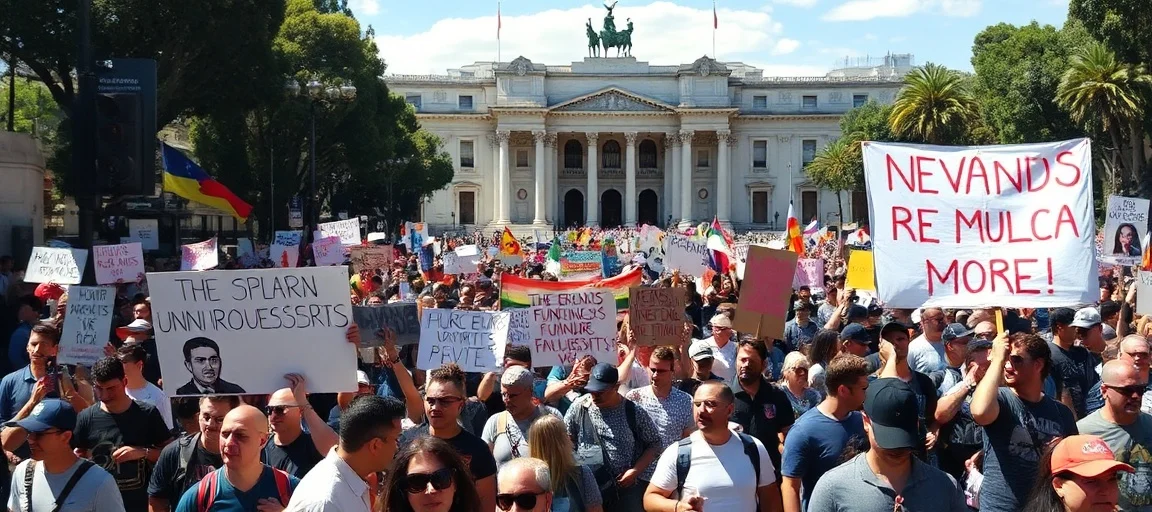
Tens of thousands of Argentines are flooding the streets across the nation in fervent protest against President Javier Milei's dramatic university funding cuts amid a sweeping government austerity drive. This widespread mobilization highlights a deep national concern over the future of public education, a cherished institution that has long been a bedrock of social mobility and intellectual pride in Argentina. The demonstrations, particularly prominent in major cities like Buenos Aires, underscore the significant public resistance to the current administration's economic policies and their profound impact on essential services.
- Mass Mobilization Across Argentina
- The Core of the Conflict: Milei's University Funding Cuts and Legislative Standoff
- Government's Stance and Ideological Underpinnings
- A Cornerstone of National Pride: The History of Public Education
- Far-Reaching Impact and Future Concerns
- Economic Context of Milei's Austerity
- Conclusion: A Nation's Fight for its Future
- Frequently Asked Questions
- Further Reading & Resources
Mass Mobilization Across Argentina
The recent "Federal University March" saw an unprecedented turnout, with organizers estimating over 1.5 million people demonstrating nationwide, including approximately 600,000 in the capital, Buenos Aires alone. These vast crowds, comprising students, professors, administrative staff, union members, and a broad spectrum of citizens, converged on critical public spaces such as the Plaza de Mayo, in front of the Casa Rosada, the presidential palace. Protesters carried banners with powerful slogans like "Without public universities, there is no future" and "Education is not a privilege, it's a right," reflecting the profound sentiment that these institutions are vital to the country's social and intellectual fabric.
The demonstrations are not isolated incidents but rather the culmination of sustained opposition to the government's fiscal policies. Multiple large-scale protests have occurred since Milei took office in December 2023, marking this latest mobilization as the fourth significant federal university march. These gatherings highlight a growing dissatisfaction with the economic "shock therapy" implemented by President Milei, which prioritizes drastic spending cuts to achieve a zero fiscal deficit.
The Core of the Conflict: Milei's University Funding Cuts and Legislative Standoff
At the heart of the widespread discontent are the significant budget reductions imposed on public universities. Since President Milei assumed office in late 2023, budget allocations to national universities have seen a cumulative decline of 45.6%, according to the National Inter-University Council (CIN). This translates to a dramatic decrease in the real value of funding, with higher education spending plummeting from 0.72% of the Gross Domestic Product (GDP) in 2023 to approximately 0.47% currently—the lowest level in two decades.
This financial squeeze has had immediate and severe consequences. University professors' salaries have declined by an estimated 33% to 40% after accounting for Argentina's persistent high inflation. This significant loss in purchasing power has prompted an alarming exodus of academic talent, with reports indicating that at least 580 research professors in engineering and science departments have left the prestigious University of Buenos Aires (UBA) for better-paying opportunities in the private sector or abroad. Nationwide, the CIN estimates approximately 10,000 resignations from academic staff due to plummeting salaries.
The government's actions have also stalled the implementation of a critical university funding law. Congress passed legislation last year to fund universities' operational costs and raise teacher salaries in line with inflation. However, President Milei vetoed this bill, citing his unwavering commitment to fiscal balance and arguing that the law failed to specify how the state would fund these mandatory increases without jeopardizing the zero-deficit policy. Despite lawmakers overriding his veto, the administration has effectively stalled the law's implementation through executive decrees and has appealed the matter to the Supreme Court. This legal and political standoff has left public universities in a precarious financial state.
Specific cuts go beyond salaries and operational costs. The Milei administration has also slashed projects including 3.8 million) for university building maintenance and 1.4 million) in science scholarships, part of over 79 million) in cuts to education, science, technology, and direct transfers. This has led to deteriorating facilities and universities resorting to rationing electricity and other essential services to stretch their dwindling funds.
Government's Stance and Ideological Underpinnings
President Javier Milei's administration has steadfastly defended its austerity measures, framing them as a necessary "shock therapy" to stabilize Argentina's long-ailing economy, characterized by chronic inflation and fiscal deficits. Milei's Undersecretary for University Policies, Alejandro Álvarez, has dismissed the large-scale protests as "completely political" and insisted that the government has compensated universities for higher operating costs, though unions have widely rejected these increases as insufficient.
A key aspect of Milei's rhetoric against public universities involves labeling them as "bastions of 'woke' indoctrination." This ideological stance aligns with his broader political platform, which seeks a radical departure from what he describes as decades of reckless spending and corruption by previous left-leaning governments. He has asserted that public universities are "not free" because taxpayers ultimately foot the bill, challenging the widely accepted notion of tuition-free higher education.
The government's argument for not implementing the congressionally approved funding law centers on the principle of fiscal austerity. They claim the law "fails to specify how the state will supply the mandatory funding increases in a time of harsh fiscal austerity." This aligns with Milei's non-negotiable commitment to achieving a fiscal surplus, with a target of 1.6% for 2025. For more on the economic strategies, see our article on Milei's Economic Policies in Argentina.
However, critics, including academic authorities, faculty, and students, argue that the government is "failing to comply with the basic democratic and constitutional rule: to uphold the university funding law." They highlight that Congress, after overruling Milei's veto, legitimately enacted the bill into law, and the government's continued stalling through executive decrees and Supreme Court appeals is a defiance of democratic process.
A Cornerstone of National Pride: The History of Public Education
Public universities in Argentina hold a unique and deeply ingrained place in the national identity. They have been tuition-free since 1949, a policy that transformed higher education into a powerful engine for social mobility and opportunity for millions, regardless of their socioeconomic background. This commitment to free and accessible education has produced a highly educated workforce and is a source of immense national pride, evidenced by Argentina's five Nobel Prize laureates who received their education through this system.
The tradition of university autonomy and accessibility dates back even further to the 1918 University Reform in Córdoba. This landmark movement democratized universities, establishing co-government by teachers and students, promoting academic freedom, and ensuring broad access to higher education. To learn more about this pivotal moment, read our piece on The History of Argentina's University Reform. These historical roots underscore why the current funding cuts are perceived not merely as budgetary adjustments, but as an attack on a fundamental human right and a core pillar of Argentine society.
The public university system is seen as an "earned asset for society" and an "acquired right," playing a crucial role in enabling upward social movement for countless families. As one law student, Sol Muñíz, 24, remarked, "University is a source of pride for us. It is the best thing we have." This sentiment resonates widely, uniting diverse segments of the population in defense of these institutions.
Far-Reaching Impact and Future Concerns
The drastic cuts by the Milei administration pose severe threats to the operational viability and academic quality of Argentina's public universities. Universities have reported an 80% real reduction in their budgets, adjusted for inflation, leading to desperate measures such as turning off classroom lights to save electricity. The rector of UBA, Ricardo Gelpi, warned that "undermining education and science is mortgaging the future," highlighting the long-term consequences of underfunding.
The "brain drain" is a pressing concern, as highly qualified academics are compelled to seek employment elsewhere, potentially depleting the country's intellectual capital. The exodus of professors leaves critical teaching and research positions vacant, impacting strategic sectors like energy, technology, and mining. Students also face immense pressure, with some expressing concerns about affording private studies if public universities become untenable.
Beyond the immediate operational challenges, the cuts risk eroding Argentina's scientific and research capabilities. Public expenditures in research and development already amounted to barely 0.3% of GNP before these latest cuts. Further restrictions on science scholarships and research funding could stifle innovation and hinder the country's progress in crucial areas.
The ongoing legal battle, with the government appealing to the Supreme Court to suspend the funding law's implementation, means the future of university funding remains uncertain. This protracted conflict creates an environment of instability for students, faculty, and researchers, making long-term planning incredibly difficult.
Economic Context of Milei's Austerity
President Milei's "chainsaw" austerity plan, implemented since he took office in December 2023, is a comprehensive economic strategy aimed at achieving a zero fiscal deficit, curbing hyperinflation, and reducing the size of the state. This approach has involved significant reductions in public sector employment, wages, pensions, and government expenditures across various sectors. For instance, public sector wages declined by 14.5% in the first year of his tenure.
While the government points to a significant slowdown in monthly inflation rates, which have fallen from 25.5% in December 2023 to 1.5% in June 2025, the social cost of these policies has been substantial. Real wages and purchasing power have sharply declined for many Argentines, with an estimated 5.5 million more people pushed into poverty in the first half-year of Milei's presidency. The erosion of real incomes, particularly among public employees and retirees, has caused significant hardship. For a broader understanding of these economic concepts, consider reading our article on Understanding Inflation and Austerity Measures.
The International Monetary Fund (IMF) has supported Milei's neoliberal economic policies, celebrating the budget surplus achieved. However, the International Trade Union Confederation (ITUC) has strongly criticized this stance, arguing that "fiscal austerity is not the answer when people's lives and their democratic rights are at stake," and highlighting the "human cost of this economic shock therapy."
Milei's government has also sought to reduce government subsidies for gas and electricity, leading to increased living costs for many. Despite these hardships, Milei has maintained a degree of popular support, particularly among those who believe his policies are necessary for long-term economic stability and a break from past corruption. His administration has challenged Congress to reallocate other budget spending to finance university demands if it wishes to increase funding, stating, "As long as they respect the zero deficit, I don't care."
Conclusion: A Nation's Fight for its Future
The widespread Argentines Protest Milei's University Funding Cuts signifies more than just a disagreement over budget numbers; it represents a profound national debate about the value of public education and the future direction of the country. For many, tuition-free universities are not merely educational institutions but symbols of equality, opportunity, and national identity. The government's austerity measures, while aimed at economic stabilization, are perceived by a significant portion of the population as threatening this cherished legacy and risking a "brain drain" that could have long-term detrimental effects on Argentina's development.
As the legal and political standoff continues, with the case potentially heading to the Supreme Court, the sustained public outcry demonstrates the deep commitment of Argentines to defending their public university system. The outcome of this struggle will undoubtedly shape not only the landscape of higher education but also the broader social and economic fabric of Argentina for years to come. The message from the streets is clear: an educated population is an indispensable foundation for any nation's progress and prosperity.
Frequently Asked Questions
Q: Why are Argentines protesting President Milei's university funding cuts?
A: Argentines are protesting President Javier Milei's drastic funding cuts to public universities, which they view as essential for social mobility, equality, and national identity. These cuts are part of a broader government austerity plan aimed at stabilizing the country's economy and achieving a zero fiscal deficit.
Q: What are the immediate impacts of these funding cuts on public universities?
A: The cuts have led to significant budget reductions, a substantial decline in faculty salaries prompting a "brain drain" of academics, and deteriorating university facilities. Universities are resorting to extreme measures like rationing electricity, threatening the quality and accessibility of historically tuition-free education.
Q: What is the Milei administration's justification for implementing these cuts?
A: The Milei administration defends the cuts as necessary "shock therapy" to combat hyperinflation and achieve fiscal balance in Argentina. They also hold an ideological stance, labeling public universities as "bastions of 'woke' indoctrination" and arguing that taxpayers ultimately bear the cost, making them not truly "free."