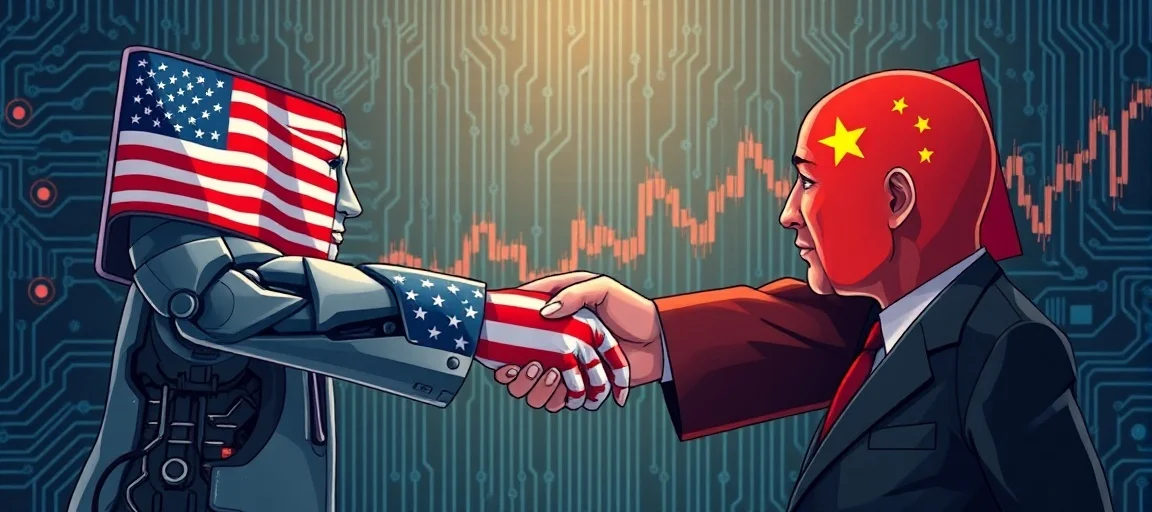
US AI Innovations Lead Global Tech Advancements

As US AI innovations lead global tech advancements into a new era, the rapid evolution of artificial intelligence has redefined the international competitive landscape. The field has been rapidly evolving, with the US AI sector at the forefront of these global transformations. Recent breakthroughs in machine learning, natural language processing, and computer vision have transformed industries and revolutionized the way we live and work. The US market, valued at 1.35 trillion by 2030, growing at a compound annual growth rate (CAGR) of 38.1%, signaling a profound shift in economic and social structures.
The Strategic Dominance of US AI in the 21st Century
The United States has long been a hub for research and development, with top universities and tech companies driving the next generation of digital intelligence. Silicon Valley, in particular, has emerged as a hotbed for startups, with many successful companies, such as Google, Meta, and Apple, headquartered there. However, the modern landscape is no longer confined to northern California. Regional hubs in Austin, Seattle, and Boston are contributing significantly to the national output, creating a distributed ecosystem of talent and capital.
The US government has also taken critical steps to support the growth of the industry. This includes the implementation of the CHIPS and Science Act, which aims to secure the domestic supply chain for the semiconductors required to train large-scale models. By investing in research, providing funding for early-stage startups, and establishing research centers like the National AI Research Resource (NAIRR), the federal government is ensuring that the nation remains the primary architect of the world’s digital future.
Key Statistics and Market Indicators
-
The domestic market is expected to create over 100,000 new highly skilled jobs by the end of 2025, specifically in prompt engineering and model architecture.
-
The global market for these technologies is projected to reach nearly $200 billion by late 2025, with American firms capturing the majority of that value.
-
The domestic sector has received unprecedented levels of private investment, with over $10 billion in venture capital funding allocated specifically to generative startups in 2022 alone.
Pivotal US AI Innovations and Breakthroughs
The American sector has seen significant breakthroughs in recent years, moving beyond simple automation into the realm of creative and generative intelligence. These innovations are not just theoretical; they are integrated into the daily workflows of millions of people.
1. Generative Pre-trained Transformers (GPT):
OpenAI’s release of the GPT series changed the world’s perception of what machines can do. By utilizing the Transformer architecture—originally a Google invention—OpenAI managed to create models that can reason, code, and converse with human-like fluidity.
2. Google's AlphaFold:
This is perhaps one of the most important scientific applications of intelligence in history. By solving the protein-folding problem, AlphaFold has provided a map for the building blocks of life, accelerating drug discovery and biological research by decades.
3. Advanced Computer Vision:
Companies like Tesla and Waymo are utilizing sophisticated vision systems to power autonomous vehicles. These systems process petabytes of visual data in real-time, allowing machines to navigate complex urban environments with increasing safety and precision.
Machine Learning and Deep Learning Advancements
Machine learning has been the engine of growth within the US AI ecosystem. We have moved from simple linear regressions to complex deep learning models that mimic the neural pathways of the human brain.
Deep Learning and Neural Networks:
This involves multiple layers of processing that allow a machine to recognize patterns in unstructured data, such as images, audio, and video. The refinement of these architectures has led to near-human accuracy in translation and image synthesis.
Reinforcement Learning from Human Feedback (RLHF):
A type of machine learning that uses human preferences to fine-tune model behavior. This has been instrumental in making chatbots more helpful and less prone to generating harmful or irrelevant content.
Expert Opinion and Industry Outlook
According to Dr. Andrew Ng, a renowned expert and founder of Coursera, the current trajectory is unmistakable. "The US AI sector is driving global tech advancements, with many innovations in areas such as machine learning, natural language processing, and computer vision. The government and private sector investments in research and development are critical to maintaining the country's leadership."
This sentiment is echoed by industry leaders at Microsoft and NVIDIA, who argue that we are currently in the "iPhone moment" of artificial intelligence. The hardware bottleneck—once a significant concern—is being addressed by rapid cycles of GPU innovation, allowing for the training of even larger and more capable models.
Socio-Economic Impact and the Workforce
The impact of these innovations on society and the economy has been profound. While there are valid concerns regarding job displacement, the current trend suggests a shift toward "augmented" work rather than total replacement.
Improved Productivity and Efficiency:
Automation has improved productivity in many industries, particularly in software development and data analysis. Tools that can write boilerplate code or summarize thousands of documents in seconds are freeing up workers to focus on high-level strategy and creative problem-solving.
Enhanced Healthcare Outcomes:
From diagnostic imaging to personalized treatment plans, the integration of intelligent systems is saving lives. By identifying patterns in medical data that are invisible to the human eye, these tools act as a force multiplier for doctors and researchers.
Future Implications and Emerging Trends
The future implications of these advancements are vast, stretching into every corner of human existence. As the technology matures, we expect to see even more specialized applications.
Personalized Medicine at Scale:
Future models will analyze an individual's entire genetic profile alongside real-time biometric data to predict and prevent diseases before they manifest.
The Rise of Autonomous Systems:
Beyond just cars, we will see the rise of autonomous logistics, where drones and robotic warehouses coordinate with minimal human intervention to optimize global supply chains.
Challenges and Ethical Considerations
Despite the optimism, the path forward is not without hurdles. The concentration of power within a few massive tech companies has raised concerns regarding competition and the democratization of technology. Furthermore, the ethical implications of bias in training data cannot be ignored. If the data used to train a model contains historical prejudices, the model is likely to replicate or even amplify those biases in its output.
Energy consumption is another growing concern. The massive data centers required to run these models consume vast amounts of electricity, prompting a push for "Green AI" initiatives. American companies are now investing heavily in renewable energy sources to power their computational infrastructure, aiming for carbon neutrality by the end of the decade.
Conclusion
In conclusion, the US AI sector continues to be the primary engine of the global digital revolution. Through a combination of academic excellence, massive private capital, and supportive government policy, the nation has maintained a competitive edge that is shaping the future of medicine, transportation, and communication. As the technology continues to evolve, the focus must remain on developing these tools responsibly, ensuring that the benefits of innovation are shared broadly across society.
Frequently Asked Questions
Q: Why is the US considered a leader in artificial intelligence?
A: The US leads due to its unique combination of massive venture capital, world-class research universities like Stanford and MIT, and the presence of tech giants that provide the necessary cloud infrastructure and data.
Q: How will US AI affect the future of the workforce?
A: While some repetitive tasks will be automated, the technology is largely expected to augment human capabilities, creating new roles in AI management, ethical oversight, and complex system design.
Q: What are the main ethical concerns surrounding these new technologies?
A: Major concerns include algorithmic bias, data privacy, the potential for misinformation through deepfakes, and the environmental impact of the high energy consumption required for large-scale computing.