Delhi Building Collapse Claims Seven Lives in Satya Niketan Tragedy
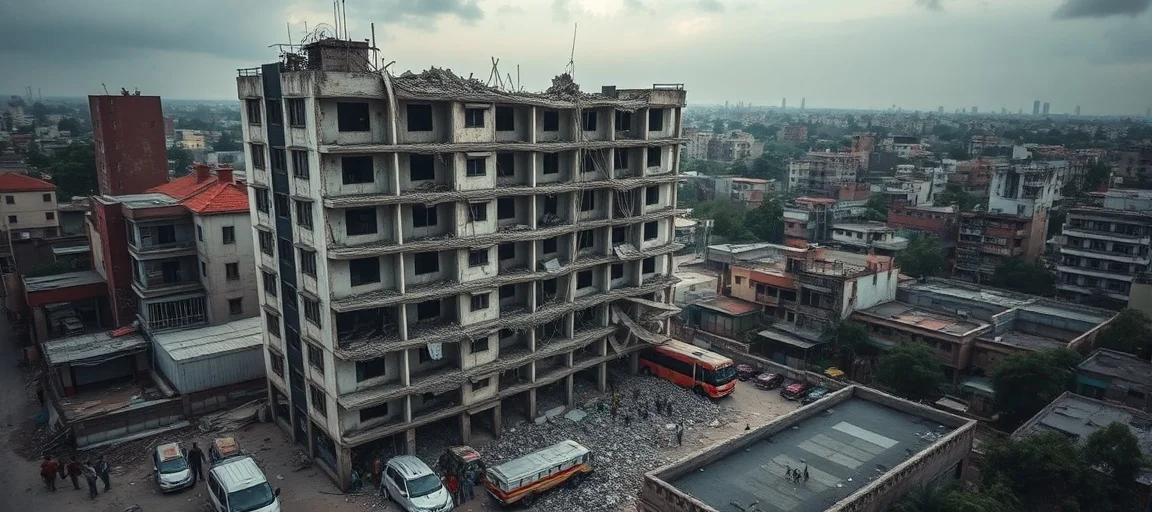
The city of Delhi mourns a profound loss as a devastating building collapse claims seven lives in the densely populated Satya Niketan area this past Sunday, marking a tragic incident that has ignited urgent concerns over urban safety and infrastructure integrity. This catastrophic event, which tragically claimed seven lives and injured several others, occurred when a five-storey structure, primarily serving as a paying guest (PG) accommodation for students, crumbled suddenly. It triggered a massive 27-hour rescue operation that concluded on Monday evening, once again casting a harsh spotlight on the precarious state of urban infrastructure and the urgent need for stricter building safety enforcement across the capital.
- The Satya Niketan Tragedy: A Timeline of Events
- Delhi Building Collapse Claims Seven Lives: Unveiling the Human Cost
- Unpacking the Causes: Age, Renovation, and Alleged Violations
- Official Response and Accountability Measures
- Broader Implications for Urban Safety in Delhi
- Conclusion
- Frequently Asked Questions
- Further Reading & Resources
The Satya Niketan Tragedy: A Timeline of Events
The fateful incident unfolded on Sunday, September 6, 2026, in Satya Niketan, a vibrant neighbourhood near Delhi University's South Campus, well-known for its private student accommodations. The building, identified as a boys' hostel, collapsed around 1:30 PM, trapping numerous occupants and labourers beneath a mountain of rubble. Eyewitnesses reported a sudden and complete collapse, leaving little time for those inside to react or escape.
Initial Response and Rescue Efforts
Immediately following the collapse, a multi-agency rescue operation was launched. Teams from the National Disaster Response Force (NDRF), Delhi Police, Delhi Fire Service, and the Delhi Disaster Management Authority (DDMA) rapidly converged on the site. Their coordinated efforts involved the deployment of specialized Collapsed Structure Search and Rescue (CSSR) equipment, medical first responder (MFR) units, and canine squads to locate and extract survivors from the unstable debris.
The initial hours were critical, with rescuers working tirelessly to pull people from the wreckage. At least 12 individuals were successfully rescued from under the rubble. Of these, five to six sustained injuries and were promptly shifted to the AIIMS Trauma Centre for urgent medical attention, with some reported to be in critical condition. The challenging conditions, including the sheer volume of debris and the instability of adjacent structures, prolonged the operation, which continued through the night into Monday.
Delhi Building Collapse Claims Seven Lives: Unveiling the Human Cost
As rescue efforts intensified, the grim reality of the disaster began to emerge. Over the course of the operation, more bodies were recovered, eventually leading to the confirmation that the Delhi building collapse claims seven lives. The deceased were identified through the post-mortem examinations conducted at AIIMS. This tragic loss has deeply affected the community, particularly the student population and the families who relied on the paying guest accommodation.
The victims included students and possibly labourers who were reportedly engaged in repair work on the premises at the time of the collapse. University of Delhi Vice-Chancellor Prof. Yogesh Singh expressed profound grief over the loss of DU students in the accident, calling the incident "shocking for everyone" and a "huge loss for Delhi University". A meeting of principals was convened, where a two-minute silence was observed to condole the students who died.
Voices of Grief and Concern
The collapse has left a trail of grief and a pervasive sense of anxiety among residents and parents of students living in similar accommodations. Many express concerns about the safety standards of older buildings and the proliferation of unregulated paying guest facilities in congested areas. The incident highlights the vulnerability of such informal housing sectors, which often operate outside strict regulatory oversight, putting the lives of their occupants at significant risk.
The community's trust in building safety and regulatory enforcement has been severely shaken. Families are grappling not only with the immediate loss but also with the unsettling questions about accountability and prevention. The tragedy underscores the human cost of negligence and the critical need for a more robust system to safeguard public safety in rapidly expanding urban centres.
Unpacking the Causes: Age, Renovation, and Alleged Violations
Preliminary investigations into the Satya Niketan building collapse suggest a confluence of factors contributed to the catastrophe. The building, reportedly 50 to 55 years old, was undergoing significant repair and renovation work at the time of its collapse. Residents reported that the structure had been under renovation for months before reopening to tenants in August, even with work remaining unfinished.
One of the key preliminary findings points to ongoing digging work in the basement, coupled with water accumulation, as potential triggers for the collapse. Experts often highlight that such activities, especially in old structures, can severely compromise the foundational integrity if not conducted with proper engineering assessments and precautions. Former Delhi Fire Services director Atul Garg noted that heavy rain and construction activity are common factors in old building collapses, both of which were present in this case.
Allegations of Unauthorised Construction and Negligence
Beyond the immediate triggers, deeper systemic issues are being scrutinized. Reports indicate that the collapsed structure was a G+4 (ground plus four floors) building, but permission for the property was allegedly only for a G+1 unit. This suggests potential unauthorised construction and the addition of extra floors over the years without adequate structural assessment, a common problem in many older, densely packed localities in Delhi. MCD officials are examining whether the building's structural capacity was reassessed after modifications, given that a building originally sanctioned for fewer floors is not structurally designed to support additional levels.
Delhi Mayor Pravesh Wahi also flagged possible negligence and the use of construction materials that may not have been of the required quality. Such allegations raise serious questions about the enforcement regime of the city's civic bodies and the oversight mechanisms intended to prevent such egregious violations.
Official Response and Accountability Measures
In the wake of the tragedy, authorities have initiated swift action and investigations. The owner of the collapsed building, Hariram Bansal (also referred to as Hariram Gupta in some reports), along with his wife Urmila and son Mahesh, have been arrested by the police. A case has been registered against them, and a magisterial inquiry has been ordered to ascertain the circumstances leading to the collapse.
Further underscoring accountability, the Municipal Corporation of Delhi (MCD) suspended five officials from its South Zone with immediate effect. These officials include Deputy Commissioner Rakesh Kumar, Superintending Engineer Ranvir Singh, Executive Engineer (Building) Lalit Kumar, Assistant Engineer (Building) Sunil Chauhan, and Junior Engineer (Building) Ashish Kumar. Delhi Chief Minister Rekha Gupta has ordered the immediate sealing of illegal multi-storey buildings across the city and announced that the government will draft a new policy requiring periodic structural audits and safety certificates for buildings used by the public, including student accommodations, nursing homes, and schools. "No public activity will be permitted" in buildings that fail to comply, Gupta stated.
Judicial Scrutiny and Calls for Reform
The Delhi High Court also took cognizance of the incident, terming the Satya Niketan building collapse "most unfortunate." The court questioned not only the responsibility of the building owners but also that of the Municipal Corporation of Delhi (MCD) and Delhi University (DU), stating that they had failed to provide adequate accommodation for outstation students who rely on private paying guest facilities. This highlights a broader systemic failure and the need for comprehensive urban planning to address the housing needs of a growing student population responsibly.
The High Court's observations emphasize the need for a multi-pronged approach that includes stricter building codes, rigorous enforcement, regular inspections, and transparent accountability mechanisms to prevent such tragedies from recurring.
Broader Implications for Urban Safety in Delhi
The Satya Niketan building collapse serves as a stark reminder of the persistent challenges in ensuring urban safety, particularly in a city as rapidly developing and densely populated as Delhi. Building collapses are a recurring hazard in parts of India, especially during the monsoon season (June to September), when heavy or prolonged rain can weaken older structures. However, the underlying issues often extend beyond natural factors to include rampant unauthorised construction, structural alterations without proper permits, and a lack of stringent oversight. The rapid pace of urbanization, coupled with informal housing markets, creates complex environments where safety standards are often compromised for economic gain.
Recent amendments to fire safety rules by the Delhi government, notified on August 28, 2026, aimed to introduce a comprehensive framework of enhanced prevention and safety standards for all buildings. These revised regulations link fire safety standards to the updated Unified Building Bye-Laws (UBBL) and mandate stricter compliance for both new and existing structures. Key measures include minimum access for fire engines, protected exits, automatic fire detection and suppression systems, and emergency power for life-safety systems. While these are crucial steps, the Satya Niketan incident underlines the critical importance of effective implementation and a zero-tolerance approach to violations that directly endanger public safety. The challenge lies in overcoming bureaucratic hurdles, corruption, and the sheer scale of monitoring required in a megalopolis like Delhi.
Towards a Safer Future: Policy and Enforcement
Moving forward, the focus must be on transforming policy into practice. This involves:
- Strict Enforcement of Building Codes: Ensuring that all construction, renovation, and structural alterations adhere to the latest building codes and safety standards.
- Regular Structural Audits: Mandating periodic structural audits and safety certifications for all public and commercial buildings, especially older ones and student accommodations.
- Combating Illegal Construction: Intensifying efforts to identify, seal, and demolish unauthorised constructions and those that violate building bye-laws.
- Strengthening Regulatory Bodies: Empowering and making civic bodies like the MCD more accountable, providing them with the necessary resources and personnel to conduct thorough inspections and take decisive action against non-compliant structures.
- Public Awareness and Reporting: Educating the public on building safety standards and establishing easy, accessible channels for reporting suspicious or illegal construction activities.
- Addressing Housing Deficiencies: The Delhi High Court's observation about the lack of adequate student accommodation by DU suggests a need for a broader housing strategy that reduces reliance on unregulated private facilities.
The path to preventing future tragedies requires a concerted effort from government agencies, building owners, residents, and the judiciary. The Satya Niketan tragedy must serve as a catalyst for a sweeping overhaul of building safety and urban planning policies in Delhi.
Conclusion
The recent Satya Niketan building collapse, a devastating event where the Delhi building collapse claims seven lives, stands as a painful reminder of the critical need for robust urban safety measures. The loss of life, particularly among young students, underscores the devastating consequences of negligence, illegal construction, and inadequate regulatory oversight. While rescue operations have concluded, the investigation into the precise causes and accountability is just beginning. It is imperative that this tragedy leads to not just punitive action, but also systemic reforms that prioritise human lives over illicit gains. Delhi's future urban development must be built on the unshakeable foundations of safety, transparency, and strict adherence to laws, ensuring that no family has to endure such a heartbreaking loss again.
Frequently Asked Questions
Q: What caused the Delhi building collapse in Satya Niketan?
A: Preliminary investigations suggest a combination of factors, including the building's age (50-55 years), ongoing repair and renovation work, basement digging, and water accumulation. Allegations of unauthorized construction and adding floors without permits are also being investigated.
Q: How many lives were lost in the Satya Niketan tragedy?
A: The Delhi building collapse in Satya Niketan tragically claimed seven lives. Several others were injured, with some requiring critical medical attention.
Q: What actions are authorities taking regarding the collapse?
A: The building owners have been arrested, and a magisterial inquiry is underway. The Municipal Corporation of Delhi (MCD) suspended five officials, and the Delhi Chief Minister has ordered the sealing of illegal multi-storey buildings and a new policy for structural audits.