China Auto Show Reveals Future of 'Physical AI' Cars
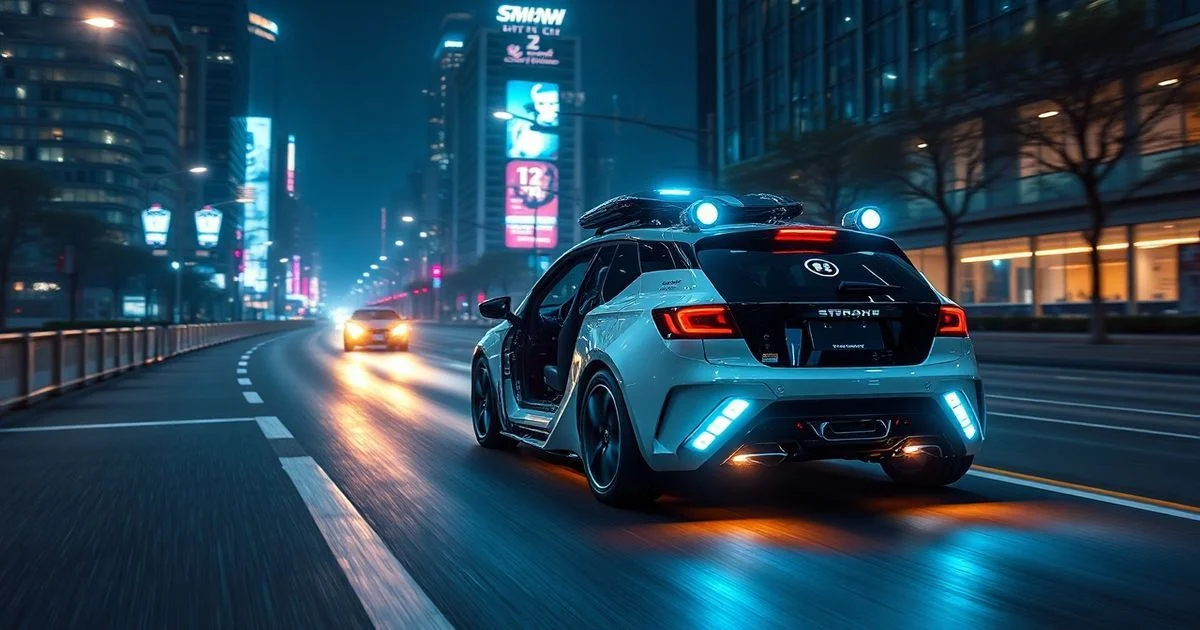
The recent China Auto Show has once again cemented its reputation as a global stage for automotive innovation, but this year, it unveiled something truly revolutionary: the future of 'Physical AI' cars. Far beyond traditional autonomous driving systems, these vehicles are designed to interact with their environment, adapt to complex scenarios, and even express a form of intelligent awareness through their physical capabilities. This marks a profound shift in how we conceive of automotive intelligence, moving from purely digital processing to an integrated system that understands and manipulates the physical world around it with unprecedented dexterity and responsiveness.
- The Dawn of Physical AI: A New Automotive Paradigm
- Key Innovations and Technologies Showcased
- Leading the Charge: Manufacturers and Concepts
- The Implications for Driving and Ownership
- The Global Race: China's Role in Automotive AI
- The Future is Now: China Auto Show Reveals Future of 'Physical AI' Cars
- Conclusion
- Frequently Asked Questions
- Further Reading & Resources
The Dawn of Physical AI: A New Automotive Paradigm
The concept of "Physical AI" in the automotive sector represents a significant evolution from the AI systems commonly found in today's smart cars. While current AI primarily focuses on perception (interpreting sensor data), planning (charting routes), and control (executing driving commands), Physical AI extends these capabilities into the very fabric and mechanics of the vehicle itself. It envisions cars not just as intelligent machines, but as cyber-physical entities capable of dynamic, adaptive, and proactive interaction with their surroundings. This means integrating AI directly into the car's actuators, suspension, steering, and even its exterior surfaces, allowing for real-time physical adjustments that optimize performance, safety, and passenger comfort in ways previously unimaginable.
This paradigm shift was a central theme at the China Auto Show, where manufacturers presented concept vehicles and prototypes demonstrating how this deep integration could revolutionize everything from emergency braking to personalized ride experiences. The emphasis was not merely on what the car could do, but how it physically manifested its intelligence.
Key Innovations and Technologies Showcased
The exhibits at the show highlighted several foundational technologies crucial to the realization of Physical AI. These innovations are converging to create vehicles that are more than just smart; they are intuitively responsive.
Advanced Robotics and Actuators
A cornerstone of Physical AI cars is the deployment of advanced robotics and sophisticated actuators. These are not just motors and gears but highly precise, intelligent electromechanical systems that can make instantaneous, nuanced adjustments. For instance, new suspension systems were showcased that don't just react to road conditions but actively predict and counteract disturbances, creating an impossibly smooth ride even on rough terrain. This predictive capability is powered by on-board AI that analyzes real-time sensor data and vehicle dynamics, enabling the car to "feel" and "respond" in a remarkably human-like manner.
Real-time Sensor Fusion and Perception
Physical AI demands an incredibly robust and detailed understanding of the vehicle's environment. The China Auto Show featured groundbreaking advancements in sensor fusion, combining data from LiDAR, radar, cameras, ultrasonic sensors, and even thermal imaging in novel ways. The AI processing these vast data streams can construct a 3D model of the surroundings with unparalleled accuracy and predictive power. This enhanced perception allows the vehicle to anticipate actions of other road users, identify potential hazards well in advance, and make micro-adjustments to its physical state – such as pre-tensioning seatbelts or preparing braking systems – before an incident even fully develops.
Adaptive Human-Machine Interfaces
The interaction between the driver (or passenger) and a Physical AI car is also undergoing a radical transformation. Beyond voice commands and touchscreens, new adaptive Human-Machine Interfaces (HMIs) presented at the show showcased how the car can physically adapt to the occupants' needs and preferences. This includes seats that dynamically adjust support based on posture and driving conditions, ambient lighting that responds to driver alertness, and even climate control that anticipates thermal comfort needs based on biometric data. The car essentially becomes an extension of the user, physically conforming to optimize their experience.
Intelligent Chassis and Dynamics Control
Perhaps one of the most exciting aspects of Physical AI is its application to intelligent chassis and dynamics control. Engineers are leveraging AI to completely reimagine how a car handles. Systems were demonstrated that could dynamically alter wheelbase, ride height, and even individual wheel torque distribution in real-time to optimize grip, stability, and agility across diverse driving scenarios. Imagine a vehicle that can "morph" its physical characteristics to excel equally on a winding mountain road or a congested city street. This level of physical adaptation, driven by sophisticated AI algorithms, represents a monumental leap in vehicle engineering.
Leading the Charge: Manufacturers and Concepts
While specific commercial models are still emerging, the China Auto Show provided a clear indication of the direction major automakers and emerging tech companies are taking. Several domestic and international brands presented their vision for Physical AI, often highlighting modular platforms designed to integrate these advanced capabilities.
Companies are investing heavily in research and development to build proprietary AI chips and software architectures tailored for real-time physical control. The focus is on creating a seamless blend of hardware and software, where the vehicle's physical components are no longer passive but active participants in the intelligent driving experience. This collaborative approach between traditional auto manufacturers and AI specialists is accelerating the development cycle, bringing these futuristic concepts closer to reality.
The Implications for Driving and Ownership
The advent of Physical AI cars promises to reshape our relationship with automobiles in profound ways. The implications span across safety, comfort, efficiency, and even the very notion of driving itself.
Enhanced Safety
By enabling vehicles to react physically and intelligently to unforeseen events with unmatched speed and precision, Physical AI has the potential to drastically reduce accidents. The ability to dynamically adjust braking, steering, and suspension can prevent collisions or mitigate their severity in situations where human reflexes simply aren't fast enough.
Unparalleled Comfort
Imagine a car that irons out every bump, anticipates every turn, and maintains perfect equilibrium regardless of external forces. Physical AI can create a supremely smooth and serene ride, transforming long journeys into genuinely relaxing experiences. This extends to interior comfort, with adaptive systems constantly optimizing the cabin environment for each occupant.
Optimized Efficiency
Intelligent physical control also offers significant efficiency gains. By dynamically adjusting aerodynamics, suspension, and powertrain characteristics based on real-time conditions, Physical AI cars can minimize energy consumption, whether they are electric, hybrid, or even traditional internal combustion engines. This contributes to longer ranges for EVs and reduced fuel costs for other powertrains.
Redefined Driving Experience
For those who still enjoy driving, Physical AI promises a more engaging and responsive experience. The car can adapt its dynamics to match the driver's mood and skill level, offering a more exhilarating ride when desired, or a more relaxed one during commutes. Conversely, for those who prefer to be chauffeured, these vehicles offer an unprecedented level of autonomous comfort and reliability.
However, the proliferation of Physical AI cars also raises important considerations. Questions around data privacy, the regulatory frameworks for such highly adaptive systems, and the ethical responsibilities of vehicles that can "make decisions" on a physical level will need careful deliberation and robust solutions as these technologies become mainstream.
The Global Race: China's Role in Automotive AI
China has long been a significant player in the global automotive market, and its strategic investments in artificial intelligence and electric vehicle technology are positioning it as a frontrunner in the Physical AI revolution. The government's strong support for innovation, coupled with a vast domestic market eager for advanced technology, creates a fertile ground for rapid development and deployment.
The China Auto Show serves as a testament to this commitment, consistently showcasing cutting-edge advancements that often set the pace for the rest of the world. Chinese companies are not merely adopting existing AI technologies but are actively innovating and pushing the boundaries of what's possible, particularly in the integration of AI with physical systems. This competitive landscape is driving rapid progress, with profound implications for the future of transportation worldwide.
The Future is Now: China Auto Show Reveals Future of 'Physical AI' Cars
The revelations at the China Auto Show underscore a critical shift in the automotive industry. We are moving beyond the era of merely "smart" cars to vehicles that are genuinely "intelligent" in their physical manifestations. The emphasis on Physical AI demonstrates a holistic approach to vehicle design, where software and hardware are inextricably linked to create a seamless, responsive, and highly adaptive driving machine. This transition is not incremental; it represents a fundamental re-imagining of what a car can be and how it interacts with the world.
Conclusion
The recent China Auto Show has decisively pointed towards a future where automobiles are not just modes of transport but highly intelligent, physically adaptive companions. The emergence of 'Physical AI' cars promises to usher in an era of unprecedented safety, comfort, and efficiency, fundamentally altering our daily commutes and long-distance travel. While challenges related to regulation, ethics, and widespread adoption remain, the technological breakthroughs showcased confirm that the vision of cars that can truly "think" and "act" in the physical world is rapidly becoming a reality. The China Auto Show Reveals Future of 'Physical AI' Cars, marking a pivotal moment in the evolution of automotive technology and setting a new benchmark for global innovation.
Frequently Asked Questions
Q: What is 'Physical AI' in cars?
A: 'Physical AI' goes beyond traditional autonomous driving by integrating AI directly into a car's physical components like suspension, steering, and actuators. This enables the vehicle to interact with and adapt to its environment in real-time, optimizing performance, safety, and comfort.
Q: How does Physical AI improve car safety?
A: By reacting physically and intelligently with unmatched speed and precision, Physical AI cars can dynamically adjust braking, steering, and suspension to prevent collisions or significantly reduce their severity. This capability often surpasses human reaction times in critical situations.
Q: What role does the China Auto Show play in Physical AI development?
A: The China Auto Show has become a pivotal global platform for showcasing cutting-edge automotive AI innovations. Its exhibitions demonstrate China's significant investment and leadership in integrating AI with physical systems, influencing the future direction of transportation worldwide.