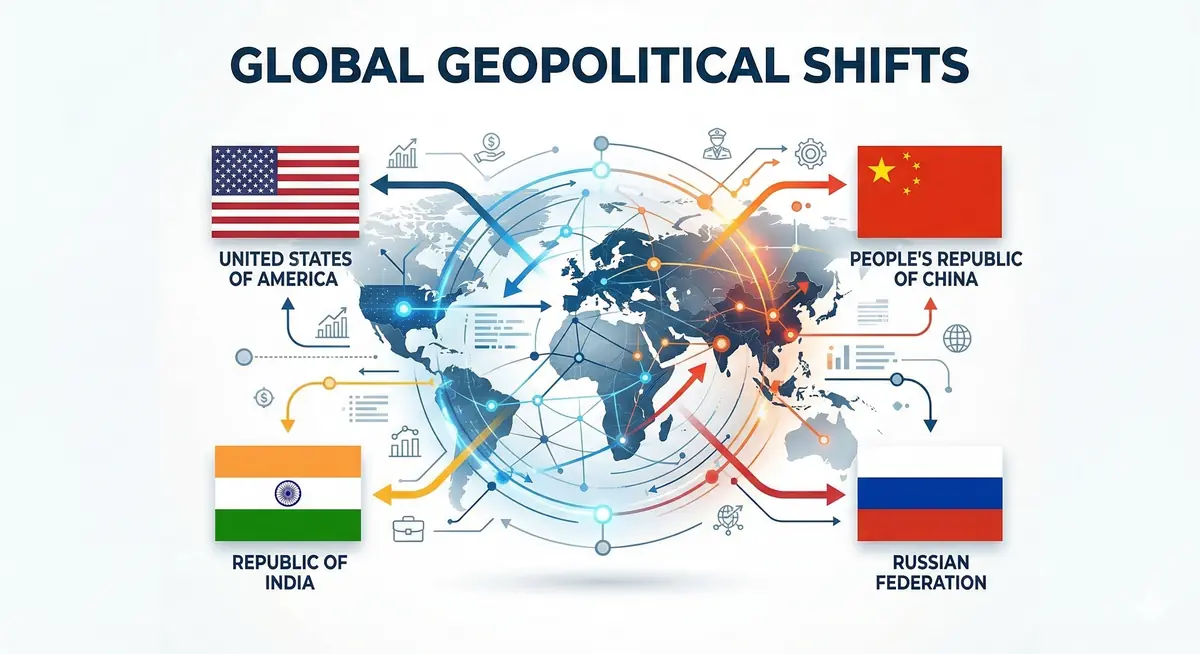
The international landscape is currently undergoing profound and rapid transformation, signaling a new era that reshapes global power dynamics and alliances. These global geopolitical shifts are characterized by a complex interplay of economic, military, and technological competition among major powers, alongside emergent challenges such as climate change and evolving regional conflicts. Understanding these pivotal changes is crucial for comprehending the future trajectory of international relations and their broad implications for nations and citizens worldwide.
The Evolving Landscape of Global Geopolitical Shifts
The traditional post-Cold War unipolar moment, where the United States held unchallenged global primacy, has steadily eroded, paving the way for a more complex and multipolar world order. This transition is marked by the ascendancy of new economic and military powers, leading to a diffusion of influence across several states and regional blocs rather than a concentration in one or two. The current global geopolitical shifts reflect a dynamic redistribution of power, where various nations and groups increasingly assert their interests on the world stage.
Multipolarity on the Rise
The rise of multipolarity is arguably the most defining feature of the contemporary geopolitical landscape. Nations such as China and India have experienced remarkable economic growth, translating into increased diplomatic and military capabilities that challenge established hierarchies. Russia continues to assert its influence, particularly in its near abroad and through energy politics, while regional powers like Brazil, South Africa, and Turkey are also playing more prominent roles in their respective spheres. This means decisions and actions taken by a broader array of states now carry significant weight in international affairs, creating a more intricate web of interactions.
Economic Interdependence and Decoupling
For decades, increasing economic interdependence was seen as a bulwark against major power conflict, fostering shared interests and mutual prosperity. However, recent years have witnessed a growing trend towards "decoupling" or "de-risking," particularly between major economic blocs like the United States and China. Concerns over supply chain vulnerabilities, national security implications of technological dominance, and human rights issues are prompting countries to re-evaluate their economic partnerships. This strategic re-calibration aims to reduce reliance on potential adversaries for critical goods and technologies, leading to diversified supply chains and, in some cases, protectionist policies.
Key Regions and Their Transformative Roles
Different regions across the globe are experiencing unique geopolitical pressures and opportunities, contributing significantly to the overall tapestry of global shifts. The Indo-Pacific, Europe, the Middle East, and Africa each present distinct dynamics that shape the broader international environment.
The Shifting Balance in the Indo-Pacific
The Indo-Pacific region has emerged as the central theater for global strategic competition, primarily due to the rapid economic and military expansion of China. Nations like the United States, Australia, Japan, and India are deepening security cooperation through initiatives such as the Quad (Quadrilateral Security Dialogue) and AUKUS (Australia, United Kingdom, United States security pact) to counterbalance Beijing's growing influence. Disputes in the South China Sea, Taiwan's status, and trade routes are focal points of tension, underscoring the region's criticality to global commerce and security. The outcome of these rivalries will significantly determine the shape of the 21st-century international order.
Europe's Redefined Security Architecture
Europe's geopolitical landscape has been profoundly altered by recent conflicts, particularly the full-scale invasion of Ukraine. This event has led to a significant re-evaluation of security priorities, a renewed commitment to NATO, and increased defense spending across many European nations. The European Union is striving to enhance its strategic autonomy, both militarily and economically, reducing its energy dependence on Russia and strengthening its collective defense capabilities. The war has also accelerated discussions around EU enlargement and the integration of new members, reflecting a desire to consolidate a united front in the face of ongoing regional instability.
The Middle East: From Conflict to Cooperation?
The Middle East remains a complex region, but recent trends suggest a potential pivot from outright conflict to a more nuanced era of cautious cooperation and de-escalation, particularly in the Arabian Gulf. Diplomatic efforts, often brokered by regional players, have led to rapprochements between long-standing rivals, such as the restoration of Saudi-Iranian diplomatic ties. While traditional conflicts persist in areas like Syria and Yemen, and the Israeli-Palestinian issue remains a flashpoint, there's a growing regional recognition of the need for economic diversification and stability. China's increasing diplomatic involvement in the region also signals a broader shift in external influence.
Africa's Growing Strategic Importance
Africa's burgeoning population, vast natural resources, and strategic geographical location are attracting increased attention from global powers. China has long been a major investor and trading partner, but Western nations, Russia, and Gulf states are also intensifying their diplomatic, economic, and security engagements across the continent. This heightened interest presents both opportunities for development and risks of renewed geopolitical competition, as external powers vie for influence, resources, and strategic alliances. African nations are increasingly asserting their agency, seeking partnerships that align with their own development goals rather than succumbing to singular external pressures.
Driving Forces Behind the Changes
Several underlying factors are accelerating and shaping the current wave of global geopolitical shifts, transcending traditional state-centric dynamics and introducing new layers of complexity. These forces range from rapid technological advancement to the existential threat of climate change.
Technological Advancement and Competition
Technological innovation, especially in artificial intelligence, quantum computing, biotechnology, and cybersecurity, is a paramount driver of geopolitical competition. Dominance in these frontier technologies is seen as crucial for economic prosperity, national security, and military superiority. Consequently, there is an intense global race to develop and control these critical technologies, leading to export controls, investment restrictions, and intellectual property disputes. The weaponization of cyber capabilities has also become a significant concern, posing threats to critical infrastructure and democratic processes worldwide.
Climate Change and Resource Scarcity
Climate change is no longer just an environmental issue; it is a profound geopolitical challenge. Rising sea levels, extreme weather events, and resource scarcity (especially water and arable land) are displacing populations, exacerbating existing conflicts, and creating new humanitarian crises. The competition for dwindling resources, particularly in fragile regions, can fuel instability and migration flows, placing additional strains on international cooperation. Furthermore, the transition to green energy and the race for critical minerals required for renewable technologies are creating new geopolitical dependencies and rivalries.
Global Health and Supply Chain Resilience
The COVID-19 pandemic exposed the fragility of global supply chains and the interconnectedness of global health. It highlighted the critical need for resilience in the face of widespread disruptions, leading many nations to prioritize domestic production of essential goods, diversify sourcing, and build strategic reserves. The pandemic also underscored the importance of international cooperation in public health, yet it simultaneously fueled vaccine nationalism and exposed inequalities, further complicating global governance efforts. The lessons learned are shaping new policies aimed at preventing future disruptions and enhancing national and collective preparedness.
The Resurgence of Nationalism and Protectionism
Across the globe, there has been a noticeable resurgence of nationalist sentiments and protectionist economic policies. This trend is often driven by a desire to protect domestic industries, jobs, and cultural identities in the face of globalization's perceived negative impacts. While some argue it allows nations to better serve their own interests, critics point to the risks of trade wars, reduced international cooperation, and increased geopolitical friction. The rise of "economic nationalism" is fundamentally altering global trade patterns and investment flows, posing challenges to multilateral institutions and the principles of free trade.
Impact on International Institutions and Alliances
The ongoing global geopolitical shifts are placing immense pressure on existing international institutions and alliances, forcing them to adapt or risk becoming obsolete. The very architecture of global governance is being tested.
Challenges to the Liberal International Order
The post-World War II liberal international order, built on multilateralism, international law, and democratic values, faces significant challenges. Rising powers often question the legitimacy and fairness of institutions like the United Nations, the World Bank, and the International Monetary Fund, arguing they are biased towards Western interests. Furthermore, ideological differences and great power rivalries are paralyzing decision-making within bodies like the UN Security Council, hindering effective responses to global crises. The erosion of trust in these institutions could lead to a more fragmented and less predictable international system.
The Future of Traditional Alliances (NATO, AUKUS)
Traditional security alliances are adapting to new threats and challenges. NATO, for instance, has demonstrated renewed vigor in response to aggression in Europe, expanding its membership and strengthening its collective defense posture. However, it also faces internal debates over burden-sharing and strategic priorities, particularly regarding its role beyond the Euro-Atlantic area. New partnerships like AUKUS illustrate a flexible approach to security cooperation, focusing on specific technological and strategic objectives in regions of heightened concern, like the Indo-Pacific. These alliances are evolving to address a wider array of threats, including cyber warfare and economic coercion.
The Rise of New Blocs (BRICS, SCO)
Alongside traditional alliances, new groupings are emerging or strengthening, reflecting the multipolar reality. Organizations like BRICS (Brazil, Russia, India, China, South Africa) and the Shanghai Cooperation Organization (SCO) are seeking to enhance cooperation among their members, often presenting alternative models of governance and economic development to the Western-led order. While their cohesion and collective power vary, these blocs represent a significant shift in diplomatic gravity, offering platforms for non-Western nations to coordinate policies, challenge existing norms, and pursue their collective interests on the global stage.
Navigating a Complex Future
The current geopolitical environment demands innovative strategies and adaptive foreign policies from all state and non-state actors. Navigating this complexity requires a multifaceted approach.
Diplomacy and Strategic Competition
In an era of intense strategic competition, robust diplomacy becomes even more critical. While competition between major powers is undeniable, channels for dialogue and de-escalation are essential to prevent miscalculation and conflict escalation. This involves both bilateral engagement and multilateral forums for addressing shared challenges like climate change, pandemics, and nuclear proliferation. Nations must find a balance between asserting their interests and engaging in constructive dialogue to manage rivalries and identify areas of common ground.
Economic Resilience and Diversification
States and businesses are increasingly prioritizing economic resilience through diversification of supply chains, investment in critical domestic industries, and the development of new trade partnerships. This involves reducing over-reliance on single suppliers or markets and fostering regional economic integration to build more robust and shock-resistant economies. Strategic investments in research and development are also crucial for maintaining a competitive edge in rapidly evolving technological sectors.
The Role of Non-State Actors
Non-state actors, including multinational corporations, non-governmental organizations, and even powerful individuals, play an increasingly significant role in global geopolitics. Corporations influence trade policies and technological standards, NGOs advocate on issues from human rights to climate change, and transnational criminal organizations pose security threats. Understanding and engaging with these diverse actors is vital for crafting effective foreign policy and addressing complex global challenges that transcend national borders.
Conclusion
The world stands at a critical juncture, characterized by dynamic global geopolitical shifts that are fundamentally reshaping the international order. From the rise of multipolarity and the intensifying technological race to the urgent imperatives of climate change and supply chain resilience, the forces at play are numerous and interconnected. Navigating this complex and often volatile landscape will require a blend of strategic competition, adaptive diplomacy, economic ingenuity, and a renewed commitment to solving shared global challenges. The choices made by nations in the coming years will determine whether this new era ushers in greater stability and cooperation or increased fragmentation and conflict.
Frequently Asked Questions
Q: What is meant by global geopolitical shifts?
A: Global geopolitical shifts refer to significant changes in the distribution of power, influence, and alliances among nations. These transformations are driven by economic, military, and technological competition, leading to a more multipolar world order.
Q: What are the primary drivers of current geopolitical changes?
A: Key drivers include the rise of new economic and military powers, rapid technological advancements like artificial intelligence and quantum computing, the profound impacts of climate change and resource scarcity, and the resurgence of nationalism. These interconnected forces profoundly reshape international relations.
Q: How do these shifts impact international institutions?
A: These shifts place immense pressure on existing international institutions like the United Nations, often challenging their legitimacy and creating impasses in decision-making. They also lead to the evolution of traditional alliances and the emergence of new blocs, diversifying the landscape of global governance.