Understanding the Physics Behind Atmospheric Pressure
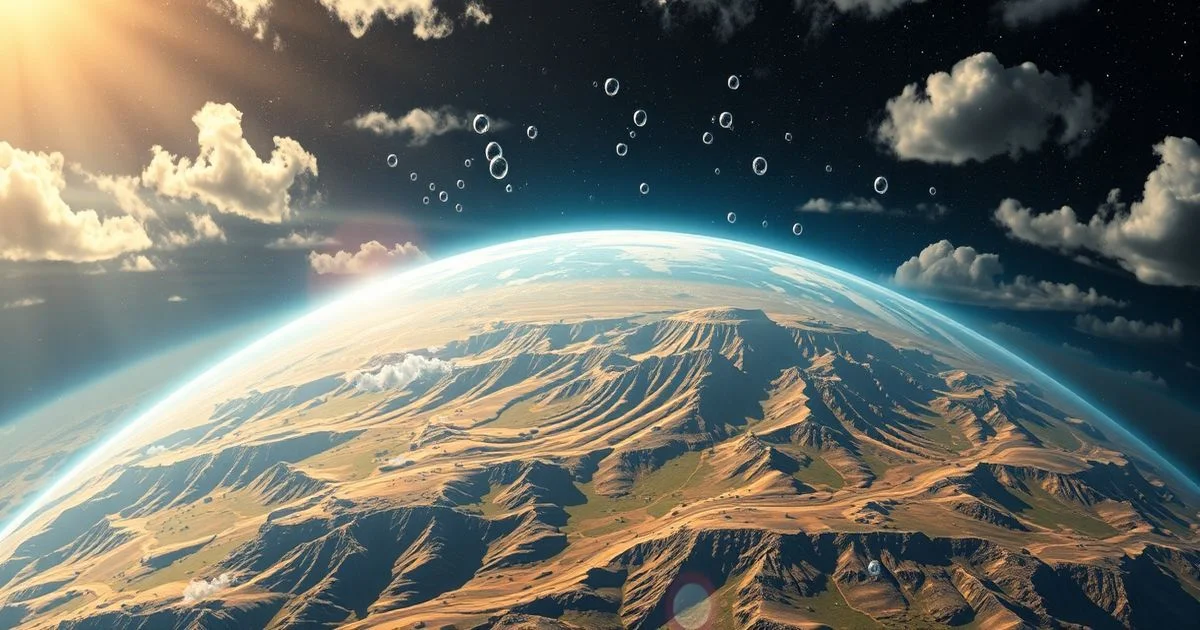
Our planet is encased in a dynamic, invisible blanket of gases we call the atmosphere, a critical component that sustains life and shapes our world. While we rarely perceive it directly, this atmospheric cloak exerts a constant, omnipresent force upon everything within and beneath it. Delving into the intricate physics behind atmospheric pressure reveals a fascinating interplay of gravity, molecular motion, and energy that drives everything from weather patterns to the very breath we take. This exploration will provide a deeper understanding of this fundamental force, unveiling the complex mechanisms that underpin its existence and influence across our global environment.
- Defining Atmospheric Pressure: The Weight of Air
- Understanding the Physics Behind Atmospheric Pressure: Fundamental Principles
- Key Factors Influencing Atmospheric Pressure
- Measuring Atmospheric Pressure: Barometers and Units
- Real-World Applications and Impact of Atmospheric Pressure
- Global Atmospheric Circulation: The Macro Perspective
- Pressure Extremes: From Ocean Depths to the Vacuum of Space
- Future Research and Climate Implications
- Conclusion
- Frequently Asked Questions
- Further Reading & Resources
Defining Atmospheric Pressure: The Weight of Air
At its most fundamental level, atmospheric pressure is simply the force exerted by the weight of the air column above a given point on Earth's surface. Imagine a vast, invisible ocean of gas, miles deep, constantly pressing down. Each cubic meter of air, though seemingly weightless to our senses, contains trillions upon trillions of molecules – primarily nitrogen and oxygen – all possessing mass and thus subject to Earth's gravitational pull.
The cumulative effect of these myriad gas molecules being pulled downwards by gravity is what generates atmospheric pressure. It’s not just a static weight; these molecules are in constant, frenetic motion, colliding with each other and with any surface they encounter, including our bodies, buildings, and the ground itself. These collisions transfer momentum, which, when averaged over a surface area, manifests as a measurable force: pressure.
Historical Context and Early Measurements
The concept of atmospheric pressure wasn't always obvious. For centuries, the prevailing belief, stemming from Aristotle, was that "nature abhors a vacuum" (horror vacui), explaining why water pumps could lift water to a certain height. It wasn't until the 17th century that Evangelista Torricelli, a student of Galileo, challenged this notion. In 1643, he famously conducted an experiment by inverting a tube filled with mercury into a dish of mercury. He observed that the mercury column would only fall to a certain height (around 760 mm or 30 inches) and no further, leaving a vacuum (the Torricellian vacuum) above it.
Torricelli correctly deduced that the column of mercury was held up not by a vacuum's aversion, but by the pressure of the surrounding air pushing down on the mercury in the dish. This groundbreaking experiment provided the first direct evidence for atmospheric pressure and gave birth to the mercury barometer, an instrument still used today. His work paved the way for Blaise Pascal, who further demonstrated that atmospheric pressure decreases with altitude by having his brother-in-law measure mercury column heights at different elevations on a mountain. These early scientific inquiries laid the essential groundwork for our modern understanding.
Understanding the Physics Behind Atmospheric Pressure: Fundamental Principles
To truly grasp the mechanisms behind atmospheric pressure, we must delve into the principles of kinetic theory, gravity, and fluid dynamics. These interlinked concepts explain how a vast sea of gas molecules can exert such a significant and variable force.
Kinetic Theory of Gases and Molecular Collisions
The air around us is not a static entity; it's a dynamic assembly of gas molecules—primarily nitrogen (N₂), oxygen (O₂), argon (Ar), and carbon dioxide (CO₂)—in constant, random motion. According to the kinetic theory of gases, these molecules possess kinetic energy proportional to the air's temperature. They are continuously colliding with each other and with the surfaces of any object immersed in the atmosphere.
Each collision imparts a tiny force. When averaged over a vast number of molecules and a significant surface area, these innumerable, microscopic forces sum up to create the macroscopic phenomenon we measure as pressure. Higher temperatures mean greater molecular kinetic energy, leading to more frequent and forceful collisions, which generally correlates with higher pressure if the volume is constrained. However, in an open atmospheric system, higher temperatures often lead to expansion and therefore lower density and pressure at a given altitude. This distinction is crucial for understanding weather patterns.
The Overriding Role of Gravity
While molecular motion explains how gas exerts pressure, gravity explains why the atmosphere stays tethered to Earth and why pressure varies with altitude. Earth's gravitational field continuously pulls every molecule of air downwards. If there were no gravity, the atmosphere would simply dissipate into space, as its constituent molecules possess enough kinetic energy to overcome any intermolecular forces and escape.
This downward pull of gravity creates a column of air extending from the ground upwards. The weight of this entire column bears down on the layers beneath it, and ultimately on the Earth's surface. This is the primary driver of atmospheric pressure. The higher you go in the atmosphere, the fewer air molecules are above you, and consequently, the less total weight is pressing down. This explains the exponential decrease in pressure with increasing altitude.
Hydrostatic Equilibrium and the Pressure Gradient
The atmosphere exists in a state of approximate hydrostatic equilibrium. This means there's a delicate balance between the downward force of gravity acting on the air and the upward force created by the pressure gradient. The pressure gradient refers to the change in pressure over a given distance. In the atmosphere, pressure naturally decreases with altitude, creating an upward pressure gradient force.
If this balance were disturbed, air would accelerate. For example, if gravity were momentarily stronger, air would compress downwards. If the upward pressure gradient force were dominant, air would expand upwards. This equilibrium is crucial for maintaining the atmosphere's structure and preventing it from either collapsing onto the surface or escaping into space. While large-scale atmospheric motions (like winds) represent temporary deviations from perfect hydrostatic equilibrium, the overall structure of the atmosphere largely conforms to this principle.
The Ideal Gas Law's Influence (PV=nRT)
The Ideal Gas Law, expressed as PV=nRT, provides a fundamental relationship between the macroscopic properties of a gas: pressure (P), volume (V), number of moles (n), ideal gas constant (R), and temperature (T). While the atmosphere is not perfectly an "ideal gas," this law offers valuable insights into how these variables interrelate.
- Temperature (T): For a given number of air molecules (n) and volume (V), increasing the temperature (T) leads to higher pressure (P) due to increased molecular kinetic energy and more forceful collisions. Conversely, cooling air can reduce pressure.
- Density (n/V): The number of moles (n) in a given volume (V) directly relates to the air's density. If density increases (more molecules in the same volume), pressure increases. If density decreases, pressure drops. This is why cold, dense air is often associated with high pressure, and warm, less dense air with low pressure, especially when considering air masses and their movements.
This law helps explain why atmospheric pressure isn't solely determined by altitude but is also significantly influenced by thermal variations across the globe.
Key Factors Influencing Atmospheric Pressure
Atmospheric pressure is not a constant value across the Earth's surface or even at a fixed altitude. Several dynamic factors conspire to create the complex pressure fields that characterize our planet's weather and climate.
Altitude: The Primary Determinant
Without question, altitude is the most significant factor affecting atmospheric pressure. As discussed, the higher you ascend, the fewer air molecules are above you, and thus, the less cumulative weight presses down. This relationship is not linear but exponential, meaning pressure decreases rapidly at lower altitudes and more slowly as you go higher.
- At sea level (0 meters), the average atmospheric pressure is approximately 1 atmosphere (atm), or 1013.25 millibars (hPa).
- At 5,500 meters (about 18,000 feet), pressure drops to roughly half of sea-level pressure.
- At 16,000 meters (about 52,000 feet), it's only about 10% of sea-level pressure.
This rapid decrease has profound implications for aviation, mountaineering, and even for human physiology, necessitating specialized equipment like pressurized cabins in aircraft and supplemental oxygen for high-altitude climbers.
Temperature: Density and Expansion
Temperature exerts a complex but crucial influence on atmospheric pressure. Generally, warmer air is less dense than colder air. When air warms, its molecules gain kinetic energy, move faster, and tend to spread out, occupying a larger volume. If the air parcel can expand freely, this expansion leads to a decrease in its density. A column of less dense, warm air therefore exerts less pressure on the surface beneath it compared to a column of denser, colder air of the same height.
This relationship is a cornerstone of global atmospheric circulation and weather systems:
- Low-Pressure Systems: Often associated with warmer air that rises, creating a relative void beneath it. This rising air cools, condenses, and can lead to cloud formation and precipitation.
- High-Pressure Systems: Typically formed by colder, denser air that sinks. This sinking air warms as it descends, increasing its capacity to hold moisture and leading to clear skies and stable weather.
Humidity: Water Vapor's Role
While it might seem counterintuitive, humid air is actually less dense than dry air at the same temperature and pressure. This is because water vapor (H₂O) molecules have a lower molecular mass (approximately 18 g/mol) than the average molecular mass of dry air (which is predominantly nitrogen at 28 g/mol and oxygen at 32 g/mol, averaging around 29 g/mol).
When water vapor displaces dry air molecules, the overall mass of the air parcel decreases, making it less dense. Consequently, a column of very humid air will exert slightly less pressure than a comparable column of dry air. This effect, though less dramatic than that of temperature or altitude, contributes to the development of low-pressure systems often associated with moist, stormy weather.
Dynamic Weather Systems and Air Movement
Large-scale atmospheric motions, driven by uneven heating from the sun and the Earth's rotation (Coriolis effect), create dynamic high and low-pressure systems.
- Convergence and Divergence: When air converges at the surface, it has nowhere to go but up, leading to rising air, cooling, condensation, and typically low pressure at the surface. Conversely, when air diverges at the surface (spreads out), it must be replaced by sinking air from above, leading to warming, drying, and high pressure at the surface.
- Upper-Level Wind Patterns: The flow of air in the upper atmosphere, particularly the jet streams, can significantly influence surface pressure. Regions of upper-level divergence (where air spreads out aloft) contribute to surface low-pressure development, while upper-level convergence (where air piles up aloft) favors surface high-pressure development.
These dynamic processes are what make weather forecasting complex, as pressure systems are constantly forming, moving, and dissipating across the globe.
Measuring Atmospheric Pressure: Barometers and Units
Accurate measurement of atmospheric pressure is indispensable for meteorology, aviation, and a host of other scientific and practical applications. The primary instrument for this measurement is the barometer.
Types of Barometers
- Mercury Barometer: This is the classic design, similar to Torricelli's original invention. It consists of a glass tube, closed at one end and filled with mercury, which is then inverted into a dish of mercury. The height of the mercury column in the tube directly reflects the atmospheric pressure. When atmospheric pressure increases, it pushes down harder on the mercury in the dish, forcing the mercury higher in the tube. Conversely, falling pressure allows the mercury column to drop. Mercury barometers are highly accurate and still used as primary standards in some meteorological stations, but their use is declining due to environmental and health concerns associated with mercury.
- Aneroid Barometer: The most common type of barometer today, especially in homes and small weather stations, is the aneroid barometer (from Greek
a neros, meaning "without liquid"). It uses a small, flexible metal box (an aneroid cell) from which most of the air has been removed, creating a partial vacuum. Changes in atmospheric pressure cause the sides of this box to expand or contract slightly. These subtle movements are amplified by a system of levers and springs, moving a needle across a calibrated dial to indicate the pressure. Aneroid barometers are portable, robust, and require less maintenance than mercury barometers. - Digital Barometers: Modern weather stations and smart devices often incorporate digital barometers, which use micro-electrical-mechanical systems (MEMS) sensors. These sensors detect pressure changes by measuring the deflection of a tiny diaphragm or the change in capacitance in a pressure-sensitive capacitor. They convert these physical changes into electrical signals, which are then displayed digitally. Digital barometers offer high precision, rapid response, and can be easily integrated into automated weather systems.
Units of Measurement
Atmospheric pressure can be expressed in several different units, reflecting its diverse applications and historical origins:
- Pascals (Pa) / Hectopascals (hPa): The SI (International System of Units) unit of pressure is the Pascal (Pa), defined as one Newton of force per square meter (N/m²). Because atmospheric pressures are large numbers in Pascals, meteorologists commonly use hectopascals (hPa), where 1 hPa = 100 Pa. A standard atmospheric pressure at sea level is 1013.25 hPa. This unit is widely used in global meteorology.
- Millibars (mb): Historically, millibars were the most common unit in meteorology, and they are numerically equivalent to hectopascals (1 mb = 1 hPa). So, standard sea-level pressure is also 1013.25 mb. Many older weather maps and texts still use millibars.
- Atmospheres (atm): The standard atmosphere (atm) is a reference unit, defined as the average atmospheric pressure at sea level. 1 atm = 101,325 Pa = 1013.25 hPa = 1013.25 mb. This unit is often used in chemistry and physics for general pressure references.
- Millimeters of Mercury (mmHg) / Torrs: Derived from the mercury barometer, millimeters of mercury (mmHg) express pressure as the height of a mercury column it can support. 1 atm is equal to 760 mmHg. A Torr is virtually identical to 1 mmHg (1 atm = 760 Torr). These units are still used in some medical and vacuum applications.
- Pounds per Square Inch (psi): Common in the United States, particularly for engineering and industrial applications (e.g., tire pressure). Standard atmospheric pressure is approximately 14.7 psi.
The choice of unit often depends on regional preference or specific application, but hPa/millibars are the international standard for meteorological reporting.
Real-World Applications and Impact of Atmospheric Pressure
The fundamental principles governing atmospheric pressure extend far beyond academic interest, having profound implications for daily life, technological advancements, and even human physiology.
Weather Forecasting: Highs and Lows
Atmospheric pressure is arguably the single most critical variable for short-term weather forecasting. Meteorologists constantly monitor pressure systems to predict changes in weather.
- High-Pressure Systems: Characterized by descending, stable air. This sinking air warms and dries, inhibiting cloud formation and leading to clear skies, calm winds, and generally pleasant weather. Barometric pressure tends to be rising or high when a high-pressure system dominates.
- Low-Pressure Systems: Associated with rising, unstable air. As air rises, it cools, leading to condensation, cloud formation, and often precipitation (rain or snow), along with stronger winds. Falling or low barometric pressure is a strong indicator of an approaching low-pressure system and potential for stormy weather. By tracking the movement and intensity of these pressure systems, forecasters can accurately predict where and when precipitation, storms, or fair weather will occur.
Aviation: Altimeters and Cabin Pressurization
Atmospheric pressure is paramount in aviation safety and operation.
- Altimeters: Aircraft altimeters work by measuring atmospheric pressure. Since pressure decreases predictably with altitude, an altimeter can convert a pressure reading into an approximate height above sea level. Pilots use altimeters to maintain safe separation from other aircraft and terrain. However, because actual atmospheric pressure varies with weather conditions, altimeters must be periodically calibrated to local pressure readings to ensure accuracy.
- Cabin Pressurization: As aircraft ascend to cruising altitudes (e.g., 30,000-40,000 feet), the external atmospheric pressure drops to dangerously low levels, insufficient to sustain human life without supplemental oxygen. Commercial airliners maintain cabin pressure equivalent to an altitude of 6,000-8,000 feet, using complex pressurization systems. This prevents altitude sickness and ensures passenger comfort and safety.
Diving and Physiology: Decompression Sickness and Barotrauma
Divers experience significant changes in ambient pressure as they descend and ascend in water. Since water is much denser than air, pressure increases much more rapidly with depth.
- Decompression Sickness (The Bends): As a diver descends, the increased ambient pressure forces more inert gases (primarily nitrogen from their breathing air) to dissolve into their blood and tissues. If the diver ascends too quickly, the external pressure drops too rapidly, causing these dissolved gases to come out of solution and form bubbles in the bloodstream and tissues. These bubbles can cause pain, tissue damage, and even death. Controlled ascent rates and decompression stops are vital to allow these gases to safely off-gas.
- Barotrauma: This refers to tissue damage caused by pressure differences between a gas-filled space in the body (e.g., ears, sinuses, lungs) and the surrounding fluid. Divers can experience ear barotrauma if they don't equalize pressure, and pilots or mountaineers can experience similar issues.
Boiling Point Variation
The boiling point of a liquid is the temperature at which its vapor pressure equals the surrounding atmospheric pressure.
- At standard sea-level pressure (1 atm), water boils at 100°C (212°F).
- At higher altitudes, where atmospheric pressure is lower, water boils at a lower temperature. For example, in Denver, Colorado (about 1,600 meters or 5,280 feet above sea level), water boils at approximately 95°C (203°F). This phenomenon affects cooking times at altitude, often requiring longer cooking for foods that rely on a specific boiling temperature for proper preparation. Conversely, pressure cookers artificially increase the internal pressure, raising the boiling point of water and speeding up cooking.
Everyday Phenomena: Suction Cups and Drinking Straws
Many common occurrences rely directly on atmospheric pressure:
- Suction Cups: A suction cup works by creating a partial vacuum underneath it when pressed against a smooth surface. The higher external atmospheric pressure then pushes the cup firmly against the surface, holding it in place. There's no "suction force" pulling; rather, it's the external pressure pushing.
- Drinking Straws: When you "suck" on a straw, you are actually removing air from inside the straw, creating a region of lower pressure. The higher atmospheric pressure on the surface of the liquid in your glass then pushes the liquid up the straw and into your mouth.
These seemingly simple examples powerfully illustrate the constant and pervasive influence of atmospheric pressure in our daily lives.
Global Atmospheric Circulation: The Macro Perspective
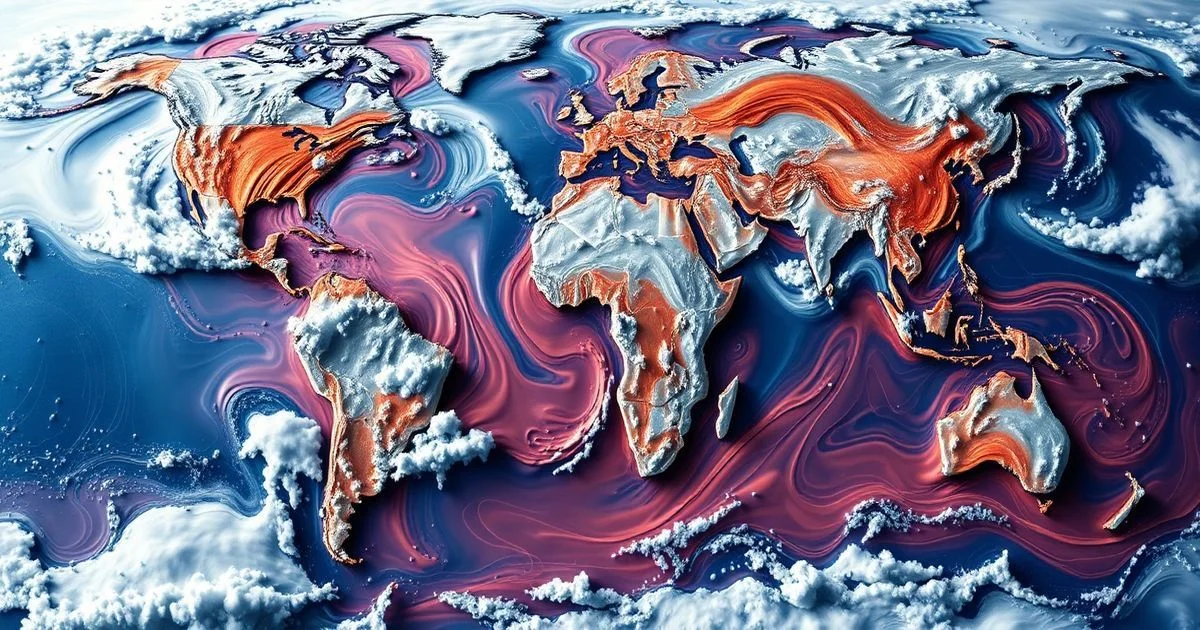
The planet's varying atmospheric pressure isn't just a localized phenomenon; it's intricately linked to global-scale atmospheric circulation patterns. These massive movements of air distribute heat and moisture around the Earth, profoundly shaping regional climates. These movements are also fundamentally linked to phenomena like ocean currents and their role in global climate patterns.
Pressure Gradients Drive Winds
Air naturally flows from areas of higher pressure to areas of lower pressure. This pressure difference, known as the pressure gradient, is the fundamental driving force behind wind. A steeper pressure gradient (i.e., a larger pressure difference over a shorter distance) results in stronger winds. Without these pressure differences, the atmosphere would be still.
Convection Cells: Hadley, Ferrel, and Polar
The Earth's spherical shape and axial tilt lead to uneven heating by the sun. The equator receives more direct solar radiation than the poles, creating significant temperature differences that drive large-scale convection cells:
- Hadley Cells (0° to 30° Latitude):
- Warm, moist air at the equator (a region of low pressure) rises, cools, and releases moisture, leading to frequent rainfall and lush rainforests.
- This rising air then moves poleward at high altitudes, cools further, and sinks around 30° latitude (creating subtropical high-pressure zones).
- The descending, dry air leads to arid conditions and is where many of the world's major deserts are found.
- At the surface, air flows back towards the equator (the trade winds), completing the cell.
- Ferrel Cells (30° to 60° Latitude): These are indirectly driven cells, acting like a "gear" between the Hadley and Polar cells.
- Air rises around 60° latitude (subpolar low-pressure zones), leading to cyclonic activity and precipitation in mid-latitudes.
- Air sinks around 30° latitude (subtropical high-pressure zones).
- Winds at the surface typically flow poleward (westerlies).
- Polar Cells (60° to 90° Latitude):
- Cold, dense air at the poles (polar high-pressure zones) sinks and flows towards the equator.
- This air warms and rises around 60° latitude (subpolar low-pressure zones).
- This creates cold, dry conditions at the poles.
The Coriolis Effect's Influence
The Earth's rotation adds another layer of complexity to these pressure-driven winds. The Coriolis effect deflects moving objects (including air and water) to the right in the Northern Hemisphere and to the left in the Southern Hemisphere. This deflection is crucial:
- It prevents air from flowing directly from high to low pressure in a straight line, instead causing it to spiral.
- This spiraling motion is responsible for the characteristic cyclonic (counter-clockwise in Northern Hemisphere) flow around low-pressure systems and anticyclonic (clockwise in Northern Hemisphere) flow around high-pressure systems.
- It also plays a key role in the formation of major wind belts like the trade winds and westerlies, and the jet streams—fast-moving ribbons of air in the upper troposphere.
Jet Streams
Jet streams are narrow bands of strong winds typically found at the tropopause (the boundary between the troposphere and stratosphere). They are created by the large temperature differences between air masses (e.g., polar vs. tropical air) and are influenced by the Coriolis effect.
- The polar jet stream and subtropical jet stream are major drivers of weather patterns, guiding storms and influencing the development and movement of surface high and low-pressure systems.
- Understanding the dynamics of jet streams is vital for long-range weather forecasting and for predicting the trajectories of major storms.
Together, these global circulation patterns, fueled by pressure gradients and shaped by the Earth's rotation, create the diverse range of climates and weather phenomena experienced across our planet.
Pressure Extremes: From Ocean Depths to the Vacuum of Space
While we often discuss atmospheric pressure in terms of Earth's surface and atmosphere, pressure exists on a vast continuum, from the crushing forces at the bottom of the ocean to the near-perfect vacuum of interstellar space.
Crushing Pressures: Deep Ocean and Other Planetary Atmospheres
- Deep Ocean Trenches: Water is significantly denser than air, so pressure increases much more rapidly with depth in the ocean. For every 10 meters (33 feet) you descend in seawater, the pressure increases by approximately 1 atmosphere. The Mariana Trench, the deepest known part of Earth's oceans, reaches depths of nearly 11,000 meters. At this depth, the pressure is over 1,100 atmospheres (16,000 psi), which is equivalent to having approximately 100 jumbo jets pressing down on every square meter. Organisms adapted to these environments possess unique biological mechanisms to withstand such extreme conditions.
- Venus's Atmosphere: While not on Earth, examining other planets highlights extreme atmospheric pressures. Venus, Earth's "sister planet," has an incredibly dense atmosphere, primarily carbon dioxide. The atmospheric pressure at Venus's surface is about 92 times that of Earth's sea-level pressure, roughly equivalent to the pressure at 900 meters (3,000 feet) below the surface of Earth's oceans. Such conditions are inhospitable to all but the most robust specialized probes.
- Gas Giant Interiors: The pressure inside gas giants like Jupiter and Saturn is astronomical. Deep within Jupiter, hydrogen is compressed to such an extent that it becomes liquid metallic hydrogen, a state of matter where electrons are shared across the lattice like in a metal, under pressures millions of times greater than Earth's atmospheric pressure.
The Vacuum: Low Pressure and Space
- High Altitudes on Earth: As we ascend Earth's atmosphere, the pressure rapidly diminishes. The Karman Line, at 100 kilometers (62 miles) above sea level, is often defined as the boundary between Earth's atmosphere and outer space. At this altitude, the air is so thin that conventional aircraft can no longer fly, and atmospheric pressure is less than one-millionth of sea-level pressure.
- Near-Earth Orbit and Interplanetary Space: In the vacuum of space, far from any celestial body, atmospheric pressure is virtually zero. While there are still scattered molecules and particles, their density is so low that they exert negligible pressure. This environment is radically different from the immense gravitational forces and dense matter found around black holes in deep space physics. This vacuum presents significant challenges for spacecraft design, requiring robust structural integrity and complex life support systems to maintain an internal, breathable atmosphere for astronauts.
- Vacuum Chambers: In scientific and industrial settings, vacuum chambers are used to create controlled environments with extremely low pressures, simulating space conditions or enabling processes that require the absence of air. These chambers can achieve pressures many orders of magnitude lower than those found in Earth's upper atmosphere, down to picopascals or femtopascals.
The vast range of pressure conditions, from the vacuum of space to the immense pressures in planetary interiors or ocean depths, underscores the diverse ways in which matter interacts under the influence of gravity and molecular forces.
Future Research and Climate Implications
Understanding atmospheric pressure is not a static field; it is continually evolving, particularly in the context of climate change and advanced atmospheric modeling. The physics behind atmospheric pressure plays a pivotal role in predicting future climatic shifts and comprehending the dynamics of other planetary atmospheres.
Atmospheric Modeling and Climate Prediction
Sophisticated global climate models (GCMs) are at the forefront of climate change research. These models incorporate complex physical equations that describe the behavior of atmospheric pressure, temperature, humidity, and winds across the globe. By simulating the interactions between the atmosphere, oceans, land surface, and ice, scientists can project future climate scenarios.
- Pressure System Shifts: Climate change is expected to alter the frequency, intensity, and location of major high and low-pressure systems. For instance, changes in polar temperatures can affect the strength and meandering of the jet streams, which in turn influences mid-latitude weather patterns, potentially leading to more persistent extreme weather events like heatwaves or prolonged cold spells.
- Tropical Cyclone Intensity: Warmer ocean temperatures, a consequence of climate change, provide more energy for tropical cyclones. While the precise link between climate change and cyclone frequency is still being researched, there is growing evidence to suggest an increase in the intensity of the strongest storms. Atmospheric pressure, being the core driver of storm strength (lower central pressure equates to stronger winds), is a critical variable in these predictions.
- Global Circulation Changes: Long-term shifts in global atmospheric circulation patterns, such as the Hadley cell expansion or changes in the strength of the westerlies, could have profound impacts on regional precipitation, drought, and desertification. These changes are fundamentally linked to alterations in atmospheric pressure gradients driven by differential heating.
Studying Exoplanet Atmospheres
The principles of atmospheric physics, including those governing pressure, are now being applied to study the atmospheres of exoplanets—planets orbiting stars other than our Sun. Telescopes like the James Webb Space Telescope are capable of analyzing the light passing through exoplanet atmospheres, allowing scientists to infer their composition, temperature profiles, and even estimate their surface pressures. By studying the atmospheric physics of diverse exoplanets, researchers gain insights into how atmospheres form, evolve, and interact with their parent stars, similar to how we understand the lifecycle of stars and stellar evolution themselves.
- Habitability Assessments: Understanding the atmospheric pressure on exoplanets is crucial for assessing their potential habitability. A planet with too low pressure cannot retain liquid water on its surface, even if the temperature is suitable. Conversely, excessively high pressure could make the surface hostile.
- Atmospheric Evolution: By studying the atmospheric physics of diverse exoplanets, researchers gain insights into how atmospheres form, evolve, and interact with their parent stars, providing a broader context for understanding Earth's own atmospheric history and future.
These areas of research highlight that understanding the physics behind atmospheric pressure remains a dynamic and vital field, not only for predicting Earth's future climate but also for expanding our knowledge of planetary systems throughout the cosmos. The invisible force above us continues to reveal its profound influence on scales from the microscopic to the galactic.
Conclusion
From the earliest philosophical inquiries to today's cutting-edge climate models and exoplanet observations, understanding the physics behind atmospheric pressure has been a journey of profound scientific discovery. We've explored how the ceaseless motion of gas molecules, coupled with the relentless pull of Earth's gravity, creates this omnipresent force. We've delved into the key factors that cause it to fluctuate – altitude, temperature, and humidity – and examined the ingenious instruments used for its measurement.
The pervasive influence of atmospheric pressure manifests in myriad ways, from guiding our daily weather to ensuring the safety of air travel and even shaping the limits of human endurance in deep-sea diving. Its role in driving global atmospheric circulation patterns underlines its fundamental importance to Earth's climate system, dictating the distribution of heat and moisture across the globe. As we face the challenges of a changing climate and look outward to the vastness of space, a deeper comprehension of this fundamental physical phenomenon remains more crucial than ever. It is a testament to the intricate workings of our planet, an invisible force that quietly dictates so much of what we experience.
Frequently Asked Questions
Q: Why does atmospheric pressure decrease with altitude?
A: Atmospheric pressure decreases with altitude because there are fewer air molecules above you at higher elevations. The weight of the air column above a given point is what creates pressure, so with less air above, the pressure naturally drops.
Q: How does temperature affect atmospheric pressure?
A: Generally, warmer air is less dense than colder air. As air warms, its molecules spread out, leading to lower density. A column of less dense, warm air exerts less pressure on the surface, often leading to low-pressure systems.
Q: What is the primary instrument used to measure atmospheric pressure?
A: The primary instrument for measuring atmospheric pressure is the barometer. Both mercury barometers and the more common aneroid barometers, along with modern digital sensors, are used to quantify this fundamental meteorological variable.