Understanding the lifecycle of a star in stellar physics: A Deep Dive
The cosmos is a grand theater, and stars are its most spectacular performers, each undergoing an intricate and often dramatic existence. From their fiery birth within colossal clouds of gas and dust to their ultimate demise as stellar remnants, these celestial bodies shape the very fabric of the universe. For the tech-savvy mind seeking depth, this deep dive offers a comprehensive guide to understanding the lifecycle of a star in stellar physics, exploring the complex interplay of gravity, nuclear fusion, and quantum mechanics that dictates their fate.
- The Cosmic Tapestry: An Overview of Stellar Evolution
- The Genesis of Stars: From Nebulae to Protostars
- Main Sequence: The Star's Prime of Life
- The Divergent Paths: Evolution of Low-Mass Stars (M < 8 Solar Masses)
- The Spectacle of Giants: Evolution of High-Mass Stars (M > 8 Solar Masses)
- Understanding the Lifecycle of a Star in Stellar Physics: Key Concepts and Implications
- The Future of Stellar Exploration and Research
- Conclusion: The Enduring Saga of Stellar Physics
- Frequently Asked Questions
- Further Reading & Resources
The Cosmic Tapestry: An Overview of Stellar Evolution
Stars are not static beacons in the night sky; they are dynamic entities constantly evolving over vast cosmic timescales. Their evolution, often termed stellar lifecycle or stellar evolution, is a fundamental concept in astrophysics, explaining the abundance of elements in the universe, the formation of planets, and the structure of galaxies. Each star embarks on a predictable yet unique journey, primarily determined by its initial mass. This journey, spanning millions to billions of years, involves several distinct stages, each marked by profound physical transformations and energy output. For a more detailed guide on this process, consider exploring The Lifecycle of Stars: A Guide to Stellar Evolution.
Understanding this journey requires delving into the intricate processes governing stellar interiors. We'll explore how gravitational collapse ignites nuclear furnaces, how stars maintain equilibrium for eons, and what catastrophic events await them when their fuel runs out. The narrative of a star is one of immense power, subtle balances, and eventual, inevitable transformation.
The Genesis of Stars: From Nebulae to Protostars
Every stellar saga begins in the depths of interstellar space, within vast cosmic nurseries. This initial phase sets the stage for the entire lifecycle, determining a star's mass, its eventual path, and its ultimate demise.
Stellar Nurseries: Molecular Clouds
The birthplace of stars is typically within giant molecular clouds (GMCs). These are cold, dense regions of interstellar gas and dust, predominantly hydrogen and helium, but also containing traces of heavier elements.
Composition and Properties:
- Hydrogen (H₂): Over 90% of the mass.
- Helium (He): About 10% of the mass.
- Trace Elements: Including carbon monoxide, water, and more complex organic molecules.
- Temperature: Extremely low, often around 10-20 Kelvin (-263 to -253°C).
- Density: Relatively high for interstellar space, about 100 to 100,000 particles per cubic centimeter, but still a near vacuum compared to Earth.
- Size: Can span tens to hundreds of light-years across, containing enough material to form thousands of stars.
Role of Gravity in Collapse:
Despite their vastness, these clouds are not perfectly uniform. Small density fluctuations, perhaps triggered by shockwaves from nearby supernovae, stellar winds from massive stars, or galactic spiral arms, can cause localized regions to become gravitationally unstable. Once a region's self-gravity exceeds the internal pressure resisting collapse, a runaway process begins. This phenomenon is described by the Jeans Instability criteria, where a cloud of a certain mass and size will inevitably collapse under its own weight.
As these dense pockets collapse, they fragment into smaller clumps, each destined to become one or more stars. This gravitational contraction is the initial driving force, converting gravitational potential energy into thermal energy, causing the core of the collapsing cloud to heat up.
The Protostar Phase
The journey from a cold, diffuse cloud fragment to a glowing star involves a crucial intermediate stage known as the protostar. This phase is characterized by intense activity and rapid transformation.
Gravitational Collapse and Heating:
As a fragment continues to contract, its core becomes denser and hotter. The increasing temperature and pressure at the center are a direct consequence of the gravitational collapse. This heating isn't yet due to nuclear fusion; it's purely from the conversion of gravitational energy. The protostar radiates energy primarily in the infrared spectrum as it cools, slowly shining brighter in these wavelengths.
Accretion Disks:
During this collapse, conservation of angular momentum causes the material to flatten into a rotating disk around the central protostar. This is known as an accretion disk. Material from this disk spirals inwards onto the protostar, continuing to feed its growth. These disks are not merely leftovers; they are critical sites for planet formation, providing the raw material from which rocky and gaseous worlds will eventually coalesce.
T Tauri Stars:
Young, low-mass protostars often pass through a T Tauri phase. These stars are still contracting and have not yet reached the stable main sequence. They are characterized by strong stellar winds and dramatic flares, indicating intense magnetic activity and ongoing mass accretion. T Tauri stars are irregular variables, meaning their brightness fluctuates unpredictably, a sign of their turbulent adolescence. This phase lasts for approximately 10-100 million years for stars like our Sun.
The protostar phase concludes when the core temperature and pressure become high enough to initiate sustained nuclear fusion. At this point, the outward pressure generated by fusion balances the inward pull of gravity, and the star achieves hydrostatic equilibrium, entering its main sequence phase.
Main Sequence: The Star's Prime of Life
The main sequence is the longest and most stable phase in a star's lifecycle, often referred to as its "adulthood." During this period, the star generates energy primarily by fusing hydrogen into helium in its core. Our Sun is currently a main sequence star.
The Balance of Power: Nuclear Fusion vs. Gravity
The stability of a main sequence star is a delicate balance between two immense forces: the inward pull of gravity, trying to collapse the star, and the outward pressure generated by nuclear fusion in the core, trying to expand it. This equilibrium is known as hydrostatic equilibrium.
Hydrogen Fusion:
The primary process powering main sequence stars is nuclear fusion, where four hydrogen nuclei (protons) combine to form one helium nucleus. This process releases a tremendous amount of energy in the form of gamma-ray photons and neutrinos, following Einstein's famous equation E=mc². The specific fusion pathway depends on the star's mass:
- Proton-Proton (p-p) Chain: Dominant in stars with masses up to about 1.5 times that of the Sun. This chain directly fuses protons, with intermediate steps involving deuterium and helium-3, to ultimately produce helium-4. It requires core temperatures of at least 4 million Kelvin.
- Carbon-Nitrogen-Oxygen (CNO) Cycle: Dominant in more massive stars (above 1.5 solar masses) where core temperatures exceed 15 million Kelvin. In this cycle, carbon, nitrogen, and oxygen act as catalysts to facilitate the fusion of hydrogen into helium. These elements are consumed and regenerated, allowing the cycle to continue.
The energy produced by fusion works its way to the surface, counteracting gravity and causing the star to shine. The rate of fusion is highly sensitive to temperature; a slight increase in core temperature dramatically boosts the fusion rate, increasing pressure and causing the core to expand and cool, thus self-regulating the process. Conversely, a slight drop in temperature would reduce fusion, allowing gravity to compress the core, reheat it, and restore the balance.
Stellar Classification and Lifespan
Stars on the main sequence are classified by their spectral type (O, B, A, F, G, K, M), which is directly related to their surface temperature, color, and mass. The Hertzsprung-Russell (H-R) diagram plots stellar luminosity against surface temperature (or spectral type), with main sequence stars forming a distinct band diagonally across the diagram.
Mass-Luminosity Relation:
A critical relationship for main sequence stars is the mass-luminosity relation, which states that a star's luminosity is roughly proportional to its mass raised to a power (L ∝ M^3.5 for main sequence stars). This means that more massive stars are significantly more luminous and hotter than less massive ones.
Lifespan Dependence on Mass:
Paradoxically, more massive stars, despite having more hydrogen fuel, have much shorter main sequence lifespans. This is because their higher gravitational forces necessitate higher core temperatures and pressures to maintain hydrostatic equilibrium, leading to vastly accelerated fusion rates.
Example Lifespans:
- O-type Star (e.g., 30 solar masses): Burns through its hydrogen in just a few million years.
- Sun-like Star (1 solar mass): Spends about 10 billion years on the main sequence.
- Red Dwarf (e.g., 0.1 solar masses): Can fuse hydrogen for trillions of years, potentially outliving the current age of the universe.
Think of it like different car engines: a small, efficient engine sips fuel slowly and lasts a long time, while a powerful, high-performance engine burns through its fuel quickly. The main sequence represents the most stable and longest phase, but its duration is a direct consequence of the star's initial mass and its metabolic rate of nuclear fuel consumption.
The Divergent Paths: Evolution of Low-Mass Stars (M < 8 Solar Masses)
Once a star exhausts the hydrogen fuel in its core, it begins to depart from the main sequence. The evolutionary path it takes is primarily dictated by its initial mass. Stars with masses less than about 8 times the Sun's mass follow a relatively gentler, though still dramatic, evolutionary track.
Red Giant Phase
When the hydrogen in the core is depleted, nuclear fusion in the core ceases. Without the outward pressure from fusion, gravity begins to win, causing the inert helium core to contract. This contraction increases the temperature and density of a shell of hydrogen surrounding the core, igniting hydrogen shell fusion.
Core Contraction, Envelope Expansion:
The hydrogen shell fusion becomes extremely vigorous, generating far more energy than the core fusion did during the main sequence. This intense energy output pushes the star's outer layers outward, causing them to expand dramatically and cool. The star swells to an enormous size, often hundreds of times its original radius, and its surface temperature drops, causing it to appear red. This is why it's called a red giant. Our Sun will become a red giant in about 5 billion years, engulfing Mercury and Venus, and possibly Earth.
Electron Degeneracy:
As the helium core continues to contract, it reaches an incredibly dense state where electron degeneracy pressure becomes significant. This quantum mechanical pressure, arising from the Pauli Exclusion Principle, resists further compression and acts as a strong outward force, preventing the core from collapsing further until it reaches a critical density and temperature.
Helium Fusion: The Triple-Alpha Process
For low-mass stars, once the degenerate helium core reaches a temperature of about 100 million Kelvin, helium nuclei begin to fuse into carbon in a process called the triple-alpha process.
The Process:
- Two helium nuclei (alpha particles) fuse to form an unstable beryllium-8 nucleus.
- Before beryllium-8 can decay, it captures another helium nucleus to form a stable carbon-12 nucleus.
- Energy is released in the form of gamma rays.
Helium Flash:
In degenerate cores of low-mass stars, the onset of helium fusion is explosive and runaway, known as the helium flash. Because the core is degenerate, its pressure is almost independent of temperature. Thus, when fusion begins, the core heats up without expanding, which would normally regulate the fusion rate. This leads to a rapid, uncontrolled increase in temperature and fusion rate. However, this flash is short-lived, lasting only minutes, and contained within the core, so it's not visible from the outside. The flash lifts the degeneracy, and the core expands, settling into stable helium fusion.
Asymptotic Giant Branch (AGB)
After core helium is exhausted and carbon (and some oxygen) accumulates in the core, the star enters a second red giant phase, known as the Asymptotic Giant Branch (AGB). Now, the star has an inert carbon-oxygen core, surrounded by a helium-fusing shell, which in turn is surrounded by a hydrogen-fusing shell.
Thermal Pulses and Mass Loss:
The AGB phase is characterized by instability. The helium-fusing shell undergoes periodic thermal pulses, where the helium fusion rate dramatically increases, causing the star to briefly expand and brighten. These pulses drive off significant amounts of the star's outer envelope through strong stellar winds, enriching the interstellar medium with newly synthesized carbon, oxygen, and other heavy elements. This mass loss is crucial for the next stage.
Planetary Nebula
As the AGB star continues to lose mass, its outer layers drift away into space, forming an expanding shell of gas around the now-exposed, hot, dense core. This glowing shell of ionized gas is called a planetary nebula. The name is a misnomer, originating from early telescopic observations that made them appear like gas giant planets.
Characteristics:
- Structure: Often beautiful and complex, displaying intricate shapes due to interactions with stellar winds and magnetic fields.
- Lifespan: Relatively short, typically lasting only tens of thousands of years.
- Composition: Primarily hydrogen and helium, but enriched with carbon, oxygen, and nitrogen ejected from the star's interior.
- Central Star: The extremely hot, exposed core emits intense ultraviolet radiation, ionizing the surrounding gas and causing it to glow.
Planetary nebulae are vital for cosmic recycling, returning heavy elements forged inside the star back into the interstellar medium, where they can become ingredients for new stars and planets.
White Dwarf: The Stellar Corpse
The exposed core of the planetary nebula, having shed its outer layers, is the final stage for low-mass stars: a white dwarf. This is a compact, incredibly dense stellar remnant, about the size of Earth, but containing roughly the mass of the Sun.
Degenerate Matter:
A white dwarf is supported against gravitational collapse by electron degeneracy pressure. No nuclear fusion occurs in a white dwarf; it is essentially a cooling ember. Its luminosity comes from residual thermal energy slowly radiating away.
Chandrasekhar Limit:
There is a fundamental limit to the mass a white dwarf can have, known as the Chandrasekhar Limit, which is approximately 1.4 solar masses. If a white dwarf accretes mass from a binary companion and exceeds this limit, the electron degeneracy pressure can no longer support it, leading to a catastrophic collapse and often a Type Ia supernova.
Cooling Over Eons:
Over immense timescales (trillions of years), a white dwarf will slowly cool down, fading into a black dwarf – a theoretical cold, dark, and dense object. Since the universe is not old enough for any white dwarfs to have fully cooled into black dwarfs, they remain hypothetical for now.
The Spectacle of Giants: Evolution of High-Mass Stars (M > 8 Solar Masses)
Stars with initial masses greater than approximately 8 solar masses lead much shorter, more spectacular lives and meet far more dramatic ends. Their high gravity mandates incredibly high core temperatures and pressures, accelerating their evolutionary pace.
Faster, Hotter, Shorter Lives
High-mass stars burn through their hydrogen fuel at an astonishing rate due to the CNO cycle's efficiency and the intense gravitational forces. Their main sequence lifetime is measured in millions rather than billions of years. Once core hydrogen is exhausted, they expand into red supergiants – even larger and more luminous than red giants.
Sequential Shell Burning:
Unlike low-mass stars that stop at carbon-oxygen cores, high-mass stars have enough gravitational energy to compress their cores further, reaching temperatures and pressures necessary to ignite successively heavier elements. This leads to a layered structure, often described as an "onion skin" model, where different elements are fusing in shells around an inert core.
Fusion Stages:
- Hydrogen → Helium: In an outer shell.
- Helium → Carbon/Oxygen: In the next shell inwards.
- Carbon → Neon: Requires ~600 million Kelvin.
- Neon → Oxygen/Magnesium: Requires ~1.2 billion Kelvin.
- Oxygen → Silicon: Requires ~1.5 billion Kelvin.
- Silicon → Iron: Requires ~2.7 billion Kelvin. This is the final stage before catastrophe.
Each successive fusion stage produces less energy per reaction and lasts for a shorter period. Silicon fusion into iron can last only days.
Iron Core Catastrophe
The fusion of silicon into iron is the ultimate turning point for high-mass stars. Iron is unique because its nucleus has the highest binding energy per nucleon of all elements. This means that fusing iron (or heavier elements) does not release energy; it consumes energy (it's endothermic).
Core Collapse:
Once the core becomes pure iron, nuclear fusion ceases to provide outward pressure. Without this support, the iron core rapidly collapses under its own immense gravity. This collapse is incredibly fast, happening in mere milliseconds, accelerating to a significant fraction of the speed of light.
Type II Supernova: A Cosmic Explosion
The collapse of the iron core triggers one of the most energetic events in the universe: a Type II supernova.
Neutrino Burst and Shockwave:
As the core collapses, it reaches nuclear densities, becoming incredibly stiff. The infalling material rebounds off this incompressible core, creating a powerful shockwave that propagates outwards. Simultaneously, the immense temperatures and pressures during collapse force protons and electrons to combine, forming neutrons and releasing a colossal burst of neutrinos. This neutrino burst carries away about 99% of the supernova's energy.
Heavy Element Nucleosynthesis:
The shockwave rips through the star's outer layers, ejecting them into space at tremendous velocities. The extreme conditions within the shockwave, including high temperatures and a flood of neutrons, facilitate the rapid synthesis of elements heavier than iron, such as gold, silver, and uranium, through processes like the r-process (rapid neutron capture). These newly forged elements are then scattered across the galaxy, enriching the interstellar medium.
A supernova can briefly outshine an entire galaxy, radiating as much energy as the Sun will in its entire 10-billion-year lifespan. These events are crucial for distributing the heavy elements necessary for planet and life formation.
Remnants of a Supernova: Neutron Stars and Black Holes
What remains after a supernova depends on the mass of the collapsed core.
1. Neutron Star:
If the remnant core's mass is between approximately 1.4 and 2-3 solar masses (the Oppenheimer-Volkoff Limit), the gravitational collapse continues beyond white dwarf densities. Electrons and protons are crushed together to form neutrons. The remnant is a neutron star: an incredibly dense object, composed almost entirely of neutrons, about 20 kilometers in diameter but containing more mass than the Sun.
- Pulsars: Many neutron stars are observed as pulsars, rapidly rotating and highly magnetized neutron stars that emit beams of electromagnetic radiation. When these beams sweep across Earth, they are detected as periodic pulses.
- Density: A sugar cube-sized piece of neutron star material would weigh billions of tons.
2. Black Hole:
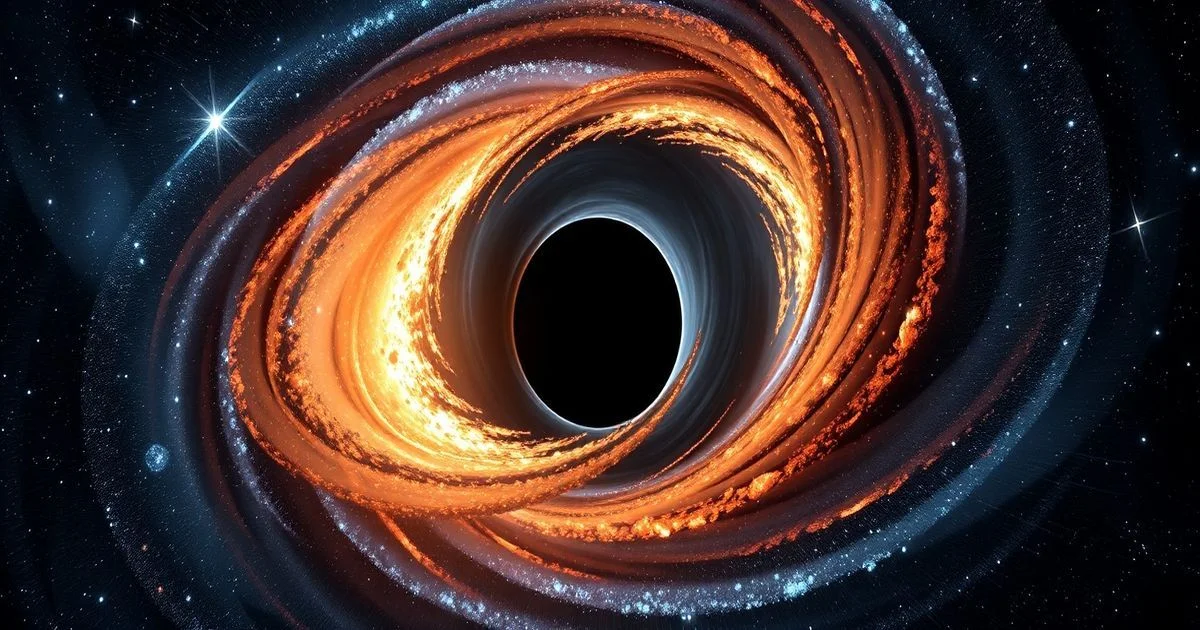
If the remnant core's mass exceeds the Oppenheimer-Volkoff Limit (roughly 2-3 solar masses), even neutron degeneracy pressure cannot halt the gravitational collapse. The core collapses indefinitely, forming a gravitational singularity surrounded by an event horizon – a black hole. To truly grasp the extreme physics involved, delving into how black holes function in deep space physics can provide further context.
- Event Horizon: The boundary around a black hole beyond which nothing, not even light, can escape.
- Singularity: A point of infinite density at the center of a black hole, where current physics breaks down.
- Properties: Black holes are characterized only by their mass, spin, and electric charge (the "no-hair" theorem).
The formation of neutron stars and black holes represents the ultimate destiny for massive stars, leaving behind some of the most exotic and extreme objects in the universe.
Understanding the Lifecycle of a Star in Stellar Physics: Key Concepts and Implications
The detailed understanding the lifecycle of a star in stellar physics not only unravels the mystery of celestial bodies but also illuminates profound connections to the origin of matter, the formation of planetary systems, and even the very existence of life.
Stellar Nucleosynthesis: The Cosmic Alchemist
Perhaps the most significant implication of stellar evolution is stellar nucleosynthesis – the process by which stars create new atomic nuclei from pre-existing protons and neutrons.
Elements up to Iron:
During their main sequence lives and subsequent red giant phases, stars produce elements up to iron (Fe) through various fusion processes. Hydrogen fuses into helium, then helium fuses into carbon and oxygen. In massive stars, carbon, oxygen, neon, magnesium, silicon, and finally iron are sequentially fused in their cores.
Elements Heavier than Iron:
Elements heavier than iron cannot be formed through fusion in ordinary stellar cores because their creation consumes energy rather than releases it. These elements are primarily forged during the explosive conditions of supernovae through processes like rapid neutron capture (r-process) and slow neutron capture (s-process), or through less dramatic processes in AGB stars. You can learn more about this incredible cosmic process in How Periodic Table Elements are Formed in Stars: A Cosmic Journey.
Our Cosmic Connection:
Every atom of carbon in our bodies, the oxygen we breathe, the silicon in our computers, and the iron in our blood was once forged inside a star, released into the cosmos by stellar winds or supernova explosions, and eventually incorporated into new star systems and planets. We are literally made of stardust. This profound realization underpins much of modern astrophysics and cosmology.
The Role of Binary Systems
While we often discuss stars as isolated entities, a significant fraction of stars (perhaps more than half) exist in binary or multiple star systems. The presence of a companion star can dramatically alter a star's evolutionary path, leading to unique and often spectacular phenomena.
Mass Transfer:
In close binary systems, one star can gravitationally "steal" matter from its companion. This mass transfer can significantly change the masses and evolutionary timelines of both stars. For instance, a white dwarf accreting matter from a companion can reach the Chandrasekhar Limit and explode as a Type Ia supernova. These supernovae are extremely important "standard candles" for measuring cosmic distances because they all originate from white dwarfs reaching the same critical mass.
Exotic Stellar Objects:
Binary interactions can lead to the formation of exotic systems, such as X-ray binaries (where a compact object like a neutron star or black hole accretes matter from a companion, heating it to X-ray emitting temperatures), cataclysmic variables, and possibly even merging black holes or neutron stars that generate gravitational waves.
The Future of Stellar Exploration and Research
Our understanding of stellar lifecycles is continually refined by cutting-edge observational and theoretical research. The next decades promise even deeper insights into these cosmic furnaces.
Observational Astronomy:
- James Webb Space Telescope (JWST): Its infrared capabilities allow us to peer through dust clouds to observe protostars in their earliest stages and study the atmospheres of distant exoplanets orbiting various types of stars.
- Hubble Space Telescope (HST): Continues to provide breathtaking images of nebulae, planetary nebulae, and supernovae remnants, offering crucial data on stellar mass loss and element distribution.
- Gaia Mission: ESA's Gaia spacecraft is meticulously mapping the Milky Way, providing unprecedented data on the positions, motions, and luminosities of billions of stars, allowing astronomers to refine stellar evolutionary models and study stellar populations.
Gravitational Wave Astronomy:
The advent of gravitational wave observatories like LIGO (Laser Interferometer Gravitational-Wave Observatory) and Virgo has opened a new window into the universe. These observatories detect ripples in spacetime caused by cataclysmic events involving massive stellar remnants, such as the inspiral and merger of black holes and neutron stars. These detections directly confirm predictions of general relativity and provide new insights into the extreme physics of stellar death.
Theoretical Modeling and Simulations:
Supercomputers are crucial for simulating the complex physics of stellar interiors, stellar explosions, and the formation of stars and planets. These simulations allow scientists to test theories, predict new phenomena, and interpret observational data. Advancements in computational astrophysics will continue to deepen our theoretical understanding.
Unanswered Questions:
Despite tremendous progress, many mysteries remain. How do the very first stars (Population III stars) form and evolve without any heavy elements? What role do magnetic fields play in stellar evolution and supernova explosions? How do the most massive stars shed their mass? The connection between stellar evolution and dark matter/dark energy remains an active area of inquiry. The quest to fully comprehend stars, from their birth to their end, continues to be a driving force in scientific discovery.
Conclusion: The Enduring Saga of Stellar Physics
The journey of a star is a profound testament to the universe's dynamic and interconnected nature. From the ethereal wisps of molecular clouds to the dramatic brilliance of a supernova, and finally to the silent vigil of a white dwarf or the enigmatic embrace of a black hole, each stage is governed by fundamental physical laws. Understanding the lifecycle of a star in stellar physics reveals not just the fate of individual celestial bodies, but also the cosmic engine behind the creation of all elements heavier than hydrogen and helium, shaping galaxies and providing the raw materials for life itself. As technology advances, our capacity to observe, measure, and simulate these stellar processes only grows, promising even more breathtaking discoveries about the lives and deaths of the universe's most luminous inhabitants.
Frequently Asked Questions
Q: What determines a star's lifespan?
A: A star's lifespan is primarily determined by its initial mass. More massive stars possess greater gravitational forces, which necessitate higher core temperatures and pressures to maintain hydrostatic equilibrium, causing them to burn through their nuclear fuel much faster and live shorter, more energetic lives than less massive stars.
Q: What is a planetary nebula?
A: A planetary nebula is a beautiful, glowing shell of ionized gas and dust that is ejected from a low-mass star (like our Sun) during its final stages of evolution. It forms around the star's super-hot, exposed core, which will eventually cool to become a white dwarf, and plays a vital role in enriching the interstellar medium with heavy elements.
Q: What are the final stages for high-mass stars?
A: High-mass stars meet a spectacular end, culminating in a Type II supernova explosion after their iron cores collapse. Depending on the remaining core's mass, the aftermath is either an incredibly dense neutron star, or if the core is massive enough, an event horizon that forms a black hole, representing the most extreme objects in the universe.