Trump Warns on Strait of Hormuz Amid Mideast Tensions: A Critical Overview
In a dramatic turn of events underscoring heightened regional instability, former U.S. President Donald Trump has issued renewed warnings on the Strait of Hormuz amid Mideast tensions, emphasizing the critical role of this waterway in global trade and energy security. The strategic chokepoint, vital for a significant portion of the world's oil and liquefied natural gas (LNG) shipments, has become a focal point of recent geopolitical maneuvers and military posturing, prompting international concern and impacting global markets. As of early April 2026, the Strait finds itself at the heart of ongoing ceasefire negotiations between the United States and Iran, following a period of intense conflict and an effective blockade by Tehran.
- The Strait of Hormuz: A Flashpoint Amidst Rising Mideast Tensions
- Trump Warns on Strait of Hormuz Amid Mideast Tensions: Resurgent Warnings and Direct Actions
- Geopolitical Ramifications and Economic Fallout
- International Law and Iran's Stance
- Ongoing Peace Talks and Future Outlook
- Frequently Asked Questions
- Further Reading & Resources
The Strait of Hormuz: A Flashpoint Amidst Rising Mideast Tensions
The Strait of Hormuz, a narrow passage between the Arabian Peninsula and Iran, connects the Persian Gulf with the Gulf of Oman and the Arabian Sea. Its geographical significance cannot be overstated; it is one of the world's most critical oil transit chokepoints, through which an average of 20 million barrels per day (mb/d) of crude oil and oil products were shipped in 2025. This volume represents approximately 25% of the world's seaborne oil trade, with roughly 80% destined for Asian markets, primarily China, India, and Japan. The historical significance of such vital global arteries is further explored in Understanding the history of major global trade routes. Beyond oil, the Strait is also crucial for global gas trade, as it facilitates nearly 20% of global LNG exports, predominantly from Qatar and the UAE.
Recent months have seen the Strait of Hormuz transform into a theater of conflict, with Iran largely blocking shipping traffic since February 28, 2026. This action followed a joint U.S. and Israeli air war against Iran, which led to retaliatory missile and drone attacks by Iran on Israel, U.S. military bases, and U.S.-allied Gulf states, escalating what some have termed Trump's Iran Ultimatum: Strait of Hormuz Crisis Escalates. The Islamic Revolutionary Guard Corps (IRGC) issued warnings forbidding passage and has reportedly laid sea mines, along with launching confirmed attacks on merchant ships. This escalation has created the most significant supply disruption in the modern oil market, taking approximately 11 million barrels per day of crude production offline and significantly reducing Middle East Gulf export volumes.
Trump Warns on Strait of Hormuz Amid Mideast Tensions: Resurgent Warnings and Direct Actions
In the context of these escalating Mideast tensions, former President Donald Trump has been vocal and assertive regarding the status of the Strait of Hormuz. His recent statements and actions highlight a determined effort to ensure the unimpeded flow of maritime traffic through this vital waterway.
Ceasefire Demands and Continued Disruption
Following weeks of military operations, President Trump announced a fragile two-week ceasefire deal with Iran on April 7, 2026. A core demand of this agreement, according to Trump, was the "complete, immediate and safe opening" of the Strait of Hormuz. However, despite this announcement, Iran has not fully relinquished its control. The regime continues to warn vessels to seek permission for transit and has reportedly imposed significant tolls on ships attempting to pass through. On April 9, 2026, Trump specifically cautioned Iran against imposing these tolls, stating via a Truth Social post, "They better not be and, if they are, they better stop now!" He further criticized Iran's "dishonorable" behavior regarding the slow flow of oil, asserting that it was "not the agreement we have!"
U.S. Military Intervention to Clear the Strait
In a direct response to Iran's continued impedance of traffic, President Trump announced on April 11, 2026, that the United States had begun the process of "clearing out" the Strait of Hormuz. He framed this as a service to countries worldwide, including major oil importers like China, Japan, and South Korea. This operation primarily involves clearing underwater mines that Iran had reportedly laid in the Strait.
U.S. Central Command (CENTCOM) confirmed these naval operations, stating that two U.S. Navy guided-missile destroyers, the USS Frank E. Petersen and USS Michael Murphy, successfully transited the Strait and began "setting conditions for the mission to ensure that the waterway is completely clear of mines laid by the Islamic Revolutionary Guard Corps." This move marks a significant escalation in efforts to restore full navigation. Interestingly, reports suggest Iran is facing challenges in locating and removing the mines it laid, some of which may have drifted or were not precisely marked.
Geopolitical Ramifications and Economic Fallout
The conflict and the subsequent closure or severe restriction of the Strait of Hormuz have sent shockwaves across the global geopolitical and economic landscape. Its significance extends far beyond the immediate region.
A Critical Chokepoint for Global Energy
The Strait's role as the primary export route for oil from Saudi Arabia, the UAE, Kuwait, Qatar, Iraq, Bahrain, and Iran makes any disruption highly consequential. While Saudi Arabia and the UAE possess some alternative pipeline routes, other nations in the region are almost entirely reliant on the Strait for their energy exports. The potential to disrupt or close this chokepoint grants Iran immense strategic leverage, particularly given that a prolonged closure could effectively strand the vast majority of the world's spare oil production capacity, much of which is held by Saudi Arabia.
Unprecedented Economic Disruption
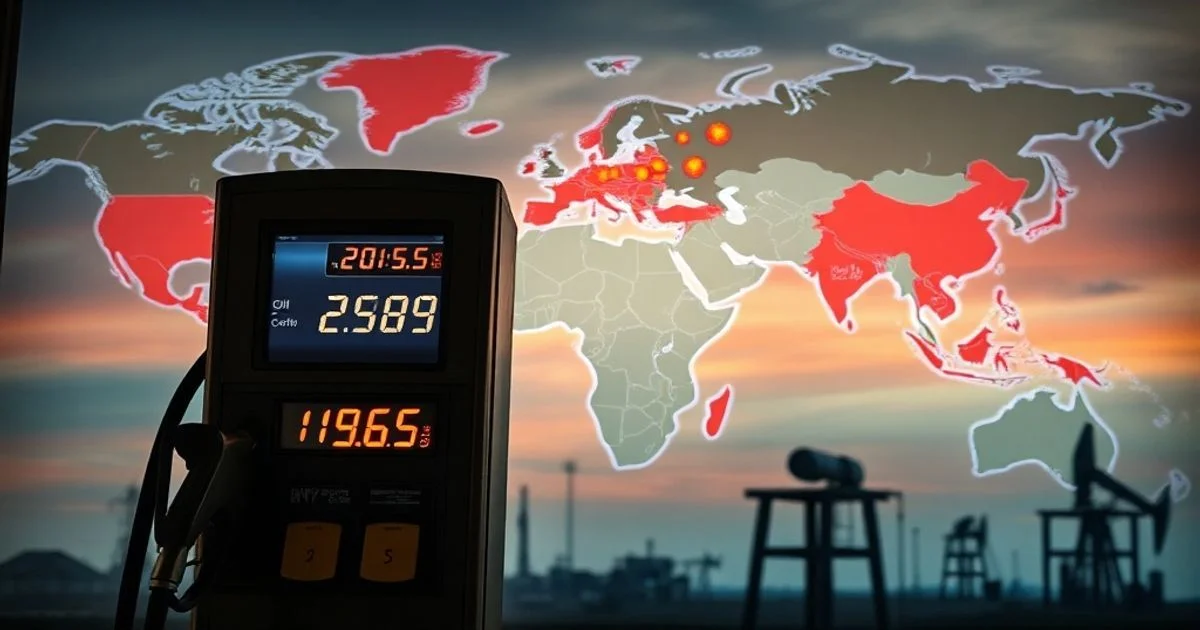
The impact on global energy markets has been severe, described by the International Energy Agency as the "greatest global energy security challenge in history" and the "largest supply disruption in the history of the global oil market." Brent crude oil prices surged dramatically, surpassing US$100 per barrel on March 8, 2026, for the first time in four years, reaching a peak of US$126 per barrel. This spike has been particularly problematic for major Asian importers like China and India, who face potential supply shortages and price volatility. For more context on global energy market disruptions, see our article on Gas Prices Soar Amidst Global Oil Tensions.
Beyond crude oil, the disruption has affected other crucial commodity markets, including:
- Natural Gas: The closure has stranded LNG exports from Qatar and the UAE, which together account for almost 20% of global LNG exports, leading to a major supply shock.
- Refined Products: Refinery run cuts in the Middle East have led to product supply losses, impacting exports from countries like India and East Asian nations.
- Industrial Commodities: Markets for aluminum, fertilizer, and helium have also suffered significant supply disruptions and price increases, with the Strait being critical for sulfur and urea exports.
The crisis has also forced QatarEnergy to declare force majeure on all exports, and oil production in Kuwait, Iraq, Saudi Arabia, and the UAE has collectively dropped by at least 10 million barrels per day as of March 12, 2026.
International Law and Iran's Stance
The legality of Iran's actions in restricting passage through the Strait of Hormuz is a complex and contentious issue under international law.
UNCLOS and Transit Passage
The Strait of Hormuz is widely recognized as an international strait under the United Nations Convention on the Law of the Sea (UNCLOS). Article 37 of UNCLOS establishes the regime of "transit passage," which guarantees free, continuous, and unobstructed passage for all ships and aircraft, both civilian and military, through international straits. This right is considered inviolable and is not suspended by armed conflict.
However, the U.S. is not a party to UNCLOS, though it considers many of its provisions as customary international law. More significantly, Iran also declined to ratify UNCLOS in 1982 and provided an interpretative declaration specifically concerning straits. Iran's position asserts that only states parties to UNCLOS are entitled to benefit from the contractual rights created therein, particularly the "right of Transit passage through straits used for international navigation." This effectively means Iran views the UNCLOS provisions on transit passage as treaty law, not customary international law binding on non-parties like itself.
The "Tehran Toll Booth" and Permissible Passage
Iran has not only blocked traffic but also imposed a $2 million transit fee on vessels and demanded that ships seek permission to traverse the Strait. These actions are considered by many international legal scholars to be illegal under UNCLOS, which prohibits charges levied on foreign ships solely by reason of passage. Iran, however, appears to be seeking legal authorities analogous to those Turkey holds over the Turkish Straits under the Montreux Convention or Egypt exercises with the Suez Canal, neither of which fully apply to an international strait like Hormuz. Iran's continued assertion of "de facto control" over the Strait, dictating which ships can pass, remains a significant point of contention.
Ongoing Peace Talks and Future Outlook
Amidst the military actions and legal disputes, diplomatic efforts are underway to de-escalate the conflict and find a lasting resolution. Peace talks between U.S. and Iranian officials have commenced in Pakistan.
Divergent Demands and a Fragile Ceasefire
The reopening of the Strait of Hormuz remains a primary U.S. demand in these negotiations. Conversely, Iran has put forth its own 10-point peace plan, which notably includes a call for continued Iranian control of the Strait of Hormuz, alongside demands for the release of frozen Iranian assets and the lifting of sanctions. These differing stances on such a critical issue highlight the deep divisions that negotiators must bridge. The current two-week ceasefire, announced by President Trump, is considered fragile, with mixed signals regarding its effectiveness and scope, particularly concerning the Strait's full reopening. Iran also asserts that the ceasefire agreement included a cessation of Israeli attacks on Hezbollah in Lebanon, a point the White House has denied, further complicating the diplomatic landscape.
Long-Term Strategies and Regional Stability
The crisis has spurred discussions on long-term strategies to reduce reliance on the Strait of Hormuz. Proposals include building new energy infrastructure that bypasses the Strait through multiple defensible routes, coupled with robust drone defenses. Such initiatives would aim to diminish Iran's leverage over the global economy, as the regime has strategically "weaponized geography."
The current situation in the Strait of Hormuz underscores the enduring volatility of the Middle East. The interplay of military pressure, economic repercussions, and intricate diplomatic negotiations will ultimately determine the future of this vital global artery. The international community watches closely as the U.S. and Iran navigate these perilous waters, understanding that the stakes involve not only regional stability but also the health of the global economy. The warnings from President Trump on the Strait of Hormuz amid Mideast tensions serve as a stark reminder of the delicate balance required to maintain peace and ensure the free flow of critical resources worldwide.
Frequently Asked Questions
Q: What is the Strait of Hormuz and why is it important?
A: The Strait of Hormuz is a crucial narrow waterway connecting the Persian Gulf to the open sea, situated between Iran and the Arabian Peninsula. It is vital for global energy trade, with approximately 20% of the world's oil and liquefied natural gas (LNG) passing through it daily, making it a critical chokepoint for global energy security.
Q: What is the impact of disruptions in the Strait of Hormuz on global markets?
A: Disruptions in the Strait of Hormuz severely impact global energy markets, causing oil and gas price surges, supply shortages, and significant economic instability worldwide. Such blockades can also affect other industrial commodities like aluminum and fertilizers, leading to cascading economic effects.
Q: What is the international legal status of the Strait of Hormuz?
A: Under the United Nations Convention on the Law of the Sea (UNCLOS), the Strait of Hormuz is recognized as an international strait with "transit passage" rights for all vessels, ensuring free and unobstructed passage. However, Iran, which has not ratified UNCLOS, asserts greater control over the waterway, making its legal status a contentious international issue.