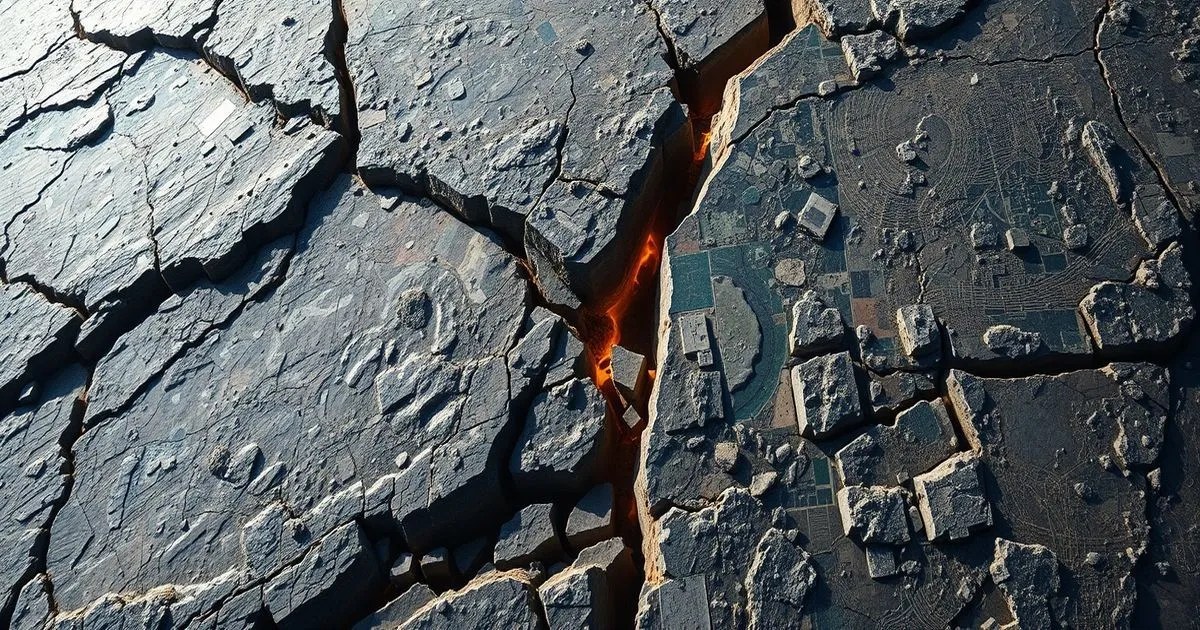
The Earth's Restless Skin: What is "The Crack of the World"?
The phrase "The Crack of the World" evokes images of a planet under immense strain, perhaps on the brink of fracturing. While this might sound like something out of a disaster movie, in a very real, scientific sense, our world is cracked. These "cracks" are the magnificent, powerful, and sometimes terrifying fault lines that crisscross Earth's surface, constantly reshaping continents, forming mountains, and triggering earthquakes.
Far from being static features, these cracks are the visible manifestations of Earth's relentless internal forces – the slow, ponderous dance of tectonic plates that define our planet's geodynamics. Understanding these colossal fractures is key to comprehending the very ground beneath our feet, from the deepest ocean trenches to the tallest peaks.
Understanding Plate Tectonics: Earth's Grand, Slow-Motion Dance
To truly grasp the concept of "the crack of the world," we must first delve into the fundamental theory of plate tectonics. Imagine the Earth not as a solid, monolithic sphere, but as an onion with several distinct layers.
- Core: A super-heated, dense inner and outer core.
- Mantle: A thick, semi-solid layer of hot, ductile rock that slowly churns through convection currents.
- Crust: The relatively thin, brittle outer shell we live on.
This crust, along with the uppermost part of the mantle, forms the lithosphere. Crucially, the lithosphere isn't a single, unbroken shell. Instead, it's fragmented into several colossal pieces called tectonic plates. These plates "float" on the more fluid-like asthenosphere (part of the mantle) and are constantly moving, driven by the immense heat and convection currents within the mantle.
The "Cracks" Themselves: Fault Lines Explained
A fault is essentially a fracture or zone of fractures between two blocks of rock. When these blocks move relative to each other, often due to the immense stresses generated by plate tectonics, it's called faulting. This movement can be sudden and dramatic, releasing vast amounts of energy in the form of an earthquake.
Geologists classify faults primarily by the direction of their movement:
1. Normal Faults
Occur in areas where the crust is being pulled apart (extensional forces). One block of rock (the hanging wall) slides down relative to the block beneath it (the footwall). These are common at divergent plate boundaries, where plates move away from each other, like in rift valleys.
2. Reverse (Thrust) Faults
These form under compressional forces, where the crust is being squeezed together. One block is pushed up and over the other. If the angle of the fault plane is low (less than 45 degrees), it's specifically called a thrust fault. They are characteristic of convergent plate boundaries, where plates collide, leading to mountain building.
3. Strike-Slip Faults
These faults involve horizontal movement, where the blocks slide past each other rather than moving up or down. They are a hallmark of transform plate boundaries, where plates grind alongside one another. The most famous example is the San Andreas Fault in California.
Iconic Cracks: Case Studies
The "cracks of the world" are not abstract concepts; they are tangible, powerful features shaping our landscapes.
The San Andreas Fault: California's Sleeping Giant
Perhaps the most famous strike-slip fault globally, the San Andreas marks a significant portion of the boundary between the Pacific Plate and the North American Plate. These two plates are sliding past each other at an average rate of a few centimeters per year. While this movement is mostly slow and continuous (known as "creep"), stress builds up along locked sections of the fault, eventually releasing in powerful earthquakes.
Scientists extensively monitor movements along the San Andreas using GPS, seismometers, and InSAR (Interferometric Synthetic Aperture Radar) data. This data helps us understand stress accumulation and predict future seismic activity, though precise earthquake prediction remains a significant challenge.
To visualize how scientists might conceptualize such data, consider a simplified representation of seismic energy release:
import numpy as np
import matplotlib.pyplot as plt

# Conceptual data: simulated seismic energy along a fault over time
# In reality, this would involve complex sensor networks and processing.
time_points = np.arange(0, 100, 1) # 100 arbitrary time units
# Simulate a general trend with some fluctuations and occasional spikes
seismic_energy = 5 * np.sin(time_points / 15) + np.random.rand(100) * 2 + 7
# Add a couple of "event" spikes to simulate larger energy releases
seismic_energy[30:32] += 10
seismic_energy[75:77] += 8

plt.figure(figsize=(12, 7))
plt.plot(time_points, seismic_energy, label='Simulated Seismic Energy Release (Arbitrary Units)', color='darkorange')
plt.xlabel('Time (Arbitrary Units)', fontsize=12)
plt.ylabel('Seismic Energy (Arbitrary Units)', fontsize=12)
plt.title('Conceptual Seismic Activity Over Time Along a Fault Section', fontsize=14)
plt.grid(True, linestyle='--', alpha=0.7)
plt.legend(fontsize=10)
plt.show()

print("This conceptual plot illustrates how geophysicists might visualize patterns in raw seismic data over time. Identifying anomalies or sudden spikes helps in understanding the dynamics of fault lines.")
This simple visualization demonstrates how even conceptual data can hint at the complex energy dynamics within a fault system.
The East African Rift Valley: A Continent Tearing Apart
In stark contrast to the San Andreas, the East African Rift Valley is a prime example of a divergent plate boundary on land. Here, the African Plate is slowly splitting apart, forming a colossal system of normal faults that stretch for thousands of kilometers. This process has created deep valleys, volcanic mountains (like Kilimanjaro), and a series of lakes. In millions of years, this "crack" could widen enough to form a new ocean basin, effectively splitting Africa into two continents.
The Mid-Atlantic Ridge: An Ocean's Birthplace
Beneath the Atlantic Ocean lies another major divergent boundary – the Mid-Atlantic Ridge. This enormous underwater mountain range, dotted with transform faults, is where new oceanic crust is continuously being generated as magma rises from the mantle. It's a colossal "crack" where the North American and Eurasian plates (and South American and African plates) are pulling apart, slowly widening the Atlantic.
Living with the Cracks: Mitigation and Monitoring
Understanding these "cracks of the world" isn't just academic; it's crucial for human safety and infrastructure.
- Seismology: The study of earthquakes and seismic waves is paramount. Seismometers continuously record ground motion, allowing scientists to pinpoint earthquake epicenters, depths, and magnitudes.
- Geodetic Monitoring: Techniques like GPS and InSAR precisely measure ground deformation over time, detecting subtle movements that precede or accompany seismic events.
- Building Codes: In earthquake-prone regions, strict building codes are enforced to ensure structures can withstand seismic shaking, minimizing damage and loss of life.
- Early Warning Systems: Advanced systems in places like Japan and California detect the first, faster seismic waves (P-waves) and issue warnings before the slower, more destructive S-waves arrive, giving precious seconds for people to take cover.
The Future of Earth's Cracks
The Earth is a constantly evolving planet. The cracks we observe today are merely snapshots in its geological timeline. Continents will continue to drift, new oceans will form, old ones will close, and mountains will rise and fall. The dynamic interplay of plate tectonics ensures that "the crack of the world" is not a static wound, but a living, breathing testament to the immense power and ceaseless change within our planet.
Conclusion
"The Crack of the World" isn't a singular, catastrophic event waiting to happen, but rather the ever-present, awe-inspiring reality of Earth's dynamic geology. From the subtle creep of a fault to the dramatic rupture of an earthquake, these fractures are fundamental to our planet's very existence. By studying them, we not only unravel the mysteries of Earth's past but also gain critical insights to prepare for its future, living more harmoniously with the powerful forces that shape our world.