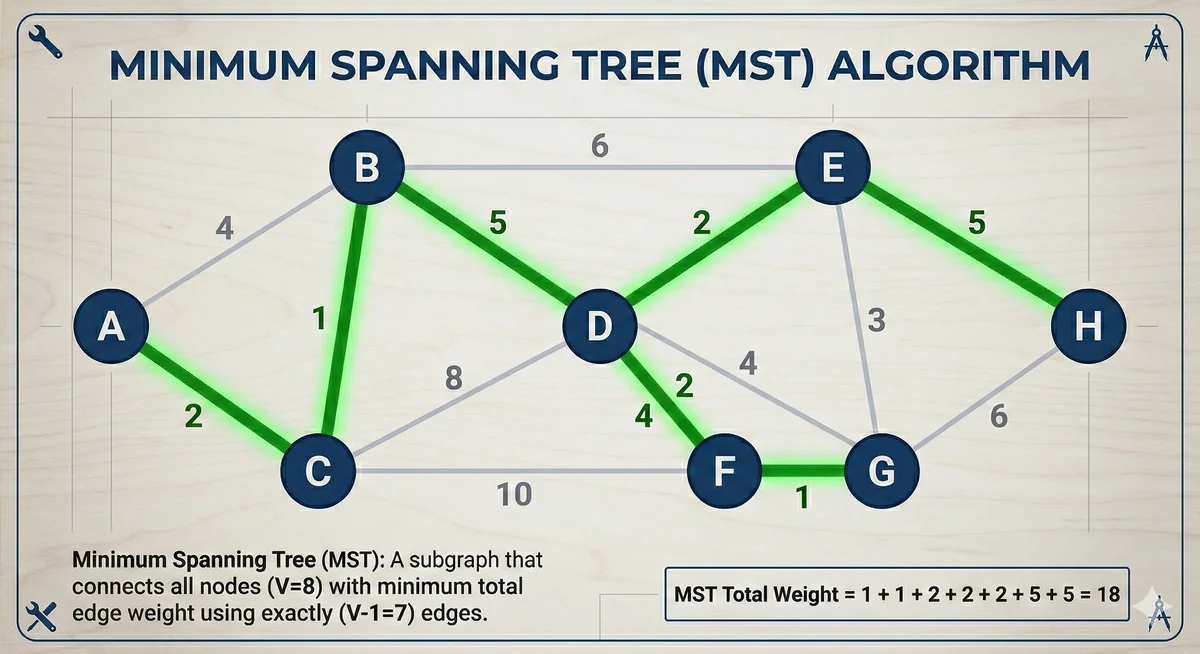
Understanding and efficiently computing the shortest path in Directed Acyclic Graph (DAG) structures is a cornerstone of modern computer science, a topic this in-depth guide will thoroughly explore. While graphs are fundamental data structures, modeling everything from social networks to logistical routes, and the problem of finding the shortest path stands as a critical challenge, specific graph types allow for highly optimized solutions. General graph algorithms like Dijkstra's or Bellman-Ford are powerful but often carry a computational overhead that can be significantly reduced when dealing with DAGs. This specialized algorithm not only unlocks superior performance for certain problems but also deepens one's grasp of dynamic programming and graph traversal.
- Unpacking Directed Acyclic Graphs (DAGs)
- The Challenge of Finding the Shortest Path in Directed Acyclic Graph
- The Algorithm: Topological Sort Meets Dynamic Programming
- Key Components and Concepts
- Advantages Over General Shortest Path Algorithms
- Real-World Applications of Shortest Path in DAGs
- Performance Considerations and Limitations
- The Future Landscape: Evolving Applications and Algorithms
- Conclusion
- Frequently Asked Questions
- Further Reading & Resources
Unpacking Directed Acyclic Graphs (DAGs)
Before we dissect the shortest path algorithm, it's essential to fully grasp the characteristics of a Directed Acyclic Graph (DAG). Imagine a network where connections have a specific one-way flow, and crucially, there are no closed loops.
What is a Graph?
At its core, a graph is a data structure consisting of a set of vertices (or nodes) and a set of edges that connect pairs of these vertices. Graphs are incredibly versatile, capable of representing relationships between entities in a myriad of contexts. For instance, cities on a map can be vertices, and roads connecting them can be edges. Web pages are nodes, and hyperlinks are edges.
Graphs can be categorized based on various properties. An unweighted graph simply indicates connectivity, while a weighted graph assigns a numerical value (weight) to each edge, representing cost, distance, time, or capacity. Similarly, graphs can be undirected, meaning edges allow bidirectional traversal, or directed, where edges enforce a one-way flow.
The "Directed" Aspect
In a directed graph, each edge has a specific orientation, typically from a source vertex (u) to a destination vertex (v), denoted as (u, v). This implies that you can traverse from u to v, but not necessarily from v to u, unless there's a separate directed edge (v, u). Think of it like a one-way street system. If a task A must be completed before task B, this forms a directed edge from A to B. This directionality is critical for modeling sequences, dependencies, and irreversible processes.
The "Acyclic" Aspect
The "acyclic" property is what truly differentiates a DAG from a general directed graph. A graph is acyclic if it contains no cycles, meaning there is no path that starts and ends at the same vertex by traversing a sequence of directed edges. If you start at any node and follow the arrows, you will never return to your starting point.
Consider a task dependency graph: if task A must precede B, and B must precede C, a cycle would imply C must precede A. This creates a logical paradox, an infinite loop of dependencies that can never be resolved. Acyclic structures inherently avoid such paradoxes, making them ideal for modeling processes that have a clear start and end, with no circular dependencies. Examples include project schedules, compilation pipelines, or the lineage of versions in a file system.
Why DAGs Matter for Shortest Paths
The combination of "directed" and "acyclic" is profound for shortest path calculations. The absence of cycles eliminates the possibility of negative cycles, which are a notorious problem for many shortest path algorithms. A negative cycle would allow an infinitely decreasing path length simply by traversing the cycle repeatedly. Furthermore, the acyclic nature enables a unique and highly efficient processing order known as topological sorting. This ability to linearly order nodes based on their dependencies is the secret sauce behind the speed of shortest path algorithms on DAGs. It ensures that when we compute the shortest path to a node, all paths leading to it from its predecessors have already been optimally determined.
The Challenge of Finding the Shortest Path in Directed Acyclic Graph
Understanding graph traversal algorithms, such as those used to solve problems like the Word Ladder puzzle, is foundational in computer science. The problem of finding the shortest path from a single source vertex to all other vertices in a graph is a cornerstone challenge, critical for countless computational tasks. For general graphs, two prominent algorithms come to mind: Dijkstra's Algorithm and the Bellman-Ford Algorithm. Dijkstra's is efficient (O(E log V) or O(E + V log V) with a Fibonacci heap) but fails in the presence of negative edge weights. Bellman-Ford handles negative weights but at a higher time complexity of O(V*E).
However, when confronted with the specific structure of a Directed Acyclic Graph, we don't need to settle for these general-purpose solutions. DAGs present an opportunity for a much faster approach, one that elegantly leverages their inherent properties. The challenge isn't just to find a shortest path, but to do so with optimal efficiency, exploiting the fact that there are no cyclical traps or ambiguous dependencies. The very structure of a DAG allows us to process nodes in an order that guarantees we will never revisit a decision based on a later-discovered shorter path through an earlier node. This crucial insight leads to an algorithm with a linear time complexity, making it significantly faster for large graphs.
The Algorithm: Topological Sort Meets Dynamic Programming
The algorithm to find the shortest path from a single source in a DAG combines two powerful concepts: topological sorting and path relaxation, which is a form of dynamic programming. This synergy results in an incredibly efficient solution, achieving linear time complexity.
Step 1: Topological Sorting
Topological sorting is a linear ordering of vertices such that for every directed edge (u, v), vertex u comes before v in the ordering. This is only possible in a DAG because the absence of cycles guarantees such an ordering exists. Imagine a list of tasks where each task must be completed before its dependent tasks can begin; a topological sort provides a valid sequence for executing these tasks.
There are primarily two algorithms for topological sorting:
-
Kahn's Algorithm (using in-degrees):
- Initialize an array
in_degreefor all vertices, storing the count of incoming edges. - Create a queue and add all vertices with an
in_degreeof 0 (no prerequisites). - While the queue is not empty:
- Dequeue a vertex
uand add it to the topological order. - For each neighbor
vofu:- Decrement
in_degree[v]. - If
in_degree[v]becomes 0, enqueuev.
- Decrement
- Dequeue a vertex
- This algorithm runs in O(V + E) time, as each vertex and edge is processed a constant number of times.
- Initialize an array
-
DFS-based Algorithm:
- Perform a Depth-First Search (DFS) on the graph.
- During the DFS, instead of adding a vertex to the topological sort before visiting its neighbors, add it after visiting all its neighbors (i.e., when it's popping off the recursion stack).
- Reverse the order of vertices collected during this post-order traversal to get the topological sort.
- This also runs in O(V + E) time.
The importance of topological sorting here cannot be overstated. By processing vertices in this specific order, we ensure that by the time we consider a vertex u, all its predecessors have already been processed, and their shortest paths from the source have been finalized. This prevents redundant computations and guarantees optimality.
Step 2: Path Relaxation
Once we have a topological order of vertices, the relaxation process is straightforward and akin to dynamic programming. We maintain an array dist[v] that stores the shortest distance found so far from the source vertex s to vertex v. Initially, dist[s] is 0, and dist[v] for all other vertices v is set to infinity.
The relaxation process proceeds as follows:
- Initialization:
dist[s] = 0(distance from source to itself is zero).dist[v] = infinityfor allv != s.
- Iterate in Topological Order:
- For each vertex
uin the topologically sorted list:- If
dist[u]is infinity, skip it (unreachable from source). - For each neighbor
vofu(i.e., for each edge(u, v)with weightw(u,v)):- Relaxation Step: If
dist[u] + w(u,v) < dist[v]:- Update
dist[v] = dist[u] + w(u,v). - Optionally, update a
predecessor[v] = uto reconstruct the path later.
- Update
- Relaxation Step: If
- If
- For each vertex
This relaxation step effectively says: "If the path from the source to v going through u is shorter than any path to v found so far, then update dist[v]." Because u is processed before v in the topological order, we are guaranteed that dist[u] already holds the true shortest path from the source to u. Thus, any update to dist[v] will correctly propagate the shortest path information.
Example Walkthrough (Conceptual)
Let's consider a simple DAG with source A: Edges: (A, B, 1), (A, C, 4), (B, C, 2), (B, D, 6), (C, D, 1)
-
Topological Sort: A possible topological order could be [A, B, C, D].
-
Initialization:
dist = {A: 0, B: inf, C: inf, D: inf}pred = {A: null, B: null, C: null, D: null} -
Process A (from topological order):
dist[A] = 0.-
Relax (A, B, 1):
dist[A] + 1 = 1 < dist[B] (inf). So,dist[B] = 1,pred[B] = A.dist = {A: 0, B: 1, C: inf, D: inf} -
Relax (A, C, 4):
dist[A] + 4 = 4 < dist[C] (inf). So,dist[C] = 4,pred[C] = A.dist = {A: 0, B: 1, C: 4, D: inf}
-
Process B:
dist[B] = 1.-
Relax (B, C, 2):
dist[B] + 2 = 1 + 2 = 3 < dist[C] (4). So,dist[C] = 3,pred[C] = B.dist = {A: 0, B: 1, C: 3, D: inf} -
Relax (B, D, 6):
dist[B] + 6 = 1 + 6 = 7 < dist[D] (inf). So,dist[D] = 7,pred[D] = B.dist = {A: 0, B: 1, C: 3, D: 7}
-
Process C:
dist[C] = 3.- Relax (C, D, 1):
dist[C] + 1 = 3 + 1 = 4 < dist[D] (7). So,dist[D] = 4,pred[D] = C.dist = {A: 0, B: 1, C: 3, D: 4}
-
Process D:
dist[D] = 4. No outgoing edges to relax.
Final dist values: A: 0, B: 1, C: 3, D: 4.
Final pred values: A: null, B: A, C: B, D: C.
To reconstruct the path to D: D <- C <- B <- A. This confirms the shortest path.
Key Components and Concepts
To fully appreciate the algorithm for finding the shortest path in Directed Acyclic Graphs, it's beneficial to understand the distinct roles of its core components and underlying concepts. Each plays a vital part in ensuring the algorithm's correctness and efficiency.
Nodes and Edges: The Fundamental Building Blocks
At the very foundation of any graph algorithm are the nodes (or vertices) and edges. Nodes represent entities or states within the system being modeled, such as cities, tasks, or data points. Edges represent the relationships or transitions between these entities. In a directed graph, an edge from node 'u' to node 'v' signifies a one-way connection or dependency. The graph's complexity and structure are entirely defined by how these nodes are connected by edges.
Weights: The Significance of Edge Values
In a weighted graph, each edge (u, v) is associated with a numerical weight, denoted as w(u,v). These weights quantify the "cost" or "length" of traversing that particular edge. Depending on the application, weights can represent:
- Distance: The physical length of a road segment.
- Time: The duration required to complete a task or travel between points.
- Cost: The monetary expense of a transaction or operation.
- Capacity: The throughput limit of a network link (though this is more common in max-flow problems, it can indirectly influence shortest paths). The presence and interpretation of these weights are critical because the algorithm aims to minimize the sum of weights along a path, not just the number of edges.
Source Vertex: The Starting Point
The source vertex s is the designated starting point from which all shortest paths are measured. In many applications, this is a specific origin point, such as a factory in a delivery network or the initial task in a project schedule. The algorithm calculates the shortest path from this single source to every other reachable vertex in the graph. If you need shortest paths between all pairs of vertices, this algorithm would be run multiple times, once for each potential source, or a different algorithm like Floyd-Warshall might be considered (though less efficient for sparse DAGs).
Distance Array: Storing Path Lengths
The dist array (often dist[v]) is an essential data structure that stores the current shortest distance found from the source s to each vertex v. It is initialized with dist[s] = 0 and dist[v] = infinity for all other vertices, reflecting that we haven't yet found a path to them. As the algorithm progresses, these infinity values are "relaxed" to finite numbers as shorter paths are discovered. This array is the algorithm's primary output, providing the length of the shortest path to every reachable node.
Predecessor Array: Reconstructing the Path
While the dist array gives us the length of the shortest path, it doesn't tell us which path. To reconstruct the actual sequence of vertices that form the shortest path, a predecessor array (often pred[v]) is used. When a relaxation step updates dist[v] because a path through u is shorter, pred[v] is set to u. After the algorithm completes, by tracing back from a target vertex using the pred array until the source is reached, the shortest path can be effectively reconstructed in reverse order. This array is crucial for practical applications where not just the cost, but the route itself, is required.
Negative Edge Weights: A Key Advantage
One of the most significant advantages of this DAG-specific shortest path algorithm is its ability to correctly handle negative edge weights. Unlike Dijkstra's algorithm, which fundamentally relies on the assumption that path lengths only increase and can break down with negative weights, the DAG algorithm processes vertices in topological order. Because there are no cycles, there can be no negative cycles. Therefore, even if a path contains negative-weighted edges, the monotonic progression through the topologically sorted nodes ensures that relaxation always leads to the true shortest path without the risk of infinite loops or incorrect updates. This makes the algorithm robust for scenarios where "costs" might actually represent gains or reductions.
Advantages Over General Shortest Path Algorithms
The specialized algorithm for finding the shortest path in Directed Acyclic Graphs offers compelling advantages over more general shortest path algorithms like Dijkstra's or Bellman-Ford, particularly in terms of time complexity and its handling of negative edge weights.
Time Complexity: O(V + E)
Perhaps the most significant advantage is its superior time complexity. The DAG shortest path algorithm runs in O(V + E) time, where V is the number of vertices and E is the number of edges. This linear time complexity is achieved by combining:
- Topological Sort: Which takes O(V + E) time.
- Path Relaxation: Each vertex and each edge is visited and processed exactly once during the relaxation phase. A loop iterates through V vertices, and for each vertex, its outgoing edges are processed. The sum of degrees of all vertices is 2E in an undirected graph and E in a directed graph. Thus, the relaxation phase also takes O(V + E) time.
Compare this to:
- Dijkstra's Algorithm: Typically O(E log V) with a binary heap or O(E + V log V) with a Fibonacci heap. While efficient, it's generally slower than O(V + E) for sparse graphs and comparable for dense graphs.
- Bellman-Ford Algorithm: O(V*E), significantly slower, especially for large graphs.
The O(V + E) complexity of the DAG algorithm is optimal, as any shortest path algorithm must at least inspect every vertex and every edge to guarantee correctness. This makes it an incredibly efficient choice when the graph structure permits its use.
Handling Negative Weights Gracefully
Another critical advantage is its inherent ability to correctly handle negative edge weights.
- Dijkstra's Algorithm fundamentally assumes non-negative edge weights. Its greedy approach relies on the idea that once a vertex's shortest distance is finalized, it will never be revisited by a shorter path. This assumption breaks down with negative weights, as a path through an unvisited vertex could suddenly shorten a previously finalized path.
- Bellman-Ford Algorithm can handle negative weights, but it does so by iterating through all edges V-1 times to ensure all paths are relaxed, making it O(V*E). It also detects negative cycles, which would invalidate any shortest path computation.
Because a DAG has no cycles (and thus no negative cycles), the issue that plagues Dijkstra's algorithm with negative weights simply doesn't exist. The topological sort ensures a sequential processing order where all predecessors of a vertex are processed before the vertex itself. This means that by the time a vertex u is processed, its dist[u] value represents the true shortest path from the source, regardless of whether some intermediate edges had negative weights. This robustness against negative weights, combined with its linear time complexity, makes the DAG algorithm uniquely powerful.
Conceptual Simplicity (for DAGs)
While the full algorithm involves two distinct steps (topological sort and relaxation), for a tech-savvy audience, the underlying logic can be seen as simpler and more intuitive for DAGs than Bellman-Ford. Bellman-Ford's iterative relaxation across all edges V-1 times can feel less direct than the DAG algorithm's single, ordered pass. The DAG algorithm's elegance stems from directly exploiting the graph's structure to avoid unnecessary iterations or complex cycle detection, leading to a more focused and efficient computation.
Real-World Applications of Shortest Path in DAGs
The ability to efficiently compute the shortest path in Directed Acyclic Graphs is not merely an academic exercise; it underpins critical functionalities across a wide spectrum of real-world computing and engineering problems. Its linear time complexity and robustness against negative weights make it an indispensable tool for optimization.
Project Scheduling & Task Dependencies: Critical Path Method (CPM)
One of the most classic applications is in project management, particularly with the Critical Path Method (CPM) and Program Evaluation and Review Technique (PERT). Here, tasks are represented as nodes, and dependencies between tasks (e.g., Task B cannot start until Task A is complete) are represented as directed edges. The weight of an edge can be the duration of the task or the time elapsed between tasks.
- Finding the Longest Path: While our algorithm finds the shortest path, by negating all edge weights and then finding the shortest path in the modified graph, we effectively find the longest path in the original graph. The longest path in a task dependency DAG represents the "critical path" – the sequence of tasks that determines the minimum total time required to complete the entire project. Delaying any task on the critical path will delay the entire project. This is crucial for resource allocation and deadline management.
Compiler Optimization: Instruction Scheduling
In the realm of compiler design, optimizing code execution is paramount. Data dependency graphs (DDGs) within a compiler represent operations as nodes and data dependencies as directed edges. For instance, if instruction B uses the result of instruction A, there's an edge from A to B. These DDGs are inherently DAGs.
- Instruction Scheduling: Compilers use shortest/longest path algorithms on these DAGs to optimally schedule instructions for execution on a processor, aiming to minimize execution time by identifying the longest sequence of dependent operations (the critical path) and arranging instructions to avoid stalls and maximize parallelism.
Dynamic Programming Problems: Implicit DAGs
Many dynamic programming problems can be elegantly modeled as finding shortest or longest paths in an implicit DAG. The states of the DP problem become nodes, and transitions between states become directed edges with associated costs.
- Example: Longest Increasing Subsequence (LIS): To find the LIS of a sequence, each number in the sequence can be a node. A directed edge exists from
nums[i]tonums[j]ifi < jandnums[i] < nums[j]. The problem then transforms into finding the longest path in this implicit DAG, often by assigning edge weights of -1 and finding the shortest path using our DAG algorithm. - Knapsack Variations, Matrix Chain Multiplication, etc.: Many optimization problems that exhibit optimal substructure and overlapping subproblems can be framed this way, transforming complex recurrences into graph traversals.
Version Control Systems (e.g., Git)
Version control systems like Git rely heavily on DAGs. Each commit in a repository can be viewed as a node, and the parent-child relationships between commits form directed edges. A commit points to its parent(s).
- History Traversal: Operations like
git logtraverse this DAG. While not strictly "shortest path" in terms of weights, understanding the ancestral relationships and identifying paths between branches or specific commits is a fundamental graph traversal problem that benefits from DAG properties. Finding the common ancestor of two branches, for example, involves navigating this DAG.
Data Pipelining and ETL Workflows
In data engineering and big data processing, data often moves through a series of transformations, filters, and aggregations. These processes can be structured as a DAG, where each processing step is a node and the flow of data is a directed edge.
- Optimizing Throughput/Latency: By assigning weights representing processing time or resource consumption to each node/edge, the shortest path algorithm (or longest path for bottlenecks) can be used to identify potential bottlenecks, optimize the sequence of operations, or minimize the overall time taken for a data pipeline (ETL - Extract, Transform, Load) to complete. This is crucial for real-time analytics and large-scale data processing.
Machine Learning: Neural Networks
Feedforward neural networks are inherently Directed Acyclic Graphs. Information flows from input layers through hidden layers to output layers, with no cycles.
- Backpropagation: While backpropagation isn't a shortest path algorithm in the traditional sense, it operates on the principles of dependency and flow within this DAG structure to propagate gradients efficiently. The computational graph of a neural network, which dictates how gradients are calculated, is a DAG where nodes are operations and edges represent data flow. Efficient processing relies on the acyclic nature.
These diverse applications highlight that the specialized algorithm for the shortest path in Directed Acyclic Graph is far more than an academic curiosity; it's a practical, high-performance solution that addresses critical challenges across numerous computational domains.
Performance Considerations and Limitations
While the algorithm for finding the shortest path in Directed Acyclic Graphs offers compelling advantages, understanding its performance characteristics and inherent limitations is crucial for appropriate application.
Pros: Unmatched Efficiency and Robustness
- Optimal Time Complexity (O(V + E)): This is the paramount advantage. For graphs with V vertices and E edges, the algorithm's linear time performance means it scales exceptionally well with increasing graph size. This makes it ideal for processing very large DAGs, often found in real-world dependency networks, where O(V*E) or O(E log V) might be prohibitively slow. Each vertex and edge is processed a constant number of times, ensuring minimal overhead.
- Handles Negative Edge Weights: Unlike Dijkstra's algorithm, the DAG shortest path algorithm correctly computes shortest paths even when edge weights are negative. This is a significant feature, enabling its use in scenarios where "costs" can represent benefits or reductions, and where traditional non-negative weight algorithms would fail or require complex transformations. The absence of negative cycles in a DAG removes the primary challenge for negative-weighted edges.
- Guaranteed Correctness: Provided the input graph is indeed a DAG, the algorithm is guaranteed to find the true shortest path from the source to all reachable vertices. The topological sort ensures that decisions about path lengths are made once, optimally, and are never invalidated by subsequent processing.
- Conceptually Elegant: For those familiar with dynamic programming, the "relaxation in topological order" approach is quite intuitive. It's a direct exploitation of the graph's structure.
Cons: Specificity and Resource Footprint
- Applicability Restricted to DAGs: This is the primary limitation. The algorithm will not work correctly on graphs that contain cycles. If a graph has cycles, a topological sort is undefined, and attempting to apply the algorithm will either fail during the topological sort phase or yield incorrect results during relaxation. If cycles are present, one must resort to more general algorithms like Bellman-Ford (which handles negative cycles by detecting them) or algorithms for specific types of graphs (e.g., Johnson's algorithm for all-pairs shortest paths with negative weights).
- Requires Topological Sort Upfront: While efficient, the topological sort is a prerequisite step and adds to the overall computation. For a graph that is nearly a DAG but contains a few cycles, detecting and breaking these cycles could be complex and computationally expensive, potentially outweighing the benefits of the specialized shortest path algorithm.
- Space Complexity: The algorithm typically requires O(V + E) space to represent the graph (e.g., using an adjacency list) and O(V) space for the distance, predecessor, and
in_degree(for Kahn's algorithm) orvisited(for DFS-based) arrays. For extremely large graphs, this memory footprint could become a consideration, though for most practical scenarios, it's manageable. - Single Source (Default): The base algorithm computes shortest paths from a single source vertex. If shortest paths between all pairs of vertices are needed, the algorithm would have to be run V times (once for each vertex as a source), leading to a total complexity of O(V*(V+E)). For dense graphs where E is close to V^2, this approaches O(V^3), at which point algorithms like Floyd-Warshall or Johnson's (for general graphs with negative weights) might become competitive or even superior depending on the sparsity.
In summary, the DAG shortest path algorithm is a prime example of how leveraging specific graph properties can lead to highly optimized solutions. Its efficiency and robustness against negative weights are significant assets, but its strict requirement for an acyclic graph structure defines its operational boundaries. When the problem domain perfectly aligns with a DAG, this algorithm is often the optimal choice.
The Future Landscape: Evolving Applications and Algorithms
The core algorithm for finding the shortest path in Directed Acyclic Graphs is a classic, but its applications and the underlying concepts continue to evolve, driven by advances in data science, distributed computing, and emerging computational paradigms. The fundamental principles remain, but their implementation and scale are continuously being pushed.
Big Data & Graph Databases: Scaling Shortest Paths
The explosion of big data and the rise of graph databases (like Neo4j, ArangoDB, or Amazon Neptune) have brought new challenges and opportunities. These databases are designed to store and query highly connected data, often represented as massive DAGs (e.g., social network interactions, supply chains, knowledge graphs).
- Scaling Algorithms: Traditional in-memory graph algorithms struggle with graphs that exceed available RAM. Future developments involve creating distributed and parallel versions of the DAG shortest path algorithm, leveraging frameworks like Apache Spark's GraphX or specialized graph processing engines. This involves partitioning the graph, minimizing communication overhead, and aggregating results across clusters to compute shortest paths on petabyte-scale DAGs.
Probabilistic and Stochastic DAGs
Many real-world systems operate under uncertainty. Future extensions of shortest path problems in DAGs will increasingly incorporate probabilistic or stochastic elements.
- Expected Shortest Path: Instead of fixed edge weights, edges might have a probability distribution for their weights (e.g., travel time varies stochastically). The goal might be to find a path that minimizes the expected travel time or the probability of exceeding a certain time threshold. This brings in elements of stochastic control and decision theory.
- Risk Assessment: In financial modeling or project management, paths might be chosen not just for minimum time/cost but also for minimum risk, where risk is modeled probabilistically along the edges.
Distributed Computing and Stream Processing
With the proliferation of real-time data streams (e.g., IoT sensor data, financial transactions), there's a growing need to compute shortest paths on dynamic or continuously updated DAGs.
- Incremental Updates: Algorithms that can incrementally update shortest path information when new nodes or edges are added (or existing ones are modified) without recomputing the entire graph from scratch will be crucial. This is particularly relevant for streaming graph analytics.
- Parallel Execution: Designing algorithms that can inherently run across multiple processing units or nodes to quickly process large, complex DAGs, especially in the context of critical path analysis for very large project schedules or deep neural networks.
Quantum Computing: Potential for Acceleration
While still largely theoretical for practical applications, quantum computing presents a speculative future avenue for accelerating certain graph algorithms.
- Quantum Graph Algorithms: Researchers are exploring how quantum algorithms, like Grover's algorithm for search or Shor's algorithm for factoring, could be adapted or new quantum primitives developed to potentially offer polynomial speedups for graph problems, including variations of shortest path. However, the exact benefits for DAGs, given their already optimal classical complexity, are still a subject of ongoing research. It's more likely to impact general shortest path problems first, or problems that are mapped to quantum annealers.
Integration with AI/ML: Graph Neural Networks
The intersection of graph theory and machine learning is a rapidly expanding field, with Graph Neural Networks (GNNs) gaining prominence.
- Feature Learning on DAGs: GNNs can learn rich representations of nodes and edges in graph structures, including DAGs. This could lead to AI-powered approaches that predict optimal paths based on learned patterns in complex, high-dimensional DAGs where traditional shortest path algorithms might only provide one component of a larger optimization goal. For example, predicting the "best" data pipeline route based on historical performance.
- Reinforcement Learning for Pathfinding: For more dynamic or complex cost functions, reinforcement learning agents could be trained to find optimal paths or sequences of operations in a DAG-structured environment, learning from experience rather than explicit edge weights.
The fundamental algorithm for the shortest path in Directed Acyclic Graph structures remains a bedrock of computational efficiency. However, its continued evolution is driven by the demand for processing ever-larger, more dynamic, and more complex graph data, integrating with cutting-edge technologies like AI and distributed systems.
Conclusion
The pursuit of efficiency is a constant in computer science, and few areas exemplify this better than graph algorithms. Our journey through the intricacies of calculating the shortest path in Directed Acyclic Graph structures reveals a powerful, elegant, and highly optimized solution. By leveraging the unique properties of DAGs – specifically the absence of cycles that allows for topological ordering – we unlock an algorithm that achieves an optimal linear time complexity of O(V + E).
This specialization not only drastically improves performance compared to general graph algorithms but also provides robust handling of negative edge weights, a significant advantage over methods like Dijkstra's. From critical path analysis in project management to compiler optimization, dynamic programming, version control systems, and complex data pipelines, the algorithm for the shortest path in Directed Acyclic Graph structures is a foundational tool. Its widespread application underscores its pivotal role in building efficient and reliable computational systems. As graphs continue to grow in size and complexity within the realms of big data and artificial intelligence, the principles governing shortest path computation in DAGs will remain indispensable, evolving with new technologies to meet future challenges.
Frequently Asked Questions
Q: What are the primary differences between finding the shortest path in a general graph versus a DAG?
A: In a general graph, algorithms like Dijkstra's or Bellman-Ford are used. Dijkstra's is fast but fails with negative edge weights, while Bellman-Ford handles negative weights and detects negative cycles but is slower. For a DAG, a specialized algorithm leverages topological sorting, offering optimal O(V+E) time complexity and naturally handling negative weights without issue due to the absence of cycles.
Q: Can the shortest path algorithm for DAGs be used to find the longest path?
A: Yes, it can. To find the longest path in a DAG, you can negate all the edge weights in the graph and then apply the standard shortest path algorithm for DAGs. The shortest path found in this modified graph will correspond to the longest path in the original graph. This technique is often used in applications like Critical Path Method (CPM) in project management.
Q: What happens if I try to apply this DAG shortest path algorithm to a graph that contains cycles?
A: The algorithm will fail or produce incorrect results. The first step, topological sorting, requires an acyclic graph. If cycles are present, a valid topological order cannot be generated. If an incomplete or incorrect ordering is somehow used, the subsequent relaxation steps will not guarantee optimality, as paths could infinitely decrease in length by traversing a negative cycle, or simply not be processed in the correct dependency order.
Further Reading & Resources
- Wikipedia: Shortest Path Problem
- Wikipedia: Directed Acyclic Graph
- GeeksforGeeks: Shortest Path in Directed Acyclic Graph
- Wikipedia: Topological Sorting