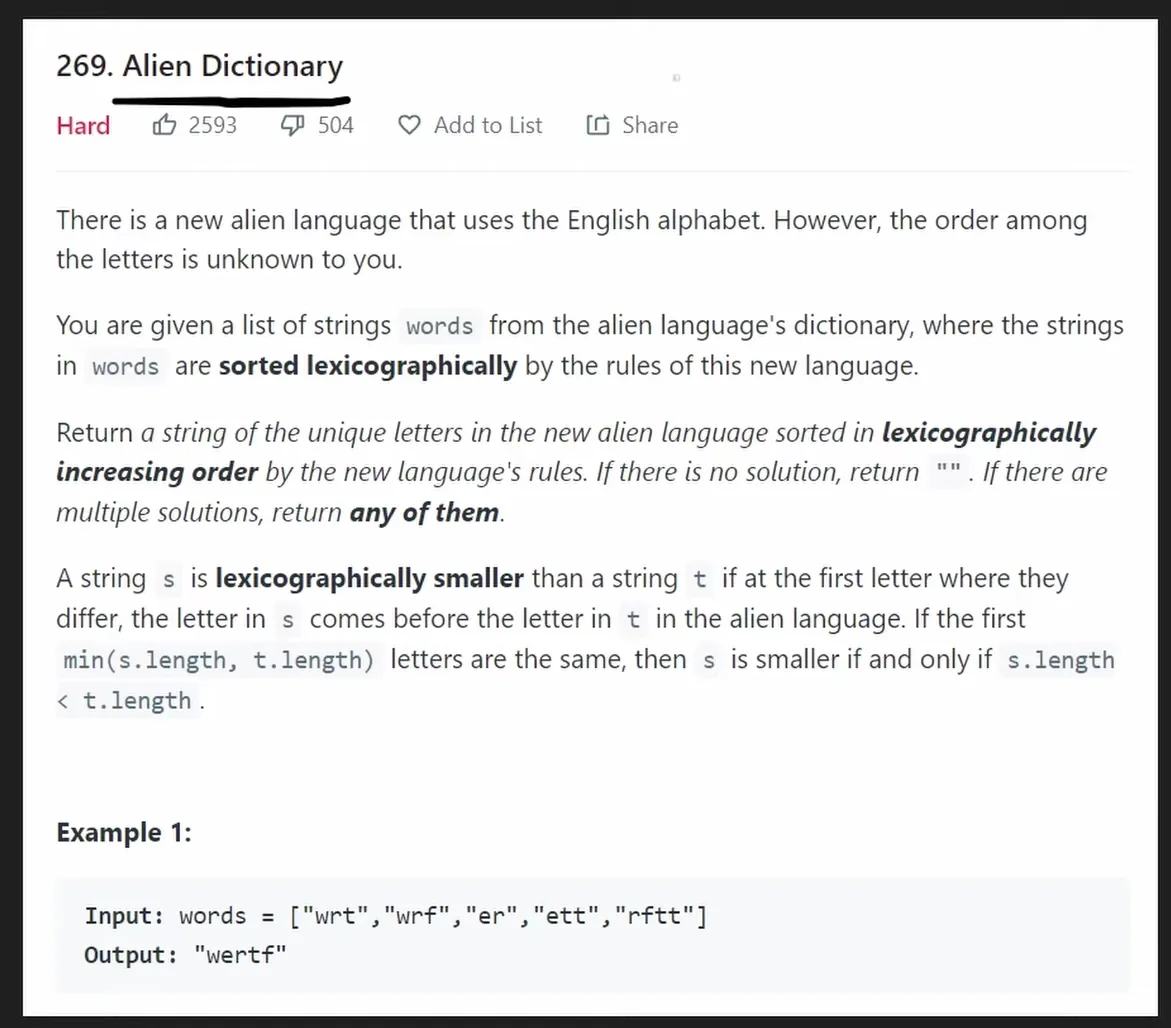
Leetcode: 269 - Alien Dictionary Code in Python, Java, C++ is a renowned and challenging problem that often appears in technical interviews for software development roles. It's a fantastic exercise in applying graph theory, specifically topological sort, to reconstruct a sequence from partial orderings. This tutorial will guide you through understanding the problem, building the necessary graph structures, and implementing the solution in three popular programming languages: Python, Java, and C++. By the end, you'll have a solid grasp of how to tackle similar graph-based ordering problems.
- Introduction to the Alien Dictionary Problem
- Prerequisites for Solving Alien Dictionary
- Understanding the Problem: Alien Dictionary in Detail
- Core Concepts: Graph Theory and Topological Sort
- Step-by-Step Solution: Building the Graph
- Step-by-Step Solution: Performing Topological Sort
- Leetcode 269: Alien Dictionary Code in Python
- Leetcode 269: Alien Dictionary Code in Java
- Leetcode 269: Alien Dictionary Code in C++
- Complexity Analysis
- Common Mistakes and Edge Cases
- Conclusion
- Frequently Asked Questions
- Further Reading & Resources
Introduction to the Alien Dictionary Problem
Imagine you've intercepted communications from an alien civilization, and you have a list of words from their dictionary, sorted lexicographically according to their unknown alphabet. Your task is to deduce the order of the letters in this alien alphabet. This is precisely what the Leetcode: 269 - Alien Dictionary problem asks us to do. Given words = ["wrt", "wrf", "er", "ett", "rftt"], for example, we need to find an ordering like "wertf". This problem is considered hard because it requires not just recognizing the underlying graph structure but also correctly applying a topological sort algorithm to derive the final character order. Successfully solving this problem demonstrates a strong understanding of graph traversal and dependency management, crucial skills for any developer.
Prerequisites for Solving Alien Dictionary
Before diving into the solution for Leetcode: 269 - Alien Dictionary code in python java and c++, ensure you have a foundational understanding of these core computer science concepts:
Graph Theory Basics
You should be familiar with what a graph is, including nodes (vertices) and edges. Understanding directed graphs (edges have a direction) and directed acyclic graphs (DAGs – directed graphs with no cycles) is crucial. The Alien Dictionary problem inherently translates into a DAG problem where characters are nodes and their orderings are directed edges.
Adjacency List Representation
Knowing how to represent a graph using an adjacency list is fundamental. This typically involves using a dictionary (hash map) where keys are nodes and values are lists of their direct neighbors. This representation is efficient for adding edges and iterating through neighbors.
Breadth-First Search (BFS) or Depth-First Search (DFS)
Familiarity with these graph traversal algorithms is important. While we'll be using topological sort, both BFS and DFS form the basis of most graph algorithms, including the two primary methods for topological sort. Kahn's algorithm, which we will use, is BFS-based. For a deeper dive into another BFS application, consider Unraveling the 01 Matrix: Finding the Nearest Zero with BFS and DP. If you're interested in DFS, exploring Mastering Depth-First Search (DFS) can be beneficial.
Basic Data Structures
You'll need a good grasp of hash maps (dictionaries), sets, and queues. Hash maps are essential for storing graph nodes and their in-degrees, sets for keeping track of unique characters, and queues for implementing Kahn's algorithm.
Programming Language Fundamentals
Solid understanding of either Python, Java, or C++ syntax, data structures, and object-oriented concepts (if applicable) is necessary to follow the code examples and implement your own solution effectively. This includes handling strings, lists/arrays, and maps/dictionaries.
Understanding the Problem: Alien Dictionary in Detail
The input to the Alien Dictionary problem is a list of strings, words, representing words in an alien language, sorted lexicographically. This means if wordA comes before wordB in the list, then wordA is lexicographically smaller than wordB according to the alien alphabet.
The goal is to return a string representing the alien alphabet's order. If no valid order can be determined (due to conflicting rules or cycles), an empty string should be returned.
Key Observations:
- Pairwise Comparisons: The ordering information comes from comparing adjacent words. If
word1andword2are consecutive in the input list, and they differ at some character positioni, then the characterword1[i]must come beforeword2[i]in the alien alphabet. - First Difference Matters: Once a difference is found between two words, say
word1[i]!=word2[i], thenword1[i]must precedeword2[i]. Any characters after this first difference in these two words provide no new ordering information relative to each other. - Prefix Rule: If
word1is a prefix ofword2(e.g., "abc", "ab"), butword2appears beforeword1in the input list, it's an invalid ordering and implies a cycle. However, ifword1is a prefix ofword2andword1appears beforeword2, this provides no ordering information betweenword1andword2themselves but confirms consistency. Ifword2is a prefix ofword1(e.g., "ab", "abc") andword1appears afterword2, it's valid. The problem states words are sorted lexicographically. Ifword1 = "apple"andword2 = "app", andword1comes beforeword2, it's an invalid input (as "app" should be smaller than "apple"). We must detect this. - All Characters: We need to consider all unique characters present across all words, even if some characters don't directly form an ordering pair. They might be part of the alphabet and appear in the final sorted order.
Core Concepts: Graph Theory and Topological Sort
The Alien Dictionary problem is a perfect fit for a graph-based solution using topological sort. Let's break down why.
Building the Directed Graph
Each unique character in the alien alphabet will be a node (or vertex) in our graph. An ordering rule, such as 'a' must come before 'b', will be represented as a directed edge from 'a' to 'b' (a -> b).
To construct this graph:
- Initialize: Create a set to store all unique characters seen across all words. Create an adjacency list (e.g.,
Map<Character, List<Character>>) to represent the graph and a map (e.g.,Map<Character, Integer>) to store the in-degree of each character. The in-degree of a node is the number of incoming edges it has. - Populate All Characters: Iterate through all words and all characters within those words. Add each unique character to your set and initialize its in-degree to 0 in the in-degree map. Also, ensure each character has an entry in the adjacency list, even if its list of neighbors is initially empty.
- Find Orderings (Edges): Iterate through the
wordslist, comparingword[i]withword[i+1].- For each pair, iterate through their characters until you find the first position
jwhereword[i][j]is different fromword[i+1][j]. - Once a difference is found,
word[i][j]must come beforeword[i+1][j]. Add a directed edge fromword[i][j]toword[i+1][j]in your adjacency list. Increment the in-degree ofword[i+1][j]. - Crucial Edge Case: If
word[i+1]is a prefix ofword[i](e.g.,words = ["abc", "ab"]), it implies an invalid lexicographical order, as "abc" should not precede "ab" if "ab" is a prefix of "abc". In this scenario, we must return an empty string, as a valid order cannot be determined. This check should occur before finding any character differences ifword[i]is longer andword[i+1]is its prefix.
- For each pair, iterate through their characters until you find the first position
Topological Sort (Kahn's Algorithm)
Once the graph is built, we apply topological sort. Kahn's algorithm (BFS-based) is particularly suitable here because it naturally handles cycle detection and produces a valid order efficiently.
- Initialize Queue: Add all characters (nodes) with an in-degree of 0 to a queue. These are the characters that have no dependencies (no characters must come before them).
- Process Queue:
- While the queue is not empty:
- Dequeue a character
u. - Append
uto your result string/list. - For each neighbor
vofu(i.e., for every charactervthatuprecedes):- Decrement the in-degree of
v. - If
v's in-degree becomes 0, enqueuev. This meansvno longer has any preceding dependencies that haven't been processed.
- Decrement the in-degree of
- Dequeue a character
- While the queue is not empty:
- Cycle Detection: After the queue is empty, compare the length of your result string with the total number of unique characters initially present in the
words. If they are not equal, it means there was a cycle in the graph, and thus no valid topological order exists. In this case, return an empty string. Otherwise, return the constructed result string.
Step-by-Step Solution: Building the Graph
Let's walk through the process of building the graph with an example: words = ["wrt", "wrf", "er", "ett", "rftt"].
Step 1: Gather All Unique Characters and Initialize Data Structures
First, we iterate through all words to identify every unique character.
'w','r','t','f','e'- Initialize:
adj = {}(adjacency list)in_degree = {}(in-degree map)- For each unique char
c:adj[c] = [],in_degree[c] = 0 all_chars = {'w', 'r', 't', 'f', 'e'}
Step 2: Extract Ordering Rules (Edges)
Now, compare adjacent words to find the first differing character.
Compare "wrt" and "wrf":
'w'=='w''r'=='r''t'!='f'. This impliestcomes beforef.- Add edge:
t -> f adj['t'].append('f')in_degree['f'] += 1(Nowin_degree['f'] = 1)
- Add edge:
Compare "wrf" and "er":
'w'!='e'. This implieswcomes beforee.- Add edge:
w -> e adj['w'].append('e')in_degree['e'] += 1(Nowin_degree['e'] = 1)
- Add edge:
Compare "er" and "ett":
'e'=='e''r'!='t'. This impliesrcomes beforet.- Add edge:
r -> t adj['r'].append('t')in_degree['t'] += 1(Nowin_degree['t'] = 1)
- Add edge:
Compare "ett" and "rftt":
'e'!='r'. This impliesecomes beforer.- Add edge:
e -> r adj['e'].append('r')in_degree['r'] += 1(Nowin_degree['r'] = 1)
- Add edge:
Current State of Graph
adj = { 'w': ['e'], 'r': ['t'], 't': ['f'], 'e': ['r'], 'f': [] }in_degree = { 'w': 0, 'r': 1, 't': 1, 'f': 1, 'e': 1 }all_chars = {'w', 'r', 't', 'f', 'e'}(total 5 unique characters)
Step-by-Step Solution: Performing Topological Sort
Now, using Kahn's algorithm (BFS-based) for the topological sort.
Step 1: Initialize Queue with Zero In-Degree Nodes
- Scan
in_degree:'w'hasin_degree = 0. Add'w'to queue.
queue = ['w']result = []
Step 2: Process Queue
Iteration 1:
- Dequeue
'w'.result = ['w'] - Neighbors of
'w':['e']- Decrement
in_degree['e'].in_degree['e']becomes 0. - Enqueue
'e'.queue = ['e']
- Decrement
Iteration 2:
- Dequeue
'e'.result = ['w', 'e'] - Neighbors of
'e':['r']- Decrement
in_degree['r'].in_degree['r']becomes 0. - Enqueue
'r'.queue = ['r']
- Decrement
Iteration 3:
- Dequeue
'r'.result = ['w', 'e', 'r'] - Neighbors of
'r':['t']- Decrement
in_degree['t'].in_degree['t']becomes 0. - Enqueue
't'.queue = ['t']
- Decrement
Iteration 4:
- Dequeue
't'.result = ['w', 'e', 'r', 't'] - Neighbors of
't':['f']- Decrement
in_degree['f'].in_degree['f']becomes 0. - Enqueue
'f'.queue = ['f']
- Decrement
Iteration 5:
- Dequeue
'f'.result = ['w', 'e', 'r', 't', 'f'] - Neighbors of
'f':[](none) queue = []
Step 3: Check for Cycle
len(result)(which is 5) ==len(all_chars)(which is 5).- No cycle detected.
Step 4: Return Result
- Join
result:"wertf"
This detailed walkthrough illustrates how the graph is constructed and then traversed using Kahn's algorithm to obtain the correct alien alphabet order.
Leetcode 269: Alien Dictionary Code in Python
import collections

class Solution:
    def alienOrder(self, words: list[str]) -> str:
        # Step 1: Initialize data structures for graph and in-degrees
        # all_chars: A set to store all unique characters encountered across all words.
        # adj: An adjacency list (graph) where adj[u] is a list of characters that 'u' must precede.
        # in_degree: A map where in_degree[c] is the count of characters that must precede 'c'.
        all_chars = set()
        adj = collections.defaultdict(list)
        in_degree = collections.defaultdict(int)

        # Populate all_chars and initialize in_degrees for all characters to 0
        for word in words:
            for char_code in word:
                all_chars.add(char_code)
                in_degree[char_code] = 0 # Initialize all to 0, will be updated as edges are added

        # Step 2: Build the graph by comparing adjacent words
        for i in range(len(words) - 1):
            word1 = words[i]
            word2 = words[i+1]

            # Critical Edge Case: If word2 is a prefix of word1 (e.g., ["abc", "ab"]), it's an invalid input.
            # This indicates an inconsistent lexicographical order.
            if len(word1) > len(word2) and word1.startswith(word2):
                return ""

            # Find the first differing character
            min_len = min(len(word1), len(word2))
            found_diff = False
            for j in range(min_len):
                char1 = word1[j]
                char2 = word2[j]
                if char1 != char2:
                    # Found an ordering rule: char1 must come before char2
                    if char2 not in adj[char1]: # Avoid duplicate edges
                        adj[char1].append(char2)
                        in_degree[char2] += 1
                    found_diff = True
                    break
            # If no difference found until min_len, it means one word is a prefix of the other.
            # The edge case check above handles word2 being a prefix of word1.
            # If word1 is a prefix of word2 (e.g. "abc", "abcd"), no ordering info is obtained from this pair,
            # which is fine.

        # Step 3: Perform Topological Sort using Kahn's Algorithm (BFS)
        # Queue for BFS, initially contains all characters with an in-degree of 0.
        queue = collections.deque([char_code for char_code in all_chars if in_degree[char_code] == 0])
        result = [] # Stores the sorted characters

        while queue:
            u = queue.popleft()
            result.append(u)

            # For each neighbor 'v' of 'u':
            for v in adj[u]:
                in_degree[v] -= 1 # Decrement in-degree of 'v'
                if in_degree[v] == 0:
                    queue.append(v) # If in-degree becomes 0, 'v' has no more prerequisites, add to queue

        # Step 4: Check for cycles
        # If the length of the result string is less than the total number of unique characters,
        # it means there was a cycle in the graph, and a valid topological order cannot be formed.
        if len(result) != len(all_chars):
            return ""

        return "".join(result)
Python Code Explanation:
- Initialization:
all_charsset gathers all unique characters.adjis adefaultdict(list)for the adjacency list (graph), andin_degreeis adefaultdict(int)to store in-degrees. All characters are added toall_charsand theirin_degreeinitialized to 0. - Graph Construction:
- It iterates through adjacent pairs of words
(words[i], words[i+1]). - Prefix Check: A critical check ensures
word2is not a prefix ofword1iflen(word1) > len(word2). This indicates an invalid input order, so we return"". - It finds the first differing character
char1fromword1andchar2fromword2. - An edge
char1 -> char2is added toadj, andin_degree[char2]is incremented.if char2 not in adj[char1]prevents duplicate edges, which is important for correct in-degree counts.
- It iterates through adjacent pairs of words
- Topological Sort (Kahn's):
- A
deque(double-ended queue) is used for the BFS queue. It's initialized with all characters that have anin_degreeof 0. - The
while queueloop processes characters.uis dequeued, added toresult. - For each neighbor
vofu,in_degree[v]is decremented. Ifin_degree[v]becomes 0,vis enqueued.
- A
- Cycle Detection: After the BFS, if
len(result)is not equal tolen(all_chars), it implies a cycle was present, and an empty string is returned. - Return: Finally,
"".join(result)constructs the alien alphabet string.
Leetcode 269: Alien Dictionary Code in Java
import java.util.*;

class Solution {
    public String alienOrder(String[] words) {
        // Step 1: Initialize data structures for graph and in-degrees
        // allChars: A set to store all unique characters encountered.
        // adj: Adjacency list (graph) where adj.get(u) is a list of characters 'u' must precede.
        // inDegree: A map where inDegree.get(c) is the count of characters that must precede 'c'.
        Set<Character> allChars = new HashSet<>();
        Map<Character, List<Character>> adj = new HashMap<>();
        Map<Character, Integer> inDegree = new HashMap<>();

        // Populate allChars and initialize inDegrees for all characters to 0
        for (String word : words) {
            for (char c : word.toCharArray()) {
                allChars.add(c);
                adj.putIfAbsent(c, new ArrayList<>()); // Ensure all chars are graph nodes
                inDegree.putIfAbsent(c, 0); // Initialize all to 0
            }
        }

        // Step 2: Build the graph by comparing adjacent words
        for (int i = 0; i < words.length - 1; i++) {
            String word1 = words[i];
            String word2 = words[i+1];

            // Critical Edge Case: If word2 is a prefix of word1 (e.g., ["abc", "ab"]), it's an invalid input.
            // This indicates an inconsistent lexicographical order.
            if (word1.length() > word2.length() && word1.startsWith(word2)) {
                return "";
            }

            // Find the first differing character
            int minLen = Math.min(word1.length(), word2.length());
            boolean foundDiff = false;
            for (int j = 0; j < minLen; j++) {
                char char1 = word1.charAt(j);
                char char2 = word2.charAt(j);
                if (char1 != char2) {
                    // Found an ordering rule: char1 must come before char2
                    // Add edge char1 -> char2 to adjacency list
                    // Only add if not already present to avoid duplicate edges and incorrect in-degree counts
                    if (!adj.get(char1).contains(char2)) { // This check can be slow for large graphs.
                                                            // A Set<Character> for values in adj.get(char1) would be faster
                                                            // or checking if inDegree count increased after adding.
                        adj.get(char1).add(char2);
                        inDegree.put(char2, inDegree.get(char2) + 1);
                    }
                    foundDiff = true;
                    break;
                }
            }
            // If no difference found and word1 is a prefix of word2 (e.g. "abc", "abcd"), no ordering info is obtained.
            // The edge case above handles word2 being a prefix of word1.
        }

        // Step 3: Perform Topological Sort using Kahn's Algorithm (BFS)
        Queue<Character> queue = new LinkedList<>();
        // Add all characters with an in-degree of 0 to the queue
        for (char c : allChars) {
            if (inDegree.get(c) == 0) {
                queue.offer(c);
            }
        }

        StringBuilder result = new StringBuilder(); // Stores the sorted characters

        while (!queue.isEmpty()) {
            char u = queue.poll();
            result.append(u);

            // For each neighbor 'v' of 'u':
            for (char v : adj.get(u)) {
                inDegree.put(v, inDegree.get(v) - 1); // Decrement in-degree of 'v'
                if (inDegree.get(v) == 0) {
                    queue.offer(v); // If in-degree becomes 0, add 'v' to queue
                }
            }
        }

        // Step 4: Check for cycles
        // If the length of the result string is less than the total number of unique characters,
        // it means there was a cycle in the graph.
        if (result.length() != allChars.size()) {
            return "";
        }

        return result.toString();
    }
}
Java Code Explanation:
The Java implementation mirrors the Python logic very closely.
- Initialization:
HashSet<Character> allChars,HashMap<Character, List<Character>> adj,HashMap<Character, Integer> inDegree.putIfAbsentis used to ensure all characters are initialized in the maps. - Graph Construction:
- Similar loop structure for adjacent words.
- The prefix check
word1.length() > word2.length() && word1.startsWith(word2)remains critical. - When adding an edge,
!adj.get(char1).contains(char2)is used to prevent duplicate edges. For very large graphs or high-degree nodes, usingHashSet<Character>as the value inadjwould be more performant thanList<Character>for thecontainscheck.
- Topological Sort:
LinkedListis used to implement theQueueinterface for BFS.offer()andpoll()methods are used for adding and removing elements from the queue.StringBuilderis used for efficient string concatenation.
- Cycle Detection: Same logic: compare
result.length()withallChars.size(). - Return:
result.toString().
Leetcode 269: Alien Dictionary Code in C++
#include <vector>
#include <string>
#include <unordered_map>
#include <unordered_set>
#include <queue>
#include <algorithm> // For std::min and std::find

class Solution {
public:
    std::string alienOrder(std::vector<std::string>& words) {
        // Step 1: Initialize data structures for graph and in-degrees
        // allChars: A set to store all unique characters encountered.
        // adj: Adjacency list (graph) where adj[u] is a list of characters 'u' must precede.
        // inDegree: A map where inDegree[c] is the count of characters that must precede 'c'.
        std::unordered_set<char> allChars;
        std::unordered_map<char, std::vector<char>> adj;
        std::unordered_map<char, int> inDegree;

        // Populate allChars and initialize inDegrees for all characters to 0
        for (const std::string& word : words) {
            for (char c : word) {
                allChars.insert(c);
                adj[c]; // Ensure char is in adj map, creates empty vector if not present
                inDegree[c] = 0; // Initialize all to 0
            }
        }

        // Step 2: Build the graph by comparing adjacent words
        for (int i = 0; i < words.size() - 1; ++i) {
            const std::string& word1 = words[i];
            const std::string& word2 = words[i+1];

            // Critical Edge Case: If word2 is a prefix of word1 (e.g., {"abc", "ab"}), it's an invalid input.
            // This indicates an inconsistent lexicographical order.
            if (word1.length() > word2.length() && word1.rfind(word2, 0) == 0) { // rfind with 0 is like startsWith
                return "";
            }

            // Find the first differing character
            int minLen = std::min(word1.length(), word2.length());
            bool foundDiff = false;
            for (int j = 0; j < minLen; ++j) {
                char char1 = word1[j];
                char char2 = word2[j];
                if (char1 != char2) {
                    // Found an ordering rule: char1 must come before char2
                    // Add edge char1 -> char2 to adjacency list
                    // Only add if not already present to avoid duplicate edges and incorrect in-degree counts

                    // Check if char2 is already a neighbor of char1.
                    // This is O(N) where N is number of neighbors. For better performance
                    // adj[char1] could be a std::unordered_set<char> instead of std::vector<char>
                    // or we could track added edges in a separate set.
                    auto& neighbors = adj[char1];
                    if (std::find(neighbors.begin(), neighbors.end(), char2) == neighbors.end()) {
                        neighbors.push_back(char2);
                        inDegree[char2]++;
                    }
                    foundDiff = true;
                    break;
                }
            }
        }

        // Step 3: Perform Topological Sort using Kahn's Algorithm (BFS)
        std::queue<char> q;
        // Add all characters with an in-degree of 0 to the queue
        for (char c : allChars) {
            if (inDegree[c] == 0) {
                q.push(c);
            }
        }

        std::string result = ""; // Stores the sorted characters

        while (!q.empty()) {
            char u = q.front();
            q.pop();
            result.push_back(u);

            // For each neighbor 'v' of 'u':
            for (char v : adj[u]) {
                inDegree[v]--; // Decrement in-degree of 'v'
                if (inDegree[v] == 0) {
                    q.push(v); // If in-degree becomes 0, add 'v' to queue
                }
            }
        }

        // Step 4: Check for cycles
        // If the length of the result string is less than the total number of unique characters,
        // it means there was a cycle in the graph.
        if (result.length() != allChars.size()) {
            return "";
        }

        return result;
    }
};
C++ Code Explanation:
The C++ solution leverages standard library containers.
- Initialization:
std::unordered_set<char> allChars,std::unordered_map<char, std::vector<char>> adj,std::unordered_map<char, int> inDegree. Usingadj[c];automatically creates an emptystd::vector<char>ifcis not yet a key. - Graph Construction:
- The
word1.rfind(word2, 0) == 0is the C++ equivalent for checking ifword1starts withword2. - When adding an edge,
std::findis used to check for duplicates in the adjacency list. As noted in the comments, for performance-critical scenarios,std::unordered_set<char>could be used for the values inadjto ensureO(1)average time for duplicate checks.
- The
- Topological Sort:
std::queue<char>is used for the BFS queue.push()andpop()(afterfront()) are used for queue operations.std::string resultusespush_back(u)to append characters.
- Cycle Detection: Compares
result.length()withallChars.size(). - Return: The
std::string result.
Complexity Analysis
Understanding the time and space complexity of the Alien Dictionary problem is crucial for evaluating its efficiency.
Time Complexity
Let N be the number of words in the input list, L be the average length of a word, and C be the total number of unique characters across all words (at most 26 for English alphabet, but could be larger for general characters).
-
Gathering All Unique Characters and Initializing Data Structures:
- Iterating through all words and their characters takes
O(N * L)time. - Adding to
allCharsset,adjmap, andinDegreemap: Eachinsertorputoperation isO(1)on average. TotalO(C)for initial setup forCcharacters. - Overall for initialization:
O(N * L).
- Iterating through all words and their characters takes
-
Building the Graph:
- We iterate through
N-1pairs of adjacent words. - For each pair
(word1, word2), we compare characters up tomin(len(word1), len(word2)), which isO(L). - Adding an edge to the adjacency list and incrementing in-degree is
O(1)on average (assumingstd::vector::push_backorList.addis amortized O(1)). - The duplicate edge check (e.g.,
!adj.get(char1).contains(char2)in Java orstd::findin C++) can beO(C)in the worst case ifadj[char1]contains many neighbors. If usingSetfor neighbors, this becomesO(1)on average. - In total, this step is
O(N * L)for comparing words. The graph can have at mostCnodes andC*(C-1)edges in the worst case (though practically, usually much fewer distinct edges based on the input words). LetEbe the number of edges. Adding edges involvesNcomparisons, each potentially adding one edge. Total for edges:O(N*L + E). - Overall for building the graph:
O(N * L + E).
- We iterate through
-
Topological Sort (Kahn's Algorithm):
- Initializing the queue:
O(C)to iterate through all characters. - The
whileloop runsCtimes (each character is dequeued once). - Inside the loop:
- Dequeueing:
O(1). - Iterating through neighbors: Sum of
len(adj[u])for alluisO(E)(each edge is traversed once). - Decrementing in-degree and enqueuing:
O(1)on average.
- Dequeueing:
- Overall for topological sort:
O(C + E).
- Initializing the queue:
Total Time Complexity: O(N * L + C + E). Since E is at most N*L (we add at most one edge per word pair, bounded by length), and also E is at most C^2, it can be simplified. A tighter bound is O(N * L + C^2) if E is considered as the maximum number of unique edges. However, the most accurate is O(N * L + E), where E is the number of distinct edges actually added. Given C is at most 26, C^2 is small, so O(N * L + E) effectively.
Space Complexity
allCharsset:O(C)to store all unique characters.adj(adjacency list):O(C + E)to storeCnodes andEedges.inDegreemap:O(C)to store in-degrees for all characters.queue: In the worst case, the queue can hold allCcharacters:O(C).resultstring/StringBuilder:O(C)for the final alphabet order.
Total Space Complexity: O(C + E).
Common Mistakes and Edge Cases
Solving the Alien Dictionary problem requires careful attention to various scenarios. Missing these can lead to incorrect solutions or runtime errors.
1. Incorrect Graph Construction
- Duplicate Edges: If you add the same edge multiple times (e.g.,
t -> fderived from("wrt", "wrf")and again from("ert", "erf")), thein_degreecount forfwill be inflated. This can preventffrom ever reaching an in-degree of 0, leading to an incorrect result (e.g.,fmight be omitted or a cycle might be falsely detected). Always check if an edge already exists before adding it and incrementingin_degree. - Missing Characters: Ensure all unique characters from all words are included in your graph and
in_degreemap, even if they don't explicitly form an ordering pair. Some characters might be part of the alphabet but only appear in isolated words. Their in-degree should be initialized to 0.
2. Failure to Detect Invalid Input Orders (Prefix Rule)
- Example:
words = ["abc", "ab"]. If "abc" comes before "ab" in a lexicographically sorted list, it implies an invalid ordering in the alien dictionary. This specific case must be handled by immediately returning an empty string. The logic should be: ifword1is longer thanword2, andword1starts withword2(i.e.,word2is a prefix ofword1), andword1appears beforeword2, it's an invalid input. - The check
if len(word1) > len(word2) and word1.startswith(word2): return ""in Python (and equivalents in Java/C++) addresses this directly before comparing characters.
3. Missing Cycle Detection
- A topological sort can only exist in a Directed Acyclic Graph (DAG). If the input words imply a cycle (e.g.,
a < b,b < c, andc < a), no valid alphabet order exists. - Kahn's algorithm naturally detects cycles: if the number of characters processed in the topological sort (
len(result)) is less than the total number of unique characters (len(all_chars)), a cycle is present. In this case, return an empty string.
4. Off-by-One Errors in Loop Boundaries
- When comparing adjacent words, the loop should go from
itolen(words) - 2(orlen(words) - 1with<). - When comparing characters within words, the loop should go up to
min(len(word1), len(word2)) - 1(or< min_len).
5. Handling Empty Input
- If
wordsis empty, an empty string should be returned. The provided solutions will correctly return an empty string for this edge case. - If
wordscontains only one word (e.g.,["abc"]), all unique characters from that word should be returned in any order (usually lexicographical, but any order is valid). The current solution correctly handles this by putting all characters with in-degree 0 into the queue and returning them.
6. Performance Considerations for Adjacency List
- In Java and C++, checking
adj.get(char1).contains(char2)orstd::find(neighbors.begin(), neighbors.end(), char2)can beO(C)in the worst case if a node has many neighbors. If the number of unique charactersCis large, this could degrade performance. For alphabets larger than 26, consider usingHashSet<Character>orunordered_set<char>for the values in your adjacency map to ensureO(1)average time for duplicate checks. ForC=26, aListorvectoris typically acceptable.
By carefully considering these common pitfalls and edge cases, you can build a robust and correct solution for the Alien Dictionary problem.
Conclusion
The Leetcode: 269 - Alien Dictionary code in python java and c++ problem is a quintessential example of how real-world ordering problems can be modeled and solved using graph theory and topological sort. We've explored the core concepts, detailed the step-by-step process of constructing the graph and applying Kahn's algorithm, and provided comprehensive code implementations in Python, Java, and C++.
Mastering this problem not only enhances your understanding of graph algorithms but also sharpens your ability to translate abstract problem statements into concrete data structures and algorithms. The key takeaways include:
- Identifying partial orderings to build a directed graph.
- Using Kahn's algorithm (BFS-based topological sort) for efficient ordering.
- Detecting cycles in the graph to determine if a valid order exists.
- Handling critical edge cases like prefix rules and duplicate edges.
With the insights and code provided, you are now well-equipped to tackle similar graph-based challenges. Keep practicing with various graph problems to solidify your understanding and algorithmic intuition. For another challenging graph problem solved with BFS, check out Leetcode 127 Word Ladder: Master the BFS Approach Easily. Happy coding!
Frequently Asked Questions
Q: Why is the Alien Dictionary problem considered a graph problem?
A: The problem involves deducing an unknown lexicographical order from a list of sorted words. This creates a set of directed dependencies between characters (e.g., 'a' must come before 'b'). These characters can be represented as nodes, and the dependencies as directed edges in a graph, making it a classic graph ordering problem.
Q: What is topological sort, and why is it crucial for solving Alien Dictionary?
A: Topological sort is an algorithm for ordering the vertices of a directed acyclic graph (DAG) such that for every directed edge from vertex 'u' to vertex 'v', 'u' comes before 'v' in the ordering. It's crucial for Alien Dictionary because it allows us to derive a valid sequence of characters based on the partial orderings extracted from the input words.
Q: How does the solution detect if a valid alien alphabet order cannot be determined?
A: A valid order cannot be determined if there's a cycle in the dependency graph (e.g., 'a' before 'b', 'b' before 'c', and 'c' before 'a'). Kahn's algorithm, used in the solution, detects cycles if the total number of characters successfully added to the sorted result is less than the total number of unique characters in the alphabet. This indicates that some characters were part of a cycle and could never reach an in-degree of zero.