Implementing Circuit Breaker Pattern in Microservices: A Deep Dive
In the complex tapestry of modern distributed systems, especially those built on a microservices architecture, managing failures is not merely a best practice—it's an absolute necessity. Services are inherently ephemeral, network latencies unpredictable, and external dependencies can introduce cascading failures capable of bringing down an entire system. This is precisely why implementing Circuit Breaker Pattern in Microservices is a pivotal strategy for architects and developers aiming for robustness and high availability. This article will take a deep dive into this critical design pattern, explaining its mechanics, benefits, and practical application, ensuring your services can gracefully handle adversity.
- Understanding the Circuit Breaker Pattern: A Foundation for Resilience
- The Mechanics of Operation: How Circuit Breakers Work
- Key Components and Features of a Circuit Breaker
- Implementing Circuit Breaker Pattern in Microservices: Practical Approaches
- Simplified circuit breaker logic using Tenacity's retry capabilities
- This is more of a retry with backoff, not a full stateful circuit breaker.
- For a true CB, you'd need a separate state machine implementation.
- Libraries like 'pybreaker' offer dedicated circuit breaker features for Python.
- Example of a dedicated Python circuit breaker library: 'pybreaker'
- Configure a circuit breaker: 5 failures, 10 sec reset timeout, 3 calls in half-open
- Go: Hystrix-Go (Community Maintained) or custom implementations
- Integration with Service Meshes (e.g., Istio, Linkerd)
- Real-World Applications of Circuit Breaker Pattern
- Advantages and Disadvantages of Circuit Breaker Pattern
- Future Outlook and Advanced Concepts
- Frequently Asked Questions
- Further Reading & Resources
Understanding the Circuit Breaker Pattern: A Foundation for Resilience
At its core, the Circuit Breaker Pattern is an elegantly simple yet profoundly powerful design pattern for creating resilient applications. It's an abstraction designed to prevent an application from repeatedly trying to invoke a service that is likely to fail. By doing so, it limits the impact of failures, prevents wasted resources, and gives the failing service time to recover without being overwhelmed by a deluge of requests. This pattern dramatically enhances the fault tolerance of microservices, ensuring that a single point of failure doesn't become a systemic catastrophe.
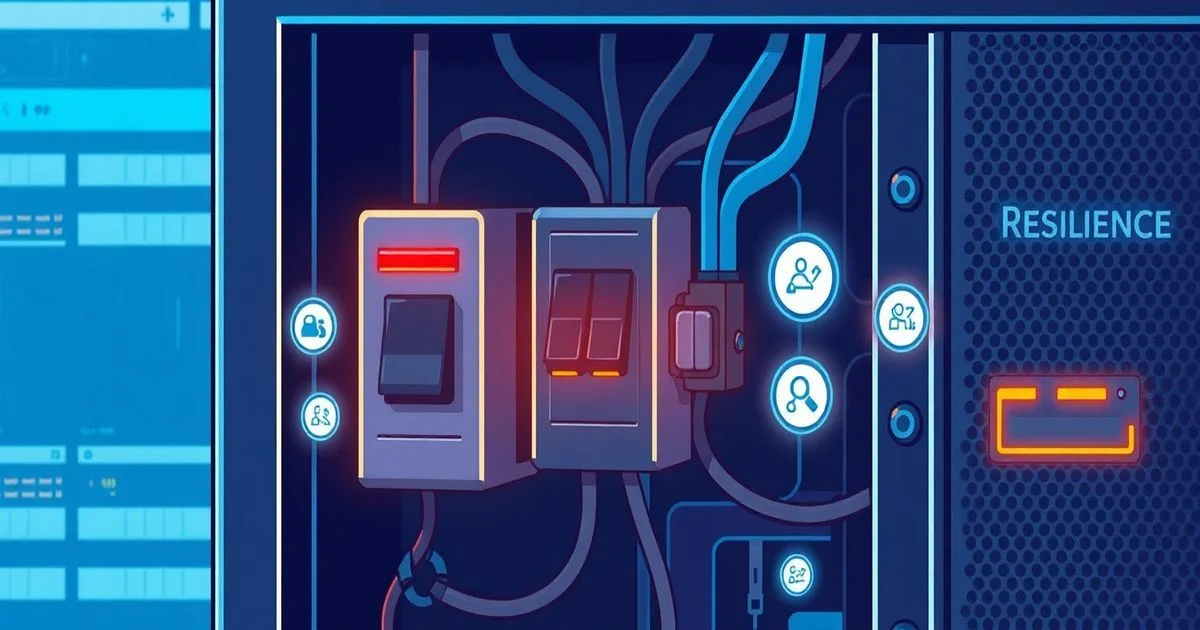
Consider an analogy from the electrical world: a household circuit breaker. When there's an electrical overload or a short circuit, the breaker trips, cutting off power to that specific circuit. This prevents damage to appliances, avoids fires, and safeguards the entire electrical system. Once the problem is resolved, you can manually reset the breaker, restoring power. The software circuit breaker operates on a strikingly similar principle, protecting your application's components from continuous interaction with failing dependencies.
Without a circuit breaker, a failing downstream service can cause a ripple effect. Upstream services might start piling up requests, exhausting their connection pools, threads, or memory, leading to their own eventual collapse. This cascading failure can quickly transform a minor outage in one microservice into a full-scale system-wide blackout, significantly impacting user experience and operational stability. The pattern acts as a guard, detecting unresponsiveness or errors from external services or resources and preventing further requests from reaching them until they are deemed healthy again.
The Mechanics of Operation: How Circuit Breakers Work
The strength of the Circuit Breaker Pattern lies in its stateful nature, which allows it to dynamically react to the health of a downstream service. It typically cycles through three primary states: Closed, Open, and Half-Open. Each state dictates how requests are handled and how the circuit breaker transitions between them, offering a sophisticated failure management mechanism. Understanding these states and their transitions is fundamental to effectively implementing Circuit Breaker Pattern in Microservices.
Closed State: The Default Operating Mode
In the Closed state, the circuit breaker behaves like a normal, healthy connection. All requests from the upstream service are routed directly to the downstream service. The circuit breaker continuously monitors the success and failure rates of these requests. It acts as a transparent proxy, letting calls pass through while observing their outcomes.
During this phase, the circuit breaker maintains a counter for failures. If the number of failures within a defined rolling window (e.g., last 10 seconds or last 100 requests) exceeds a predetermined threshold, or if a single request takes too long (timeout), the circuit transitions to the Open state. This threshold is crucial and needs careful tuning based on the expected reliability of the dependency. For instance, if 5 out of 10 consecutive requests fail, or if more than 50% of requests within a 30-second window are errors, the circuit might trip.
Open State: Preventing Further Damage
Once the circuit breaker trips and enters the Open state, it immediately stops all subsequent requests from reaching the failing downstream service. Instead of attempting to call the unhealthy service, the circuit breaker instantly returns an error or a fallback response to the calling service. This prevents the calling service from wasting resources (threads, network connections) on a service that is known to be failing.
The Open state serves a dual purpose: first, it gives the failing service a chance to recover without being hammered by continuous requests; second, it prevents resource exhaustion and cascading failures in the upstream service. While in the Open state, the circuit breaker starts a "reset timeout" timer. This timeout defines how long the circuit should remain open before attempting to check if the downstream service has recovered. This duration is critical—too short, and the service might still be unhealthy; too long, and recovery is delayed.
Half-Open State: Probing for Recovery
When the reset timeout in the Open state expires, the circuit breaker transitions to the Half-Open state. In this state, the circuit breaker allows a limited number of "test" requests to pass through to the downstream service. This is a cautious attempt to determine if the service has recovered sufficiently to handle full traffic.
If these test requests succeed, it's an indication that the downstream service has likely recovered, and the circuit breaker then transitions back to the Closed state, allowing normal traffic to resume. However, if any of these test requests fail, it signals that the service is still unhealthy, and the circuit breaker immediately reverts to the Open state, restarting the reset timeout. This methodical probing prevents a premature full reopening of the circuit, protecting the system from immediate relapse. This strategic probing mechanism is vital for maintaining stability and carefully re-establishing connections.
State Transitions and Their Triggers
The transitions between these states are governed by specific triggers:
- Closed to Open: Triggered by exceeding a failure threshold (e.g., a certain number of failures, a percentage of failed requests, or sustained high latency) within a defined monitoring period.
- Open to Half-Open: Triggered automatically after a specified reset timeout duration has elapsed.
- Half-Open to Closed: Triggered by a configurable number of successful test requests passing through to the downstream service.
- Half-Open to Open: Triggered by any failure among the test requests, indicating that the service has not yet recovered.
This state machine approach ensures that the system dynamically adapts to the health of its dependencies, providing a robust and self-healing mechanism that is crucial for modern distributed architectures.
Key Components and Features of a Circuit Breaker
Beyond the core state machine, a robust implementation of the Circuit Breaker Pattern incorporates several key configurable components and features. These elements allow developers to fine-tune its behavior to specific service characteristics and operational requirements, making it an indispensable tool for enhancing system reliability when implementing Circuit Breaker Pattern in Microservices.
1. Failure Threshold
The failure threshold determines when the circuit breaker should trip from the Closed state to the Open state. It can be configured in various ways:
- Count-based: The circuit opens after
Nconsecutive failures orNfailures withinXtotal requests. For example, if 5 consecutive calls fail, the circuit trips. - Percentage-based: The circuit opens if the failure rate exceeds
Ppercent within a rolling window ofMrequests. For instance, if 70% of 100 requests fail within 60 seconds, the circuit trips. This is often preferred in high-volume scenarios where occasional failures are tolerable. - Latency-based: If the average response time for requests exceeds a certain threshold, it can also be considered a failure, prompting the circuit to trip.
Choosing the right threshold requires understanding the typical behavior and expected reliability of the protected service. A too-low threshold might lead to false positives, tripping the circuit unnecessarily, while a too-high threshold could delay protection.
2. Reset Timeout (Open to Half-Open)
The reset timeout specifies how long the circuit breaker should remain in the Open state before attempting to transition to Half-Open. This duration gives the failing service ample time to recover without being bombarded by requests.
- Duration: Typically configured in seconds or minutes (e.g., 30 seconds, 5 minutes).
- Dynamic Adjustment: More advanced implementations might dynamically adjust this timeout based on observed recovery patterns or exponential backoff strategies to avoid overwhelming a still-recovering service.
A carefully chosen reset timeout is crucial. If it's too short, the service might still be unhealthy, causing the circuit to immediately re-open. If it's too long, recovery time is unnecessarily extended, impacting system availability.
3. Success Threshold (Half-Open to Closed)
Once in the Half-Open state, the circuit breaker allows a limited number of requests to pass through. The success threshold determines how many of these test requests must succeed for the circuit to transition back to Closed.
- Count-based: For example, if 3 consecutive requests succeed in the Half-Open state, the circuit closes.
- Percentage-based: If 80% of the test requests succeed, the circuit closes.
This mechanism ensures that the downstream service has truly recovered before full traffic is restored, preventing "flapping" (rapid switching between Closed and Open states) if the service is only intermittently stable.
4. Fallback Mechanisms
A critical feature associated with circuit breakers is the provision of fallback mechanisms. When a circuit is Open (or sometimes Half-Open and failures occur), instead of simply returning an error, the circuit breaker can invoke a fallback logic.
- Default Response: Return a cached value, a default static response, or a predefined error message.
- Alternative Service: Route the request to a degraded but functional alternative service or a different data source.
- Empty Response: For non-critical data, return an empty set or list, gracefully degrading functionality.
Fallbacks are essential for maintaining a positive user experience even when parts of the system are unavailable. They allow for graceful degradation, providing partial functionality rather than a complete service outage.
5. Event Monitoring and Metrics
Effective circuit breaker implementations provide rich monitoring capabilities. They emit events and metrics that are crucial for operational visibility and debugging:
- State Transitions: Events for
Closed -> Open,Open -> Half-Open,Half-Open -> Closed. - Success/Failure Counts: Metrics on total calls, successful calls, failed calls, and short-circuited calls.
- Latency Metrics: Response times for calls passing through the circuit breaker.
These metrics can be integrated with monitoring dashboards (e.g., Prometheus, Grafana) and alerting systems (e.g., PagerDuty) to provide real-time insights into service health and enable proactive incident response. Monitoring helps in fine-tuning thresholds and understanding the overall resilience of the system.
6. Isolation and Bulkheads
While not strictly part of the circuit breaker's state machine, the concept of isolation, often implemented through bulkheads, is highly complementary. Bulkheads limit the resources (e.g., thread pools, semaphores) available for calls to a specific downstream service.
- If a service becomes unresponsive, only the resources allocated to that specific bulkhead are exhausted, preventing the failure from consuming resources intended for other services.
- Circuit breakers and bulkheads work synergistically: the bulkhead prevents resource exhaustion, while the circuit breaker prevents even attempting to use the now-isolated, failing service.
By combining these components, developers can build highly robust and adaptive systems that can withstand various failure modes and maintain operational stability in complex distributed environments.
Implementing Circuit Breaker Pattern in Microservices: Practical Approaches
Implementing Circuit Breaker Pattern in Microservices is a common requirement, and fortunately, many robust libraries and frameworks exist across different programming languages to simplify this task. Instead of building a circuit breaker from scratch, leveraging these battle-tested solutions is almost always the recommended approach. These libraries handle the complexities of state management, metrics collection, and thread safety, allowing developers to focus on application logic.
Popular Libraries and Frameworks
Here are some prominent examples across different ecosystems:
Java: Resilience4j and Hystrix (Deprecated but Influential)
-
Resilience4j: This is a lightweight, easy-to-use, and highly configurable fault tolerance library designed for Java 8 and functional programming. It offers circuit breaker, rate limiter, retry, bulkhead, and time limiter patterns. It's built with modern Java features and integrates well with Spring Boot.
```java import io.github.resilience4j.circuitbreaker.CircuitBreaker; import io.github.resilience4j.circuitbreaker.CircuitBreakerConfig; import io.vavr.CheckedFunction0; import io.vavr.control.Try; import java.time.Duration;
public class MyService {
private final CircuitBreaker circuitBreaker;

public MyService() {
    CircuitBreakerConfig config = CircuitBreakerConfig.custom()
        .failureRateThreshold(50) // Percentage of failures to trip the circuit
        .waitDurationInOpenState(Duration.ofSeconds(5)) // Time circuit stays open
        .permittedNumberOfCallsInHalfOpenState(3) // Calls in half-open state
        .slidingWindowType(CircuitBreakerConfig.SlidingWindowType.COUNT_BASED)
        .slidingWindowSize(10) // Size of the sliding window for failure rate calculation
        .recordExceptions(RuntimeException.class)
        .build();

    circuitBreaker = CircuitBreaker.of("myBackendService", config);
}

public String callExternalService() {
    CheckedFunction0<String> decoratedSupplier = CircuitBreaker
        .decorateCheckedSupplier(circuitBreaker, () -> {
            // Simulate an external service call that might fail
            if (Math.random() > 0.7) {
                throw new RuntimeException("External service failed!");
            }
            return "Success from external service!";
        });

    return Try.of(decoratedSupplier)
        .recover(throwable -> "Fallback: Service currently unavailable.")
        .get();
}
} ```
In this example,
Resilience4jis configured with a 50% failure rate threshold, a 5-second wait in the open state, and 3 permitted calls in the half-open state. ThedecorateCheckedSupplierwraps the actual service call, and.recover()provides a fallback. -
Netflix Hystrix: While officially deprecated, Hystrix was the pioneering library that popularized the Circuit Breaker Pattern in microservices. Many current libraries draw inspiration from its design. It provided resilience capabilities through isolation (thread pools/semaphores), fallback options, and circuit breaking. It's worth understanding its concepts as a historical context, even if new projects should opt for active alternatives like Resilience4j.
.NET: Polly
-
Polly: A comprehensive and fluent .NET resilience and transient-fault-handling library that allows developers to express policies such as Retry, Circuit Breaker, Timeout, Bulkhead Isolation, and Fallback in a fluent and thread-safe manner. It's widely adopted in the .NET ecosystem and integrates seamlessly with ASP.NET Core.
```csharp using Polly; using Polly.CircuitBreaker; using System; using System.Threading.Tasks;
public class ExternalServiceCaller { private readonly CircuitBreakerPolicy _circuitBreakerPolicy;
public ExternalServiceCaller()
{
    _circuitBreakerPolicy = Policy
        .Handle<HttpRequestException>() // Define which exceptions to handle as failures
        .CircuitBreaker(
            exceptionsAllowedBeforeBreaking: 5, // Number of failures before tripping
            durationOfBreak: TimeSpan.FromSeconds(30), // How long the circuit stays open
            onBreak: (ex, breakDelay) => {
                Console.WriteLine($"Circuit breaking! After {breakDelay.TotalSeconds}s, due to: {ex.Message}");
            },
            onReset: () => {
                Console.WriteLine("Circuit reset.");
            },
            onHalfOpen: () => {
                Console.WriteLine("Circuit half-open, trying next call...");
            }
        );
}

public async Task<string> GetDataAsync()
{
    try
    {
        return await _circuitBreakerPolicy.ExecuteAsync(async () =>
        {
            // Simulate an external HTTP call
            if (new Random().Next(0, 10) < 6) // 60% failure rate for demo
            {
                throw new HttpRequestException("Simulated HTTP request failed.");
            }
            Console.WriteLine("External service call succeeded.");
            return "Data from external service.";
        });
    }
    catch (BrokenCircuitException)
    {
        Console.WriteLine("Circuit is open! Returning fallback.");
        return "Fallback: Service unavailable due to circuit breaker.";
    }
    catch (Exception ex)
    {
        Console.WriteLine($"Unhandled exception: {ex.Message}");
        return "Fallback: An error occurred.";
    }
}
} ```
Polly's fluent API makes it very readable. It defines the number of exceptions before breaking and the duration of the break, with callbacks for state changes.
Python: Tenacity or Istio (for Service Mesh)
-
Tenacity: While not exclusively a circuit breaker library, Tenacity is a general-purpose retry library for Python that can be adapted to implement circuit breaker-like logic through its stop and wait strategies. For full-fledged circuit breakers, a custom implementation or a service mesh might be considered.
```python import random from tenacity import retry, wait_fixed, stop_after_attempt, retry_if_exception_type, before_sleep_log import logging
logging.basicConfig(level=logging.INFO) logger = logging.getLogger(name)
class ExternalServiceError(Exception): """Custom exception for external service failures.""" pass
Simplified circuit breaker logic using Tenacity's retry capabilities
This is more of a retry with backoff, not a full stateful circuit breaker.
For a true CB, you'd need a separate state machine implementation.
Libraries like 'pybreaker' offer dedicated circuit breaker features for Python.
@retry( wait=wait_fixed(2), # Wait 2 seconds between retries stop=stop_after_attempt(3), # Stop after 3 attempts retry=retry_if_exception_type(ExternalServiceError), # Only retry on specific exception before_sleep=before_sleep_log(logger, logging.INFO) ) def call_external_service_with_retry(): if random.random() < 0.6: # 60% chance of failure logger.error("External service call failed!") raise ExternalServiceError("Service temporarily unavailable") logger.info("External service call succeeded.") return "Data from external service"
Example of a dedicated Python circuit breaker library: 'pybreaker'
from pybreaker import CircuitBreaker, CircuitBreakerError
Configure a circuit breaker: 5 failures, 10 sec reset timeout, 3 calls in half-open
breaker = CircuitBreaker(fail_max=5, reset_timeout=10, exclude=[ValueError])
@breaker def call_external_service_cb(): if random.random() < 0.7: logger.error("External service failed!") raise ConnectionRefusedError("Simulated connection error") logger.info("External service call succeeded (CB).") return "Data from external service (CB)"
if name == "main": print("--- Tenacity Retry Example ---") try: result = call_external_service_with_retry() print(result) except ExternalServiceError as e: print(f"Fallback for retry: {e}")
print("\n--- Pybreaker Circuit Breaker Example ---")
for i in range(20):
    try:
        print(f"Attempt {i+1}:")
        result_cb = call_external_service_cb()
        print(result_cb)
    except CircuitBreakerError:
        print("Circuit is OPEN! Fallback: Service is down.")
    except ConnectionRefusedError as e:
        print(f"Service call failed, waiting for breaker to trip: {e}")
    except Exception as e:
        print(f"An unexpected error occurred: {e}")
    import time
    time.sleep(1) # Simulate time passing
```
For Python, dedicated libraries like
pybreakerare more suitable for full circuit breaker implementations compared toTenacitywhich is primarily for retries.
Go: Hystrix-Go (Community Maintained) or custom implementations
- Hystrix-Go: A GoLang implementation of Netflix Hystrix, maintained by the community. It provides similar functionalities for circuit breaking, fallback, and bulkhead patterns.
- Go's Concurrency Primitives: Given Go's strong concurrency primitives, it's also feasible to implement a custom, lightweight circuit breaker if existing libraries don't fit specific needs. This often involves using goroutines, channels, and atomic operations to manage state and monitor requests.
Integration with Service Meshes (e.g., Istio, Linkerd)
For more complex microservices deployments, particularly in Kubernetes environments, which leverage concepts of containerization, service meshes offer circuit breaking as a built-in feature at the infrastructure level.
apiVersion: networking.istio.io/v1alpha3
kind: DestinationRule
metadata:
  name: my-service-dr
spec:
  host: my-service
  trafficPolicy:
    connectionPool:
      tcp:
        maxConnections: 100
      http:
        http1MaxPendingRequests: 10
        http2MaxRequests: 100
        maxRequestsPerConnection: 10
    outlierDetection:
      consecutiveErrors: 5 # Number of errors before ejecting the host
      interval: 30s # Time interval between health checks
      baseEjectionTime: 60s # Minimum time an instance is ejected
      maxEjectionPercent: 100 # Maximum percentage of hosts that can be ejected
This Istio configuration demonstrates outlierDetection, which effectively implements a circuit breaker by ejecting unhealthy instances from the load balancing pool after a certain number of consecutive errors.
- Benefits of Service Mesh Circuit Breaking:
- Decoupling: Resilience logic is separated from application code.
- Centralized Configuration: Policies can be applied consistently across all services.
- Language Agnostic: Works regardless of the language used for the microservice.
- Observability: Centralized metrics and tracing for circuit breaker events.
While application-level libraries offer fine-grained control, service meshes provide a powerful, platform-level solution, especially for large-scale deployments where consistent policy enforcement is critical. Choosing between application-level libraries and service mesh capabilities often depends on the project's scale, infrastructure, and team expertise. In many cases, a hybrid approach might be most effective.
Real-World Applications of Circuit Breaker Pattern
The Circuit Breaker Pattern isn't just a theoretical concept; it's a fundamental building block for robust, production-grade microservices across various industries. Its ability to contain failures and enable graceful degradation makes it invaluable in complex distributed systems. Here are a few real-world applications demonstrating the impact of implementing Circuit Breaker Pattern in Microservices.
E-commerce Platforms
Consider a large e-commerce website during a flash sale. Thousands of concurrent requests hit various microservices: product catalog, user authentication, payment gateway, inventory, recommendation engine, and shipping.
- Scenario: The recommendation engine, an AI-powered service, experiences a sudden spike in latency or starts throwing errors due to an overloaded database or an issue with its underlying machine learning model.
- Without Circuit Breaker: The product page microservice, which relies on the recommendation engine, keeps sending requests. These requests pile up, exhausting the product page service's connection pool, leading to it becoming unresponsive. This might then affect the cart service, as users cannot add products they can't see, eventually degrading the entire shopping experience.
- With Circuit Breaker: The circuit breaker protecting calls to the recommendation engine trips. The product page service immediately receives a fallback. Instead of showing no products, it might display a generic "Popular Items" list (from cache) or simply hide the recommendations section, ensuring the core functionality (browsing, adding to cart, checkout) remains unaffected. The system avoids cascading failures and maintains crucial business operations.
Financial Services
In financial applications, real-time transaction processing, fraud detection, and customer account management are critical. Any downtime or unresponsiveness can lead to significant financial losses and reputational damage.
- Scenario: A microservice responsible for checking customer credit scores (which might call an external credit agency API) becomes slow or unavailable.
- Without Circuit Breaker: Every transaction requiring a credit check would hang, eventually timing out or failing. This could block new account openings, loan applications, or even certain large transactions, leading to a backlog and customer frustration.
- With Circuit Breaker: The circuit breaker around the credit score service trips. New credit check requests are immediately short-circuited. Depending on the business rule, the system might:
- Route to a secondary, perhaps less real-time, credit check service.
- Put the transaction in a pending state for manual review or later processing (with appropriate customer notification).
- For low-risk transactions, temporarily allow them without a real-time check, based on internal heuristics. This ensures that the core banking system remains operational, handling other critical functions without being dragged down by a single external dependency.
IoT and Connected Devices
IoT platforms often deal with massive streams of data from millions of devices, processed by various backend microservices for data ingestion, analytics, and command dispatch.
- Scenario: A specific data analytics microservice, perhaps performing complex aggregations or machine learning inference, starts failing under high load or due to a bug.
- Without Circuit Breaker: The data ingestion service might continuously attempt to forward data to the failing analytics service, causing its queues to overflow, exhausting memory, and potentially dropping incoming device data. This could lead to data loss or a complete halt in data processing.
- With Circuit Breaker: The circuit breaker protecting calls to the analytics service trips. The data ingestion service immediately stops sending data to the unhealthy analytics service. It can then:
- Buffer the data locally and retry later when the analytics service recovers.
- Route the data to a backup, simpler analytics service for basic processing.
- Log the data for delayed processing, ensuring no data is lost and the ingestion pipeline remains fluid. This preserves the integrity of the data pipeline and ensures that device connectivity and basic telemetry continue uninterrupted.
In all these scenarios, the Circuit Breaker Pattern serves as a critical guardian, preventing localized failures from spiraling into system-wide outages. It promotes system stability, improves user experience through graceful degradation, and ultimately contributes to the overall robustness of microservices architectures.
Advantages and Disadvantages of Circuit Breaker Pattern
Like any design pattern, the Circuit Breaker Pattern comes with its own set of benefits and trade-offs. Acknowledging both the strengths and weaknesses is crucial for making informed decisions about when and how to implement this pattern effectively in your microservices landscape.
Advantages
- Prevents Cascading Failures: This is the primary and most significant benefit. By stopping calls to a failing service, the circuit breaker prevents resource exhaustion (e.g., connection pools, threads) in the calling service, thereby preventing the failure from propagating throughout the system. This dramatically increases the overall resilience of the microservices architecture.
- Improves System Stability: By isolating problematic services, the entire application remains more stable and available. A single slow or unavailable dependency no longer has the power to bring down the whole system. This leads to higher uptime and reliability.
- Faster Failure Detection and Response: Instead of waiting for a network timeout (which can be long), the circuit breaker immediately detects failures and returns an error or fallback, often within milliseconds. This rapid response frees up resources faster and improves the user experience by providing immediate feedback.
- Graceful Degradation: When combined with fallback mechanisms, circuit breakers enable graceful degradation of service. Instead of a hard error, users might receive a slightly reduced feature set or cached data, maintaining a usable experience. This is vital for business continuity.
- Gives Failing Services Time to Recover: By temporarily halting traffic to an unhealthy service, the circuit breaker provides a "cooling-off" period. This allows the overloaded or buggy service to recover its resources, stabilize, and eventually become healthy again without being continuously hammered by requests.
- Enhanced Observability: Most circuit breaker implementations provide metrics and logs about state transitions, failures, and successes. This rich telemetry data is invaluable for monitoring service health, diagnosing issues, and understanding the resilience characteristics of the system in real-time.
- Resource Efficiency: By avoiding repeated calls to an unresponsive service, the calling service conserves its own resources, such as CPU cycles, memory, and network bandwidth, which can then be allocated to processing requests for healthy services.
Disadvantages
- Increased Complexity: Introducing circuit breakers adds a layer of abstraction and state management to your service calls. This increases the overall complexity of the system, both in terms of code and configuration. Developers need to understand how circuit breakers work and how to configure them correctly.
- Configuration Overhead and Tuning: Each circuit breaker needs careful configuration (failure thresholds, reset timeouts, success thresholds). These parameters are specific to the protected service and its expected behavior. Incorrect tuning can lead to false positives (tripping unnecessarily) or delayed protection. This often requires iterative testing and monitoring to get right.
- Potential for False Positives: If thresholds are set too aggressively, a temporary network glitch or a brief, recoverable spike in errors could trip the circuit breaker prematurely. This would unnecessarily block legitimate requests until the circuit resets, potentially impacting service availability.
- Requires Fallback Implementation: While a powerful feature, implementing effective fallback logic adds development effort. Deciding what constitutes a reasonable fallback for every protected dependency can be challenging and resource-intensive, especially for critical data.
- Monitoring Dependency: To manage circuit breakers effectively, robust monitoring and alerting systems are essential. Without good observability, it's hard to know why a circuit has tripped, when a service has recovered, or if the configuration needs adjustment.
- State Management Overhead: For applications with a very large number of downstream dependencies or highly dynamic environments, managing the state of many circuit breakers can introduce its own overhead, though this is usually managed efficiently by dedicated libraries.
- Not a Panacea for All Failures: Circuit breakers mitigate certain types of failures (transient network issues, overloaded services). They do not solve fundamental design flaws, data corruption, or permanent outages. They complement, rather than replace, other reliability patterns like retries, timeouts, and bulkheads.
Despite these disadvantages, the benefits of preventing cascading failures and ensuring system stability in microservices environments overwhelmingly outweigh the complexities. With careful planning, appropriate library choices, and continuous monitoring, the Circuit Breaker Pattern is a highly effective tool for building resilient systems.
Future Outlook and Advanced Concepts
The landscape of microservices resilience is continuously evolving. As systems grow more distributed and complex, so too do the strategies for managing their inherent unreliability. The Circuit Breaker Pattern, while foundational, is seeing advancements and deeper integration with emerging technologies and paradigms.
AI and Machine Learning for Adaptive Resilience
Traditional circuit breakers rely on static, human-configured thresholds. While effective, these can be suboptimal in highly dynamic environments. The future may see:
- Dynamic Thresholds: AI/ML models could analyze historical performance data, network conditions, and load patterns to dynamically adjust circuit breaker thresholds in real-time, a concept often explored further in What is Machine Learning? A Comprehensive Beginner's Guide. For instance, during off-peak hours, a circuit might be more tolerant of failures, while during peak load, it might be more aggressive in tripping to prevent overload.
- Predictive Circuit Breaking: Instead of reacting to failures, ML models could predict potential service degradation based on leading indicators (e.g., rising CPU usage, queue depth) and proactively trip a circuit breaker before an actual failure occurs. This proactive approach could further reduce user-facing impact.
- Intelligent Fallback Selection: AI could help in choosing the most appropriate fallback response based on context, user impact, and available resources, moving beyond simple static responses.
Enhanced Observability and AIOps Integration
The telemetry generated by circuit breakers is a goldmine for operational intelligence. Future trends will push for:
- Deeper Integration with AIOps Platforms: Circuit breaker events (trips, resets, half-opens) will be fed into AIOps platforms for automated root cause analysis, anomaly detection, and correlation with other system metrics.
- Automated Remediation: In some cases, AIOps systems could use circuit breaker state information to trigger automated remediation actions, such as scaling up the failing service, restarting pods, or rerouting traffic, without human intervention.
- Topology-Aware Circuit Breaking: Understanding the entire service dependency graph, circuit breakers could offer more intelligent protection, perhaps even considering the impact of a service failure on critical business transactions before tripping.
Standardization and Widespread Service Mesh Adoption
As service meshes like Istio, Linkerd, and Consul Connect mature, their role in providing infrastructure-level resilience will expand:
- Standardized Configuration: Expect more standardized and declarative ways to define circuit breaker policies across different service mesh implementations, simplifying multi-cloud and hybrid deployments, a critical aspect of modern cloud computing infrastructure.
- Universal Resilience: Circuit breaking, retries, and timeouts will become ubiquitous features managed transparently by the infrastructure layer, making it easier for developers to focus solely on business logic without embedding resilience code.
- Edge and Gateway Circuit Breaking: The pattern will be increasingly applied at the API Gateway or edge of the system to protect backend services from external overload, acting as the first line of defense.
Beyond Basic Circuit Breaking: Adaptive Resilience Patterns
The circuit breaker is often part of a larger resilience strategy that includes:
- Rate Limiting: To control the rate of requests sent to a service, preventing overload.
- Bulkheads: To isolate resources for different dependencies, preventing one service's failure from consuming resources meant for others.
- Timeouts and Retries with Exponential Backoff: To handle transient network issues and give services time to recover.
Future systems will see more sophisticated orchestrations of these patterns, dynamically adjusting their interactions based on real-time system health and performance. This holistic approach, combining various patterns, will lead to truly self-healing and adaptive microservices architectures. The continuous drive towards more robust, self-healing, and intelligent systems ensures that the core principles of the Circuit Breaker Pattern will remain relevant, even as its implementation and integration evolve.
Frequently Asked Questions
Q: What is the primary purpose of the Circuit Breaker Pattern?
A: Its primary purpose is to prevent cascading failures in distributed systems by stopping repeated attempts to invoke a failing service, thereby protecting the calling service and giving the failing service time to recover.
Q: How does a Circuit Breaker know when to open?
A: A circuit breaker opens when the number of failures or the failure rate within a defined monitoring window (e.g., consecutive errors, percentage of errors) exceeds a configured threshold.
Q: What happens when a circuit breaker is in the Half-Open state?
A: In the Half-Open state, the circuit breaker allows a limited number of test requests to pass through to the downstream service to determine if it has recovered. If these succeed, it closes; if they fail, it re-opens.