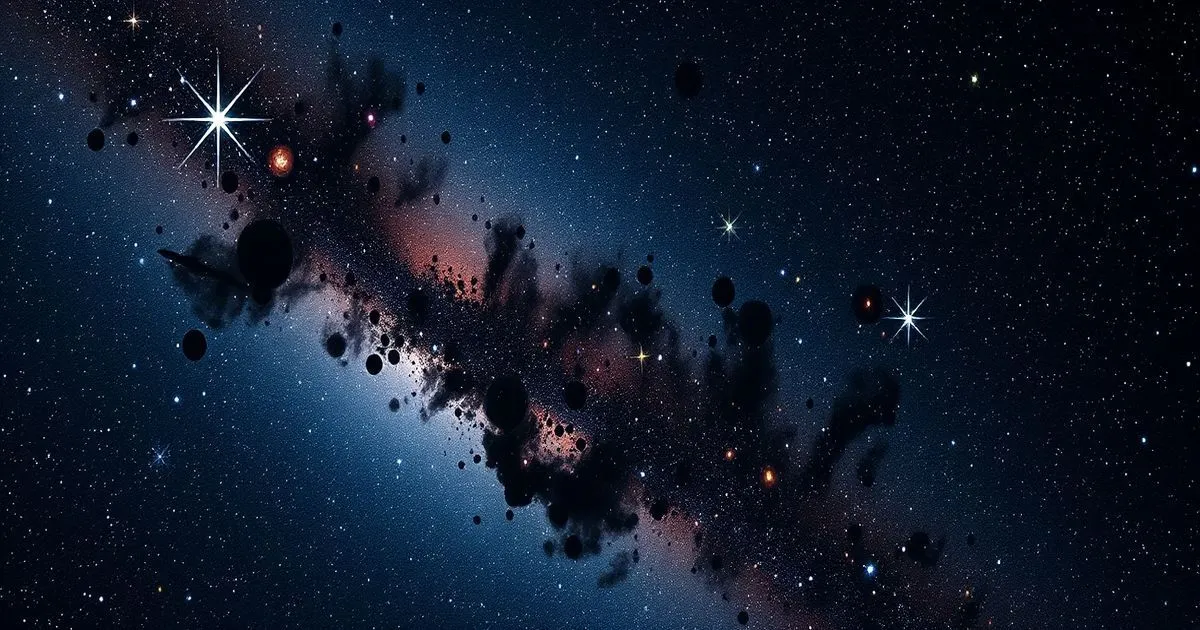
The Age-Old Question: Counting the Cosmic Glitter
Since humanity first gazed upwards, the night sky has been a source of endless wonder and profound questions. Among the most common and captivating is: "How many stars does space have?" It's a question that ignites the imagination, hinting at the true scale of the universe we inhabit.
The short answer, delivered with a touch of cosmic humility, is: we don't truly know. But that doesn't mean scientists haven't made incredible strides in estimating this unfathomable number! Let's embark on a journey through the cosmos to understand why this question is so challenging to answer and what our best guesses reveal.
Why Counting Stars Is (Almost) Impossible
Imagine trying to count all the grains of sand on all the beaches of Earth, simultaneously, while they're constantly shifting, and you can only see a tiny fraction of them. That's a bit like counting stars! Here’s why it's such a monumental task:
The Sheer Vastness of Space
Space is incomprehensibly huge. Even light, the fastest thing we know, takes billions of years to cross the universe. We're talking about distances so great they defy everyday comprehension.
Limits of Observation
Our telescopes, as powerful as they are, have limits. Light from the most distant stars and galaxies hasn't had enough time to reach us since the Big Bang, meaning there are parts of the universe we simply cannot see. This region is known as the "observable universe."
Stars Aren't Uniformly Distributed
Stars aren't scattered evenly throughout space; they're clustered into galaxies, which are themselves clustered into groups and superclusters. This makes a simple "sample and multiply" approach incredibly difficult.
Dust and Gas Obscuration
Within galaxies, vast clouds of dust and gas can block our view of distant stars, making them impossible to detect with visible light telescopes.
Our Galactic Neighborhood: The Milky Way
Before we venture into the furthest reaches of the cosmos, let's start with what we know best: our own galaxy, the Milky Way.
Estimating Stars in the Milky Way
Even counting stars in our home galaxy is an estimate. Scientists typically do this by:
- Measuring the Milky Way's mass: Using gravitational effects on objects within the galaxy.
- Estimating the average mass of a star: This varies greatly, but an average helps.
- Dividing the total mass by the average star mass: This gives an approximate number.
Based on these methods, astronomers estimate that the Milky Way contains anywhere from 100 billion to 400 billion stars. That's just one galaxy!
Beyond Our Galaxy: The Observable Universe
Now, let's zoom out to the observable universe – the part of the cosmos from which light has had time to reach Earth since the Big Bang.
Counting Galaxies
The Hubble Space Telescope and other powerful instruments have given us an unprecedented view of deep space. Images like the Hubble Deep Field reveal thousands of galaxies in tiny patches of sky. By extrapolating these observations across the entire sky, scientists estimate there are at least 2 trillion (2,000,000,000,000) galaxies in the observable universe. Some more recent estimates push this number even higher!
The Grand Total: Stars in the Observable Universe
If we multiply the estimated number of galaxies by the average number of stars per galaxy (which varies, but let's use our Milky Way's 100-400 billion as a rough guide), the numbers become truly mind-boggling.
2 trillion galaxies * 100 billion stars/galaxy = 200,000,000,000,000,000,000,000 stars. That's 200 sextillion stars, or 2 x 10^23.
Other estimates, taking into account different galaxy sizes and types, often arrive at figures closer to a septillion (10^24) or even an octillion (10^27) stars within the observable universe. To write that out, an octillion looks like this: 1,000,000,000,000,000,000,000,000,000.
The True Number: An Unknowable Infinity?
It's crucial to remember that all these spectacular figures relate only to the observable universe. What about the universe beyond our observational horizon?
Current cosmological models suggest that the universe extends far, far beyond what we can see, and it might even be infinite in extent. If the universe is indeed infinite, then the number of stars it contains would also be infinite.
While this concept is almost impossible for our brains to fully grasp, it highlights the ultimate limitation of our question: we can only count what we can see or reasonably infer exists.
Conclusion: A Universe of Unfathomable Sparkle
So, how many stars does space have? For the observable universe, our best estimates hover around a septillion to an octillion – a number so vast it's hard to process. For the universe as a whole, the answer might be infinite.
Every tiny point of light in the night sky represents a colossal sun, often orbited by planets, much like our own. The sheer number of stars reminds us of the incredible scale and beauty of the cosmos and the endless possibilities for discovery that await. Each new telescope and scientific breakthrough brings us a step closer to understanding our place in this dazzling, star-studded reality.
Further Reading & Resources
- The Milky Way Galaxy: Explore our home galaxy in more detail from NASA.
- The Observable Universe: Understand the limits of what we can see, explained by NASA.
- Hubble Space Telescope: Learn about the iconic telescope that has revolutionized our view of the cosmos.
- How Many Stars Are There?: A straightforward explanation for a general audience from NASA Space Place.
- Hubble Reveals Ten Times More Galaxies Than Previously Thought: An article from ESA highlighting increased estimates of galaxy numbers.