The History and Origins of Traditional Japanese Tea Ceremonies
Exploring the history and origins of traditional Japanese tea ceremonies reveals a complex social protocol that functions much like a high-level operating system for human interaction. For centuries, this ritualized practice, known as Chadō or Sadō (The Way of Tea), has synchronized aesthetics, philosophy, and precise physical movements into a seamless user experience. By understanding the history and origins of traditional Japanese tea ceremonies, we can decode how a simple caffeinated beverage evolved into a pillar of national identity and a masterclass in minimalist design.
- Defining the System: What is Chadō?
- The Core Architecture: Physical and Environmental Hardware
- Decoding The History and Origins of Traditional Japanese Tea Ceremonies
- The Sengoku Period: Sen no Rikyū and the "Wabi-cha" Protocol
- Aesthetic Algorithms: Wabi-Sabi and Ichigo Ichie
- The Logic of the Ritual: Procedural Steps
- The Scientific Synthesis: The Chemistry of Matcha
- Modern Context: Tea Ceremonies in the 21st Century
- Frequently Asked Questions
- Conclusion
- Further Reading & Resources
Defining the System: What is Chadō?
At its core, the Japanese tea ceremony is a choreographic ritual of preparing and serving powdered green tea (Matcha) in the presence of guests. However, viewing it merely as "making tea" is like calling a modern smartphone "just a calculator." It is an interdisciplinary system that integrates architecture, garden design, ceramics, calligraphy, and culinary arts.
The ceremony operates on four fundamental principles, often referred to as the "core logic" of the practice:
- Wa (Harmony): The interaction between the host, the guest, and the environment. It requires the elimination of ego to ensure all elements of the gathering are in sync.
- Kei (Respect): The acknowledgement of the innate worth of every object and individual involved. This involves deep bowing and specific hand placements when handling utensils.
- Sei (Purity): Both the physical cleanliness of the utensils and the spiritual clarity of the participants. The act of wiping a tea scoop is not just for hygiene; it is a symbolic purification of the mind.
- Jaku (Tranquility): The "steady state" achieved once the first three principles are successfully executed. It is the silence that exists between the sound of boiling water and the whisking of tea.
In a traditional setting, the host must master hundreds of temae (procedures), which are essentially "code blocks" of movement that dictate exactly how to enter the room, clean the tools, and whisk the tea. Every movement is optimized for efficiency and grace, minimizing "noise" in the environment to allow for a focused, meditative connection. This level of intentionality shares many psychological benefits of minimalist living that modern tech professionals use to combat decision fatigue.
The Core Architecture: Physical and Environmental Hardware
To understand how the ritual functions, we must look at the hardware—the physical components that facilitate the experience. The ceremony does not happen in a vacuum; it requires a specialized environment designed to minimize external distractions and focus the participants' sensory inputs.
The Chashitsu (Tea Room) and Roji (Garden Path)
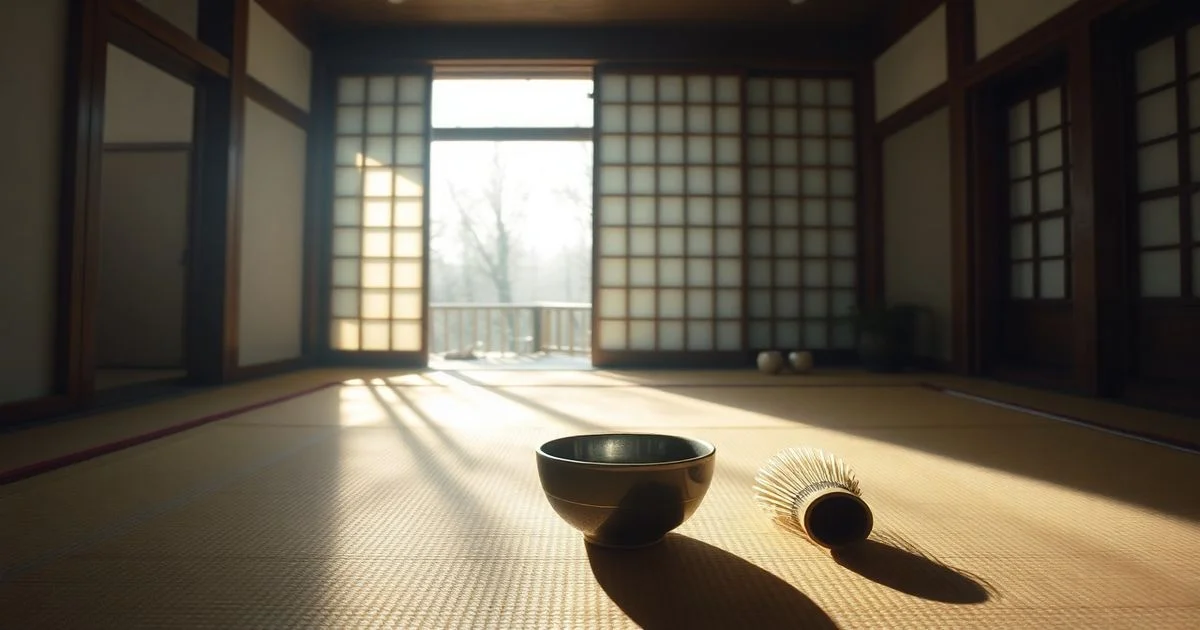
The tea room is a highly constrained environment. Traditionally, it is small—often only four and a half tatami mats (roughly 65 square feet). This spatial limitation is intentional; it forces a "high-bandwidth" intimacy between the host and guests.
Before entering the room, guests must traverse the Roji (Dewy Path). This garden path acts as a "buffer zone" or a "loading screen," transitioning the guest from the chaotic outside world to the sacred space of the tea room. It typically includes:
- Tsukubai (Stone Basin): Where guests wash their hands and mouths, a physical "reset" of their personal state.
- Nijiriguchi (Crawl-in Entrance): A small, low door that requires all guests to bow and crawl to enter. This functions as a social "leveler," stripping away rank (and historically, requiring samurai to leave their swords outside).
- Tokonoma (Alcove): A dedicated space for displaying a scroll or flower arrangement (chabana). This serves as the "visual UI," setting the theme or mood for the session.
The Utensil Stack
The tools used in the ceremony are not merely kitchenware; they are historical artifacts, often with their own lineages and names.
Utensil Hardware Specifications:
- Chawan (Tea Bowl): The primary interface; varied shapes for seasonal heat retention.
- Chasen (Bamboo Whisk): Carved from a single piece of bamboo; defines the tea's texture.
- Chashaku (Tea Scoop): Usually bamboo; used to measure the precise dosage of Matcha.
- Natsume/Chaire (Tea Caddy): Containers for the tea powder; aesthetic varied by formal level.
- Kama (Kettle): The heat source; its "song" (sound of boiling water) is a vital audio component.
- Hishaku (Ladle): A bamboo tool used to transfer water; its handling requires extreme precision.
Decoding The History and Origins of Traditional Japanese Tea Ceremonies
The evolution of the tea ceremony is not a linear path but a series of "version updates" influenced by religious shifts, political power plays, and aesthetic revolutions. To trace the history and origins of traditional Japanese tea ceremonies, we must look back over a thousand years to the initial "import" of tea culture from mainland Asia.
The Pre-Alpha Phase: Tang Dynasty Roots (8th–9th Century)
Tea was first introduced to Japan from China during the Tang Dynasty. At this time, tea was a medicinal "patch" used by Buddhist monks to stay awake during long meditation sessions. The first recorded instance of a Japanese ruler drinking tea was in 815 AD, when the Emperor Saga was served tea by the monk Eichū.
During this era, tea was prepared by steaming the leaves, roasting them, and then boiling them with additives like salt or ginger. However, when the Tang Dynasty declined and Japan's missions to China were suspended, the initial "Tea v1.0" largely faded from the Japanese cultural mainstream, remaining only within a few isolated monasteries.
The Kamakura Period: Zen Integration (12th Century)
The true origin of the modern tea ceremony lies in the late 12th century, with the monk Eisai. Upon returning from China (Song Dynasty), Eisai brought back not just tea seeds, but a new "compilation method": powdered green tea.
He authored the Kissa Yōjōki (Record of Drinking Tea for Health), which framed tea as a sophisticated health supplement. More importantly, Eisai's tea culture was inextricably linked to Zen Buddhism. The "meditative focus" required to prepare the tea became a form of "active mindfulness," laying the groundwork for the ritual's philosophical framework. He emphasized that tea was the "ultimate mental medicine" for a nation suffering from civil unrest.
The Muromachi Refinement: Social Scaling (14th–15th Century)
As tea culture moved from the monasteries to the elite samurai class, it underwent a significant "UI overhaul." The Ashikaga shoguns turned tea into a display of extreme wealth and political status. This era saw the rise of:
- Tocha (Tea Tournaments): These were essentially "benchmarking" competitions where guests would drink various teas and try to identify which ones were from the famous tea fields of Uji. Winners were often awarded extravagant prizes like silk or weapons.
- Shoin-style: Ceremonies moved into large, opulent reception halls decorated with expensive Chinese imports (karamono). The focus was on outward display rather than inward reflection.
During this period, the priest Murata Jukō began to push back against this "bloatware" of extravagance. He proposed a more austere, inward-looking style that emphasized the relationship between host and guest. This was the first iteration of what we now call Wabi-cha, or the "poverty-style" tea.
The Sengoku Period: Sen no Rikyū and the "Wabi-cha" Protocol
If the tea ceremony were a modern operating system, Sen no Rikyū (1522–1591) would be its lead architect. Living during the turbulent "Warring States" period, Rikyū served as the tea master to Japan's great unifiers, Oda Nobunaga and Toyotomi Hideyoshi.
Rikyū revolutionized the practice by stripping away everything unnecessary. He standardized the Wabi-sabi aesthetic—finding beauty in the imperfect, the rustic, and the transient.
- The Two-Mat Room: Rikyū reduced the physical footprint of the tea room to its absolute minimum (sometimes just two tatami mats), forcing a focus on the human interaction rather than the surroundings.
- Raku Ceramics: He moved away from flawless Chinese porcelain in favor of hand-molded, rustic Raku bowls. These bowls felt "warm" and "human" in the hands, prioritizing the tactile user experience over visual perfection.
- The Political API: Rikyū understood that the tea room was a "secure environment" for sensitive political negotiations. Within the tea room, the strict hierarchies of the battlefield were temporarily suspended.
Rikyū's influence was so profound that even after his ritual suicide (ordered by Hideyoshi), his descendants formed the "San-Senke" (the three houses of Sen), which still govern the major schools of tea today: Urasenke, Omotesenke, and Mushakōjisenke. Mastering these movements is a lesson in the core principles of effective time management, as every second and every gesture is accounted for.
Aesthetic Algorithms: Wabi-Sabi and Ichigo Ichie
To the tech-savvy mind, the aesthetics of the tea ceremony can be viewed as "design patterns" that optimize for specific psychological states.
Wabi-Sabi: The Beauty of Imperfection
Wabi-sabi is the rejection of the "high-gloss," "perfect-pixel" aesthetic. It values the crack in a bowl (often repaired with gold in a process called Kintsugi) because it represents the history and "logs" of the object's life. In a world of planned obsolescence, Wabi-sabi is a design philosophy that values durability and the patina of time.
Ichigo Ichie: One Time, One Encounter
The concept of Ichigo Ichie functions like a "singleton pattern" in software—an instance that occurs only once. It reminds both host and guest that this specific gathering, with these specific people, at this specific time, can never be repeated. This creates a state of "real-time awareness," discouraging distractions and ensuring that all mental resources are allocated to the present moment.
The Logic of the Ritual: Procedural Steps
A full tea ceremony (Chaji) can last up to four hours and follows a strict procedural sequence. This is the "runtime" of the tea ceremony system, requiring participants to focus on the task at hand to effectively manage professional burnout through meditative immersion.
-
Phase 1: The Kaiseki Meal: A multi-course, seasonal meal designed to prepare the stomach and the palate for the strong tea to come. It is the "pre-loading" phase. Each course is served on specific ceramics that match the season.
-
Phase 2: Nakadachi (The Break): Guests briefly exit the tea room to a waiting area (machiai), allowing the host to reset the environment—changing the scroll to a flower arrangement and preparing the tea utensils.
-
Phase 3: Koicha (Thick Tea): This is the "high-priority" segment. A single bowl of very thick, intense matcha is shared among all guests. The texture is almost like liquid clay, and the focus here is on collective unity and silence.
-
Phase 4: Usucha (Thin Tea): The "low-latency" segment. Individual bowls of lighter, frothy tea are served to each guest. The atmosphere becomes more relaxed, and conversation is encouraged.
Throughout these phases, the host follows a strict "state machine" of movements. If the host is purifying a tea scoop, there is a specific way the cloth is folded and a specific path the hand takes. This consistency ensures that the "interface" remains familiar across different ceremonies.
The Scientific Synthesis: The Chemistry of Matcha
Beyond the ritual, the history and origins of traditional Japanese tea ceremonies are grounded in the chemical interaction between the tea and the human brain. Matcha is unique because the entire leaf is consumed, providing a concentrated dose of phytochemicals.
The L-Theanine/Caffeine Stack:
Matcha contains high levels of L-theanine, an amino acid that promotes relaxation without drowsiness. When paired with caffeine, it creates a "synergistic effect." Instead of the sharp spike and subsequent crash associated with coffee, the L-theanine in Matcha modulates the caffeine's absorption. This results in a state of "relaxed alertness" or "calm focus" that can last for 4-6 hours. In technical terms, this is the physiological equivalent of optimizing a system for both speed and stability.
Antioxidant Density:
Matcha is packed with catechins, specifically EGCG (epigallocatechin gallate), which help neutralize free radicals. The shade-growing process used for Matcha leaves (where the plants are covered for 20-30 days before harvest) triggers a massive increase in chlorophyll production, giving the tea its vibrant green "UI" and its earthy flavor profile.
Modern Context: Tea Ceremonies in the 21st Century
In the digital age, the tea ceremony is experiencing a "reboot." Modern practitioners are integrating the core principles into contemporary life without necessarily requiring a traditional tea house.
- Office Tea Rituals: Tech companies in Tokyo and Silicon Valley have experimented with "Tea Mindfulness" rooms to combat developer burnout, applying the "low-noise" philosophy to the workplace.
- Virtual Tea: During the pandemic, tea masters used high-definition video feeds to host "remote ceremonies." While this lost the tactile "hardware" aspect, it focused on the "software" of shared timing and conversation.
- Sustainability: Modern tea culture is leaning back into its Wabi-sabi roots by emphasizing plastic-free utensils and ethically sourced, organic Matcha from historical regions like Uji and Nishio.
For more information on the specific techniques of various schools, you can visit the official site of Urasenke or Omotesenke. These organizations act as the "standardization bodies" for the tea world, maintaining the documentation for future generations.
Frequently Asked Questions
Q: How long does it take to learn the Japanese tea ceremony?
A: While basic procedures can be learned in a few months, mastering the various temae and the philosophy behind them is considered a lifelong pursuit, often taking decades to reach the level of a certified master.
Q: Is there a difference between "Matcha" and the tea used in ceremonies?
A: Ceremonial grade Matcha is specifically grown, harvested, and stone-ground for the ceremony. It uses the youngest tea leaves and is significantly higher in quality (and price) than the "culinary grade" matcha used in lattes or baking.
Q: Why do guests have to rotate the tea bowl before drinking?
A: Guests rotate the bowl twice to avoid drinking from the "front" (the most decorative side) of the bowl. This is a gesture of humility and respect for the host's choice of utensil.
Conclusion
Understanding the history and origins of traditional Japanese tea ceremonies allows us to appreciate it not as a relic of the past, but as a sophisticated technology of the spirit. It is a system designed to solve the eternal human problem of disconnection. By creating a space where "Wa, Kei, Sei, and Jaku" are the primary operating protocols, the tea ceremony provides a blueprint for intentional living.
Whether you are a developer looking for a way to "defrag" your mind after a long sprint, or a history enthusiast fascinated by the political utility of aesthetics, the Way of Tea offers a deep, multi-layered experience. It reminds us that sometimes, the most advanced "tech" isn't found in a silicon chip, but in the precise, mindful preparation of a single bowl of tea. As we look back at the history and origins of traditional Japanese tea ceremonies, we see a timeless method for achieving harmony in a chaotic world.