Introduction to the Floyd Warshall Algorithm
- Introduction to the Floyd Warshall Algorithm
- Prerequisites for Understanding Floyd Warshall
- Understanding the Floyd Warshall Algorithm
- Implementing the Floyd Warshall Algorithm in Python, Java, and C++
- Time and Space Complexity Analysis
- Common Mistakes and Troubleshooting
- Conclusion
- Frequently Asked Questions
- Further Reading & Resources
Welcome to this comprehensive tutorial where we will deeply explore the Floyd Warshall Algorithm in Python, Java and C++. This powerful algorithm is a fundamental concept in graph theory, designed to find the shortest paths between all pairs of vertices in a weighted graph. Whether you're a student embarking on your algorithmic journey or a seasoned developer looking to refresh your knowledge, this tutorial will guide you through understanding its core principles, practical implementation, and common pitfalls across these popular programming languages. Mastering the Floyd Warshall Algorithm offers invaluable insights into dynamic programming and graph traversal, proving essential for various real-world applications ranging from network routing to transportation logistics. Our goal is to provide a clear, step-by-step approach, ensuring you can confidently apply this technique to your own projects.
Prerequisites for Understanding Floyd Warshall
Before diving into the intricacies of the Floyd Warshall Algorithm, it’s beneficial to have a foundational understanding of several key computer science concepts. These prerequisites will ensure you can fully grasp the logic and implementation details presented in this tutorial.
Basic Graph Theory
Familiarity with fundamental graph theory concepts is essential. This includes knowing what a graph is (set of vertices and edges), understanding directed and undirected graphs, and being aware of weighted edges. Concepts like adjacency matrices, which represent connections and weights between nodes, are particularly important as they form the primary data structure for the Floyd Warshall Algorithm. Knowing the difference between an edge's weight (cost) and a path's total weight will also be helpful.
Dynamic Programming
The Floyd Warshall Algorithm is a classic example of dynamic programming. A basic understanding of dynamic programming principles, such as breaking down a complex problem into smaller, overlapping subproblems and storing the results to avoid redundant calculations, will significantly aid your comprehension. If you've encountered problems like the Fibonacci sequence or knapsack problem using dynamic programming, you're well-prepared.
Basic Programming Concepts
You should have a working knowledge of at least one of the target languages: Python, Java, or C++. This includes understanding:
- Loops:
forloops are extensively used in the algorithm's implementation. - Arrays/Matrices: Representing graphs using 2D arrays (adjacency matrices) is central to the algorithm.
- Constants: Using a large integer to represent "infinity" for unreachable paths.
- Conditional Statements: For comparisons and updates.
Possessing these foundational skills will enable you to follow the algorithmic logic and the provided code examples with ease, allowing you to focus on the unique aspects of the Floyd Warshall Algorithm itself.
Understanding the Floyd Warshall Algorithm
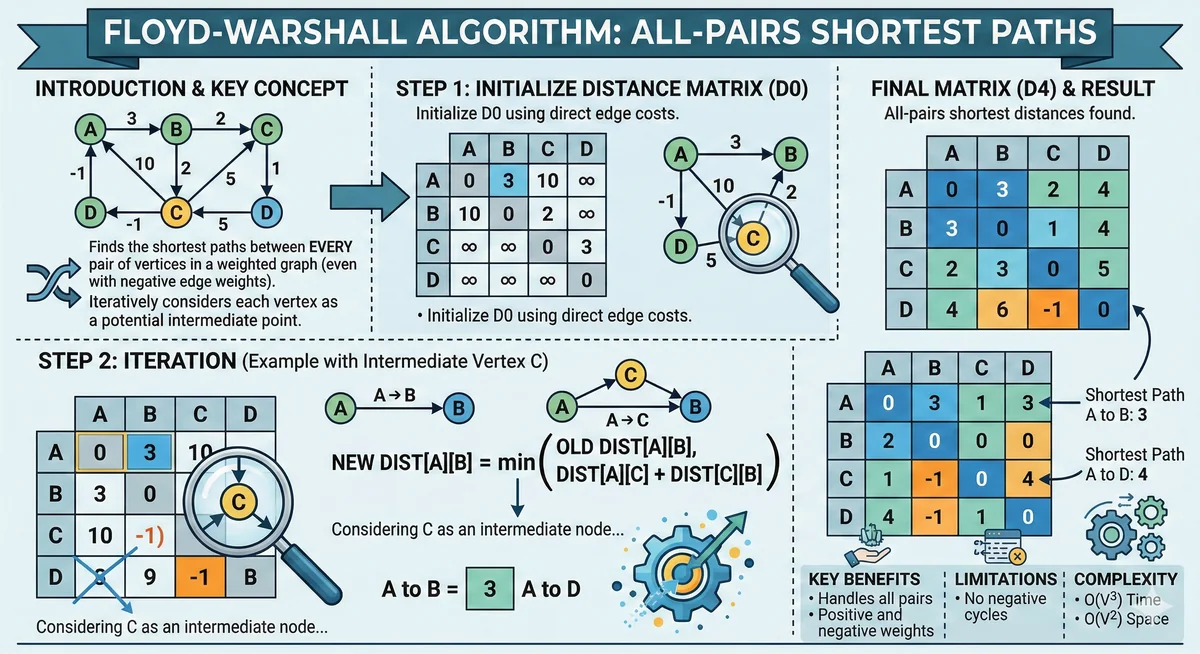
The Floyd Warshall Algorithm is an elegant and powerful algorithm for solving the all-pairs shortest path problem in a weighted, directed graph. Unlike single-source shortest path algorithms like Dijkstra's Algorithm or the Bellman-Ford Algorithm, Floyd Warshall calculates the shortest path between every possible pair of vertices in the graph. It can handle graphs with positive and negative edge weights, but it cannot handle negative cycles (a cycle where the sum of edge weights is negative), as such a cycle would allow for infinitely decreasing path lengths.
What is the All-Pairs Shortest Path Problem?
The all-pairs shortest path problem asks us to find, for every pair of vertices (u, v) in a given graph, the path with the minimum total weight from u to v. This is a common problem in areas like network routing, where you need to know the fastest or cheapest way to get from any point to any other point.
Key Concepts
Dynamic Programming Paradigm
At its heart, the Floyd Warshall Algorithm is a prime example of dynamic programming. It builds up a solution incrementally. Instead of solving the problem directly, it solves a sequence of related subproblems, storing their solutions and reusing them to build the final answer. Each iteration improves upon the previous one by considering an additional vertex as a potential intermediate point on the shortest path.
Intermediate Vertices
The core idea revolves around iteratively allowing more and more vertices to be used as "intermediate" points in a path. Let dist[i][j] be the shortest distance from vertex i to vertex j. When considering a vertex k as an intermediate vertex, we ask: "Is the path from i to k then k to j shorter than the current known shortest path from i to j?"
- Initially,
dist[i][j]is just the direct edge weight (or infinity if no direct edge). - In the first iteration, we allow
V0as an intermediate vertex. - In the second iteration, we allow
V0orV1as intermediate vertices. - This continues until we allow all vertices
V0throughV(N-1)as intermediate vertices.
Adjacency Matrix Representation
The algorithm typically uses an adjacency matrix dist[N][N] to store the shortest path distances.
dist[i][j]stores the shortest distance from vertexito vertexj.- If
iequalsj,dist[i][j]is 0. - If there is a direct edge from
itoj,dist[i][j]is its weight. - If there is no direct edge,
dist[i][j]is initialized to infinity (a very large number).
The Algorithm's Core Logic
The Floyd Warshall Algorithm proceeds in N phases, where N is the number of vertices in the graph. In the k-th phase (where k ranges from 0 to N-1), the algorithm considers paths that are allowed to use vertices 0, 1, ..., k as intermediate points.
The core of the algorithm is a set of three nested loops:
for k from 0 to N-1:         // k is the intermediate vertex
    for i from 0 to N-1:     // i is the source vertex
        for j from 0 to N-1: // j is the destination vertex
            // If vertex k is on the shortest path from i to j,
            // then update the value of dist[i][j]
            dist[i][j] = min(dist[i][j], dist[i][k] + dist[k][j])
Let's break down this update rule:
dist[i][j]represents the current shortest path found fromitojwithout using any vertex greater thank-1as an intermediate.dist[i][k] + dist[k][j]represents the path fromitojthat does usekas an intermediate vertex. Here,dist[i][k]is the shortest path fromitokusing intermediate vertices up tok-1, and similarly fordist[k][j].- By taking the
minof these two values, we are effectively saying: the shortest path fromitojusing intermediate vertices up tokis either the shortest path without usingk(which isdist[i][j]) or the shortest path that does usek(which isdist[i][k] + dist[k][j]).
The crucial aspect of this algorithm's correctness is the order of the loops. The outermost loop must iterate through k (the intermediate vertex) first. This ensures that when dist[i][k] and dist[k][j] are used to update dist[i][j], they already contain the shortest path distances allowing intermediate vertices up to k-1.
Handling Negative Cycles
The Floyd Warshall Algorithm can also detect negative cycles. If, after the algorithm completes, dist[i][i] for any vertex i is negative, it indicates the presence of a negative cycle reachable from i and returning to i. This is because a negative cycle would allow the path length from i to i to continuously decrease.
Implementing the Floyd Warshall Algorithm in Python, Java, and C++
Now, let's proceed with the practical implementation of the Floyd Warshall Algorithm. We'll provide code examples in Python, Java, and C++, along with detailed explanations for each step.
Step 1: Initialize the Distance Matrix
The first step for all implementations is to set up an N x N distance matrix. This matrix will initially represent the direct edge weights between vertices.
dist[i][j]will be the weight of the direct edge fromitoj.- If
i == j,dist[i][j]is 0. - If there's no direct edge from
itoj,dist[i][j]is set to a special "infinity" value to denote that the vertices are unreachable from each other (or that a path hasn't been found yet).
Step 2: Apply the Triple Nested Loop
After initialization, the core of the algorithm involves three nested loops. The outermost loop iterates through all possible intermediate vertices (k), followed by loops for source vertices (i) and destination vertices (j). Inside the innermost loop, the distance matrix is updated using the min(dist[i][j], dist[i][k] + dist[k][j]) formula.
Step 3: Check for Negative Cycles (Optional but Recommended)
After the algorithm completes, you can iterate through the diagonal of the distance matrix (dist[i][i]). If any dist[i][i] is less than 0, it signifies the presence of a negative cycle in the graph.
Python Implementation
Here's how to implement the Floyd Warshall Algorithm using Python. Python's clear syntax and dynamic typing make it an excellent language for understanding algorithmic concepts.
import math

# Define a large number for infinity
INF = float('inf')

def floyd_warshall_python(graph):
    """
    Implements the Floyd Warshall Algorithm to find all-pairs shortest paths.

    Args:
        graph (list of lists): An adjacency matrix representation of the graph.
                               graph[i][j] is the weight of the edge from i to j.
                               If there is no direct edge, use INF. Self-loops are 0.

    Returns:
        list of lists: A matrix where dist[i][j] is the shortest path from i to j.
                       Returns None if a negative cycle is detected.
    """
    num_vertices = len(graph)

    # Initialize the distance matrix
    # Make a deep copy to avoid modifying the original graph
    dist = [row[:] for row in graph]

    # Main algorithm: Triple nested loops
    # k is the intermediate vertex
    for k in range(num_vertices):
        # i is the source vertex
        for i in range(num_vertices):
            # j is the destination vertex
            for j in range(num_vertices):
                # If vertex k is on the shortest path from i to j,
                # then update the value of dist[i][j]

                # Ensure that dist[i][k] and dist[k][j] are not INF
                # before adding to prevent overflow issues with INF + number
                # and to correctly handle unreachable paths.
                if dist[i][k] != INF and dist[k][j] != INF:
                    dist[i][j] = min(dist[i][j], dist[i][k] + dist[k][j])

    # Check for negative cycles
    for i in range(num_vertices):
        if dist[i][i] < 0:
            print(f"Negative cycle detected at vertex {i}!")
            return None # Or handle as per requirement, e.g., raise an error

    return dist

# --- Example Usage (Python) ---
if __name__ == "__main__":
    # Example graph represented as an adjacency matrix
    # 4 vertices: 0, 1, 2, 3
    # INF represents no direct edge

    # Graph 1: Basic example
    graph1 = [
        [0, 3, INF, 7],
        [8, 0, 2, INF],
        [5, INF, 0, 1],
        [2, INF, INF, 0]
    ]

    print("--- Graph 1: Basic Example ---")
    shortest_paths1 = floyd_warshall_python(graph1)
    if shortest_paths1:
        print("Shortest path matrix:")
        for row in shortest_paths1:
            print([round(val, 2) if val != INF else "INF" for val in row])
    print("\n")

    # Graph 2: Example with negative edge weights (but no negative cycle)
    graph2 = [
        [0, 1, INF, INF],
        [INF, 0, -2, INF],
        [INF, INF, 0, 3],
        [-4, INF, INF, 0]
    ]

    print("--- Graph 2: With Negative Edges (No Negative Cycle) ---")
    shortest_paths2 = floyd_warshall_python(graph2)
    if shortest_paths2:
        print("Shortest path matrix:")
        for row in shortest_paths2:
            print([round(val, 2) if val != INF else "INF" for val in row])
    print("\n")

    # Graph 3: Example with a negative cycle
    graph3 = [
        [0, 1, INF],
        [INF, 0, -3],
        [-2, INF, 0] # Cycle: 0 -> 1 -> 2 -> 0 (1 + (-3) + (-2) = -4)
    ]

    print("--- Graph 3: With Negative Cycle ---")
    shortest_paths3 = floyd_warshall_python(graph3)
    if shortest_paths3:
        print("Shortest path matrix:")
        for row in shortest_paths3:
            print([round(val, 2) if val != INF else "INF" for val in row])
    print("\n")
Explanation for Python Implementation
INF = float('inf'): We usefloat('inf')from Python's math module to represent unreachable paths. This is a convenient way to handle the concept of "infinity" in numerical comparisons.floyd_warshall_python(graph)function:- Takes an adjacency matrix
graphas input. num_vertices = len(graph): Determines the number of vertices.dist = [row[:] for row in graph]: Creates a deep copy of the input graph to prevent modifying the original matrix. Thisdistmatrix will store the shortest paths.- Triple Nested Loops: The heart of the algorithm.
- The outer loop
for k in range(num_vertices)iterates through all possible intermediate vertices. - The middle loop
for i in range(num_vertices)iterates through all possible source vertices. - The inner loop
for j in range(num_vertices)iterates through all possible destination vertices.
- The outer loop
- Update Rule:
dist[i][j] = min(dist[i][j], dist[i][k] + dist[k][j]). Before adding, we checkif dist[i][k] != INF and dist[k][j] != INF. This check is crucial to preventINF + actual_numberfrom resulting inINFand potentially allowing a path through an unreachable node to appear shorter than it is. It correctly handles cases where a direct path fromitokorktojdoes not exist. - Negative Cycle Detection: After the loops, we check if
dist[i][i] < 0for anyi. If true, a negative cycle exists, and the function returnsNone. - Finally, the function returns the
distmatrix containing all-pairs shortest paths.
- Takes an adjacency matrix
- Example Usage: Demonstrates how to call the function with sample graphs, including one with a negative cycle to show the detection mechanism.
Java Implementation
For Java, we'll use a similar structure, adapting to Java's strong typing and array handling.
import java.util.Arrays;

public class FloydWarshallJava {

    // Define a large number for infinity. Integer.MAX_VALUE / 2 is safer than MAX_VALUE
    // to prevent overflow when adding two "infinity" values.
    private static final int INF = 1_000_000_000; // A sufficiently large number

    public static int[][] floydWarshall(int[][] graph) {
        int numVertices = graph.length;
        int[][] dist = new int[numVertices][numVertices];

        // Initialize the distance matrix
        for (int i = 0; i < numVertices; i++) {
            for (int j = 0; j < numVertices; j++) {
                dist[i][j] = graph[i][j];
            }
        }

        // Main algorithm: Triple nested loops
        // k is the intermediate vertex
        for (int k = 0; k < numVertices; k++) {
            // i is the source vertex
            for (int i = 0; i < numVertices; i++) {
                // j is the destination vertex
                for (int j = 0; j < numVertices; j++) {
                    // If vertex k is on the shortest path from i to j,
                    // then update the value of dist[i][j]

                    // Ensure that dist[i][k] and dist[k][j] are not INF
                    // before adding to prevent overflow
                    if (dist[i][k] != INF && dist[k][j] != INF) {
                        dist[i][j] = Math.min(dist[i][j], dist[i][k] + dist[k][j]);
                    }
                }
            }
        }

        // Check for negative cycles
        for (int i = 0; i < numVertices; i++) {
            if (dist[i][i] < 0) {
                System.out.println("Negative cycle detected at vertex " + i + "!");
                return null; // Or throw an exception
            }
        }

        return dist;
    }

    // Helper method to print the matrix
    public static void printMatrix(int[][] matrix) {
        if (matrix == null) {
            System.out.println("No valid shortest path matrix (negative cycle detected).");
            return;
        }
        for (int[] row : matrix) {
            for (int val : row) {
                if (val == INF) {
                    System.out.print("INF\t");
                } else {
                    System.out.print(val + "\t");
                }
            }
            System.out.println();
        }
    }

    // --- Example Usage (Java) ---
    public static void main(String[] args) {
        // Example graph represented as an adjacency matrix
        // 4 vertices: 0, 1, 2, 3
        // INF represents no direct edge

        // Graph 1: Basic example
        int[][] graph1 = {
            {0, 3, INF, 7},
            {8, 0, 2, INF},
            {5, INF, 0, 1},
            {2, INF, INF, 0}
        };

        System.out.println("--- Graph 1: Basic Example ---");
        int[][] shortestPaths1 = floydWarshall(graph1);
        printMatrix(shortestPaths1);
        System.out.println();

        // Graph 2: Example with negative edge weights (but no negative cycle)
        int[][] graph2 = {
            {0, 1, INF, INF},
            {INF, 0, -2, INF},
            {INF, INF, 0, 3},
            {-4, INF, INF, 0}
        };

        System.out.println("--- Graph 2: With Negative Edges (No Negative Cycle) ---");
        int[][] shortestPaths2 = floydWarshall(graph2);
        printMatrix(shortestPaths2);
        System.out.println();

        // Graph 3: Example with a negative cycle
        int[][] graph3 = {
            {0, 1, INF},
            {INF, 0, -3},
            {-2, INF, 0} // Cycle: 0 -> 1 -> 2 -> 0 (1 + (-3) + (-2) = -4)
        };

        System.out.println("--- Graph 3: With Negative Cycle ---");
        int[][] shortestPaths3 = floydWarshall(graph3);
        printMatrix(shortestPaths3);
        System.out.println();
    }
}
Explanation for Java Implementation
INF = 1_000_000_000: We use a large integer value to represent infinity. UsingInteger.MAX_VALUEdirectly can cause issues ifInteger.MAX_VALUE + Xis performed, leading to an overflow and becoming a negative number. A sufficiently large number, roughlyMAX_VALUE / 2, is a common practice to avoid this.floydWarshall(int[][] graph)function:- Takes a 2D integer array
graph(adjacency matrix) as input. int[][] dist = new int[numVertices][numVertices];: Declares and initializes thedistmatrix. Java arrays are initialized to default values (0 forint), so explicit copying fromgraphis necessary.- Initialization Loop: Explicitly copies values from the input
graphtodist. - Triple Nested Loops: Identical logic to the Python version, using
Math.min()for comparison. - Overflow Prevention: The condition
dist[i][k] != INF && dist[k][j] != INFis crucial in Java (and C++) to prevent integer overflow when addingINFvalues, which could result in a negative number and incorrect path detection. - Negative Cycle Detection: Similar logic, checking
dist[i][i] < 0. Returnsnullif detected.
- Takes a 2D integer array
printMatrixhelper method: A utility method to print the 2D array, handling theINFrepresentation for better readability.mainmethod: Provides example usage with different graphs.
C++ Implementation
The C++ implementation will be very similar to Java, utilizing std::vector for dynamic arrays and INT_MAX for infinity, with careful consideration for potential integer overflow.
#include <iostream>
#include <vector>
#include <algorithm> // For std::min
#include <limits>    // For std::numeric_limits

// Define a large number for infinity.
// Using a value less than INT_MAX to avoid overflow when adding.
const int INF = std::numeric_limits<int>::max() / 2;

// Function to implement Floyd Warshall Algorithm
std::vector<std::vector<int>> floydWarshall(std::vector<std::vector<int>>& graph) {
    int numVertices = graph.size();
    std::vector<std::vector<int>> dist(numVertices, std::vector<int>(numVertices));

    // Initialize the distance matrix
    for (int i = 0; i < numVertices; ++i) {
        for (int j = 0; j < numVertices; ++j) {
            dist[i][j] = graph[i][j];
        }
    }

    // Main algorithm: Triple nested loops
    // k is the intermediate vertex
    for (int k = 0; k < numVertices; ++k) {
        // i is the source vertex
        for (int i = 0; i < numVertices; ++i) {
            // j is the destination vertex
            for (int j = 0; j < numVertices; ++j) {
                // If vertex k is on the shortest path from i to j,
                // then update the value of dist[i][j]

                // Ensure that dist[i][k] and dist[k][j] are not INF
                // before adding to prevent overflow issues and incorrect comparisons.
                if (dist[i][k] != INF && dist[k][j] != INF) {
                    dist[i][j] = std::min(dist[i][j], dist[i][k] + dist[k][j]);
                }
            }
        }
    }

    // Check for negative cycles
    for (int i = 0; i < numVertices; ++i) {
        if (dist[i][i] < 0) {
            std::cout << "Negative cycle detected at vertex " << i << "!" << std::endl;
            // A common way to signal an invalid state, e.g., by returning an empty matrix
            // or a matrix filled with INF/specific error codes.
            // For simplicity, we'll return a special value.
            return {}; // Return an empty vector of vectors to indicate error
        }
    }

    return dist;
}

// Helper function to print the matrix
void printMatrix(const std::vector<std::vector<int>>& matrix) {
    if (matrix.empty()) {
        std::cout << "No valid shortest path matrix (negative cycle detected)." << std::endl;
        return;
    }
    for (const auto& row : matrix) {
        for (int val : row) {
            if (val == INF) {
                std::cout << "INF\t";
            } else {
                std::cout << val << "\t";
            }
        }
        std::cout << std::endl;
    }
}

// --- Example Usage (C++) ---
int main() {
    // Example graph represented as an adjacency matrix
    // 4 vertices: 0, 1, 2, 3
    // INF represents no direct edge

    // Graph 1: Basic example
    std::vector<std::vector<int>> graph1 = {
        {0, 3, INF, 7},
        {8, 0, 2, INF},
        {5, INF, 0, 1},
        {2, INF, INF, 0}
    };

    std::cout << "--- Graph 1: Basic Example ---" << std::endl;
    std::vector<std::vector<int>> shortestPaths1 = floydWarshall(graph1);
    printMatrix(shortestPaths1);
    std::cout << std::endl;

    // Graph 2: Example with negative edge weights (but no negative cycle)
    std::vector<std::vector<int>> graph2 = {
        {0, 1, INF, INF},
        {INF, 0, -2, INF},
        {INF, INF, 0, 3},
        {-4, INF, INF, 0}
    };

    std::cout << "--- Graph 2: With Negative Edges (No Negative Cycle) ---" << std::endl;
    std::vector<std::vector<int>> shortestPaths2 = floydWarshall(graph2);
    printMatrix(shortestPaths2);
    std::cout << std::endl;

    // Graph 3: Example with a negative cycle
    std::vector<std::vector<int>> graph3 = {
        {0, 1, INF},
        {INF, 0, -3},
        {-2, INF, 0} // Cycle: 0 -> 1 -> 2 -> 0 (1 + (-3) + (-2) = -4)
    };

    std::cout << "--- Graph 3: With Negative Cycle ---" << std::endl;
    std::vector<std::vector<int>> shortestPaths3 = floydWarshall(graph3);
    printMatrix(shortestPaths3);
    std::cout << std::endl;

    return 0;
}
Explanation for C++ Implementation
#include <limits>andINF: We usestd::numeric_limits<int>::max() / 2forINF. This is a robust way to get the maximum integer value and then halve it to prevent overflow issues when adding twoINForINF + a_number.std::vector<std::vector<int>>: C++ usesstd::vectorfor dynamic arrays, making it flexible for graph representation.std::vector<std::vector<int>> dist(numVertices, std::vector<int>(numVertices));initializes anN x Nmatrix.
- Initialization and Loops: The logic for initializing
distand the three nested loops are functionally identical to the Java implementation. - Overflow Prevention: The
if (dist[i][k] != INF && dist[k][j] != INF)check is equally critical in C++ forinttypes to prevent overflow. - Negative Cycle Detection: Similar detection, returning an empty
std::vector<std::vector<int>>to signify an error or invalid state due to a negative cycle. printMatrix: A helper function to display the matrix, withconst auto&for efficient iteration andconstreference for the matrix to avoid unnecessary copying.
Time and Space Complexity Analysis
Understanding the performance characteristics of an algorithm is just as important as knowing how to implement it. The Floyd Warshall Algorithm has a distinct time and space complexity profile that makes it suitable for certain types of problems and graph sizes.
Time Complexity: O(V³)
The time complexity of the Floyd Warshall Algorithm is cubic, specifically O(V³), where V is the number of vertices in the graph. This arises directly from its structure:
- The algorithm consists of three perfectly nested
forloops. - Each loop iterates
Vtimes (once for each vertex). - The innermost operation (the
mincomparison and addition) takes constant time.
Therefore, the total number of operations is proportional to V * V * V, leading to O(V³).
This cubic complexity implies that the algorithm's performance degrades rapidly as the number of vertices increases. For graphs with a very large number of vertices (e.g., thousands), O(V³) can become computationally prohibitive. For instance, a graph with 1000 vertices would require approximately 1 billion operations, which could take a significant amount of time.
Space Complexity: O(V²)
The space complexity of the Floyd Warshall Algorithm is quadratic, specifically O(V²).
- The algorithm primarily uses a 2D array (the distance matrix
dist) of sizeV x Vto store the shortest path distances between all pairs of vertices. - This matrix directly scales with the square of the number of vertices.
No other auxiliary data structures that grow significantly with V are typically required. Therefore, the total space required is dominated by this V x V matrix.
Comparison with Other Algorithms
It's useful to put these complexities into perspective with other shortest path algorithms:
- Dijkstra's Algorithm: For single-source shortest paths on graphs with non-negative edge weights. Using a min-priority queue, its complexity is typically
O(E log V)orO(E + V log V), whereEis the number of edges. If runVtimes (once for each source) to solve the all-pairs problem, it becomesO(V * E log V). - Bellman-Ford Algorithm: For single-source shortest paths on graphs with negative edge weights (but no negative cycles). Its complexity is
O(V * E). If runVtimes, it becomesO(V² * E).
Key Takeaways on Complexity:
- Floyd Warshall is simpler to implement than
Vruns of Dijkstra or Bellman-Ford for the all-pairs problem, especially when path reconstruction is not explicitly handled in thoseVruns. - For dense graphs (where
EapproachesV²),Vruns of Dijkstra or Bellman-Ford can approach or exceedO(V³). In such cases, Floyd Warshall is competitive. - For sparse graphs (where
Eis much smaller thanV²),Vruns of Dijkstra (O(V E log V)) can be significantly faster than Floyd Warshall'sO(V³). - The Floyd Warshall Algorithm's ability to handle negative edge weights (unlike Dijkstra) and its clean detection of negative cycles are significant advantages in its specific use cases.
In essence, the O(V³) time complexity makes Floyd Warshall best suited for graphs where the number of vertices V is relatively small, typically up to a few hundred. For larger graphs, alternative approaches or more specialized algorithms might be necessary, depending on the graph's density and edge weight properties.
Common Mistakes and Troubleshooting
Implementing graph algorithms like the Floyd Warshall Algorithm in Python, Java and C++ can introduce several common pitfalls. Being aware of these will help you troubleshoot and write more robust code.
1. Incorrect Initialization of the Distance Matrix
- Mistake: Not setting diagonal elements
dist[i][i]to 0 (shortest path from a vertex to itself is 0). Or, incorrectly using0for non-existent edges, which implies a free path. - Resolution: Always initialize
dist[i][i]to 0 for alli. For non-existent direct edges(i, j), initializedist[i][j]to yourINFconstant (a very large number). Only direct edges with given weights should populate the initialdist[i][j]value. Ensure your graph representation correctly differentiates between an edge with weight 0 and no edge at all.
2. Improper Handling of "Infinity"
- Mistake: Using
Integer.MAX_VALUEdirectly forINFin Java/C++ without consideration for overflow. IfINF + any_numberresults in a value exceedingMAX_VALUE, it will wrap around to a negative number, leading to incorrect shortest path calculations (e.g., an unreachable path suddenly appearing as a very short negative path). - Resolution: In languages like Java and C++, use
Integer.MAX_VALUE / 2or a sufficiently large constant less thanMAX_VALUEforINF. In Python,float('inf')handles this gracefully, but be cautious if mixing with large integers that might exceed standardintlimits in certain contexts (though generally not an issue for typical graph sizes). Always checkif dist[i][k] != INF && dist[k][j] != INFbefore attemptingdist[i][k] + dist[k][j]to prevent addingINFvalues, which might also result inINF, but could mask specific numerical issues or comparisons.
3. Incorrect Loop Order
- Mistake: Swapping the order of the
k,i, andjloops. The algorithm's correctness hinges onk(the intermediate vertex) being the outermost loop. - Resolution: The order must be
for k, thenfor i, thenfor j. Thekloop iteratively allows more vertices to be used as intermediate points, and its completion ensures thatdist[i][k]anddist[k][j]are already updated to their shortest possible values considering intermediate vertices up tok-1before they are used to updatedist[i][j].
4. Not Detecting or Misinterpreting Negative Cycles
- Mistake: Failing to check for negative cycles or misinterpreting their presence. If a negative cycle exists and is reachable, the concept of a "shortest path" becomes ill-defined as one could traverse the cycle indefinitely to achieve arbitrarily small (large negative) path weights.
- Resolution: After the main triple loops complete, iterate through
dist[i][i]for alli. If anydist[i][i] < 0, a negative cycle is detected. The algorithm effectively finds the shortest path even with negative cycles, but ifdist[i][i]is negative, it indicates an issue for paths involvingi. Your function should ideally return a special value (e.g.,nullin Java, empty vector in C++,Nonein Python) or throw an exception when a negative cycle is detected, as the computed shortest paths might no longer be meaningful.
5. Modifying the Original Graph Adjacency Matrix
- Mistake: Directly modifying the input
graphmatrix instead of working on a copy. This can lead to unexpected side effects if the original graph is needed elsewhere. - Resolution: Always create a deep copy of the initial adjacency matrix into your
distmatrix. In Python,dist = [row[:] for row in graph]creates a deep copy for a list of lists. In Java/C++, explicitly copy elements or ensure yourdistmatrix is a separate, new allocation.
6. Off-by-One Errors in Loop Bounds
- Mistake: Incorrectly setting loop bounds (e.g.,
range(num_vertices - 1)instead ofrange(num_vertices)). - Resolution: Ensure all loops iterate correctly from
0tonum_vertices - 1(inclusive of0, exclusive ofnum_verticesin Python'srange, or inclusive of both in C++/Javaforloops).
By keeping these common issues in mind, you can approach the implementation of the Floyd Warshall Algorithm with greater confidence and build more robust and accurate solutions.
Conclusion
We've journeyed through the intricacies of the Floyd Warshall Algorithm in Python, Java and C++, a foundational tool in graph theory for solving the all-pairs shortest path problem. This tutorial has equipped you with a comprehensive understanding of its dynamic programming principles, the core logic involving intermediate vertices, and practical, step-by-step implementations in Python, Java, and C++. We covered the essential initialization of the distance matrix, the critical triple nested loop structure, and even the important mechanism for detecting negative cycles.
You now understand that while its O(V³) time complexity limits its application to graphs with a relatively small number of vertices, its elegance, simplicity, and ability to handle negative edge weights (unlike Dijkstra's) make it invaluable in scenarios where finding all-pairs shortest paths is crucial. We also explored common pitfalls, such as incorrect initialization, issues with "infinity" representation, and the vital order of loops, providing you with the knowledge to troubleshoot effectively.
The Floyd Warshall Algorithm is more than just a theoretical concept; it's a powerful and practical technique with applications spanning network routing, resource allocation, and even social network analysis. By mastering this algorithm, you've not only added a significant tool to your algorithmic arsenal but also deepened your understanding of dynamic programming and graph traversal. Continue to practice with different graph structures and experiment with its parameters to solidify your grasp on this essential algorithm.
Frequently Asked Questions
Q: What is the main purpose of the Floyd Warshall Algorithm?
A: The Floyd Warshall Algorithm is designed to find the shortest paths between all possible pairs of vertices in a weighted graph. It calculates the minimum total weight to travel from any starting vertex to any other destination vertex.
Q: Can Floyd Warshall handle negative edge weights, and what about negative cycles?
A: Yes, the Floyd Warshall Algorithm can correctly handle graphs with negative edge weights. However, it cannot correctly find shortest paths in graphs that contain negative cycles, as such cycles would allow for infinitely decreasing path lengths. The algorithm can detect the presence of negative cycles.
Q: How does the Floyd Warshall Algorithm compare to Dijkstra's Algorithm?
A: Floyd Warshall finds all-pairs shortest paths and can handle negative edge weights, with a time complexity of O(V³) (where V is the number of vertices). Dijkstra's Algorithm, conversely, finds single-source shortest paths, requires non-negative edge weights, and typically has a complexity of O(E log V) or O(E + V log V) (where E is the number of edges). For dense graphs, Floyd Warshall can be competitive for the all-pairs problem.
Further Reading & Resources
- Wikipedia - Floyd–Warshall algorithm: https://en.wikipedia.org/wiki/Floyd%E2%80%93Warshall_algorithm
- GeeksforGeeks - Floyd Warshall Algorithm: https://www.geeksforgeeks.org/floyd-warshall-algorithm-dp-16/
- Programiz - Floyd Warshall Algorithm: https://www.programiz.com/dsa/floyd-warshall-algorithm