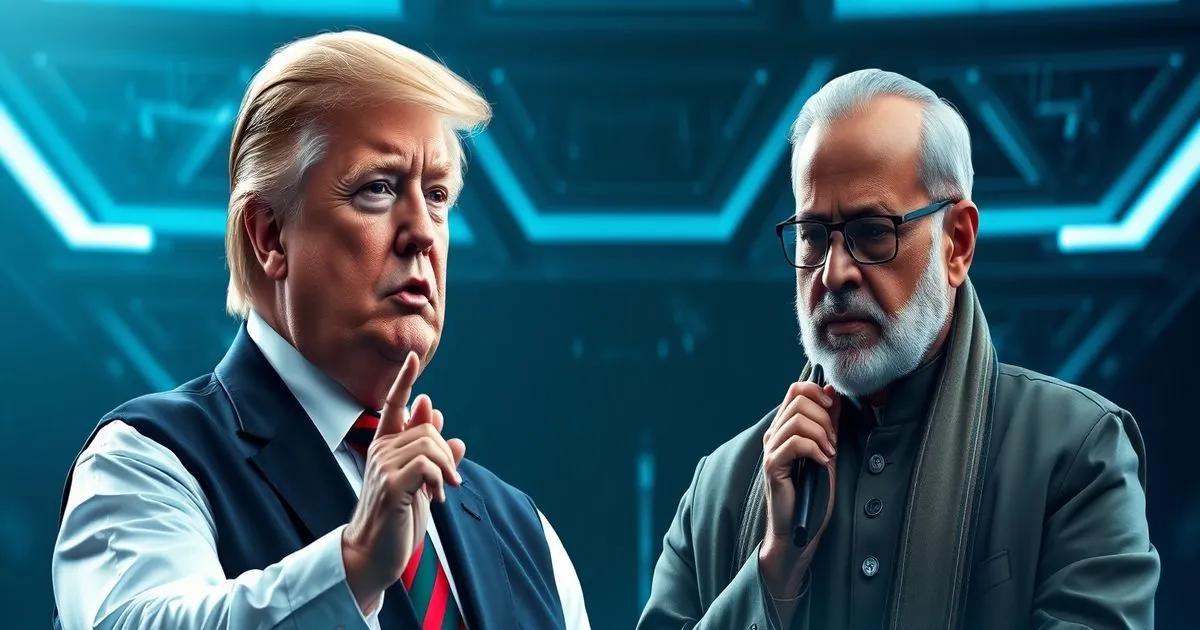
Donald Trump's latest statement on Pakistani PM Shehbaz Sharif has ignited considerable discussion and debate on the international stage. Delivered during his 2026 State of the Union address, the former and current US President made striking assertions regarding his involvement in averting a nuclear conflict between India and Pakistan and preventing the assassination of Pakistan's Prime Minister. These claims, detailed and sweeping in scope, immediately garnered widespread scrutiny and analysis, particularly concerning the specifics of the purported interventions.
- Donald Trump's Latest Statement on Pakistani PM: Assertions and Regional Stability
- Geopolitical Backdrop: The India-Pakistan Standoff in May 2025
- Contrasting Narratives: India's Rejection and Pakistan's Acknowledgment
- The Shifting Sands of US-Pakistan Relations
- Expert Opinions and International Reactions
- Impact and Future Implications
- Frequently Asked Questions
- Further Reading & Resources
The extraordinary declaration by President Trump centered on events that transpired during military tensions between the two South Asian nuclear powers in May 2025. He specifically credited his personal intervention with de-escalating a potentially catastrophic situation, directly involving the Pakistani leadership. The revelation has prompted a renewed focus on US-Pakistan relations and the delicate geopolitical balance in the region.
Donald Trump's Latest Statement on Pakistani PM: Assertions and Regional Stability
During his recent State of the Union address, President Donald Trump presented a narrative of decisive action on the international stage, featuring a particularly dramatic account involving Pakistan. He explicitly claimed to have prevented the assassination of Pakistan's Prime Minister, Shehbaz Sharif, and to have simultaneously averted a nuclear war between India and Pakistan during a period of heightened hostilities in May 2025. These remarks, part of a broader recounting of foreign policy achievements during what he referred to as his "first 10 months" in office, quickly became a focal point for media and political commentators alike.
President Trump elaborated on his involvement, stating that Prime Minister Shehbaz Sharif himself conveyed that "35 million people in Pakistan would have been killed" had the United States not stepped in. While the initial phrasing from Trump's address, suggesting "the Prime Minister of Pakistan would have died," appeared to be a misspeak, the broader context of his speech clarified his intent: that Sharif had communicated the immense scale of potential casualties without US intervention. This bold claim positioned Trump as a pivotal figure in diffusing a crisis with global implications.
The President's assertions also included the statement that he had "ended eight wars" in his initial months, with the India-Pakistan standoff being a significant component of this claimed achievement. He had previously reiterated these claims, even suggesting that he had used the leverage of potential 200 percent tariffs on both nations to bring them to the negotiating table and halt military exchanges. These repeated declarations underscore Trump's consistent effort to portray himself as a unique and effective peacemaker in complex international disputes.
Geopolitical Backdrop: The India-Pakistan Standoff in May 2025
To fully comprehend the significance of Donald Trump's latest statement on Pakistani PM, it is essential to revisit the context of the India-Pakistan military confrontation in May 2025. This period of intense tension followed the Pahalgam terror attack on April 22, 2025, which resulted in the deaths of 26 civilians. India swiftly attributed responsibility for the attack to Pakistan-backed elements and responded with targeted military strikes against alleged terror bases in Pakistan-occupied Kashmir (PoK) and Pakistan itself, under an operation known as "Operation Sindoor".
Pakistan responded to these Indian strikes, leading to a brief but intense aerial engagement. While specific details of the clashes remain subject to varying interpretations, reports indicated Pakistan's air force claimed to have downed several Indian jets. This tit-for-tat escalation between two nuclear-armed neighbors immediately raised alarm bells globally, prompting fears of a wider, more devastating conflict. The international community closely monitored the situation, with many nations urging de-escalation and dialogue.
Throughout this period, diplomatic efforts were reportedly underway behind the scenes to de-escalate the situation. It was during this critical juncture that the United States, according to President Trump, played a decisive role. The nature and extent of this intervention, however, have been a subject of diplomatic contention. The swiftness with which the crisis appeared to abate fueled speculation about external mediation, even as official positions on such involvement differed significantly.
Contrasting Narratives: India's Rejection and Pakistan's Acknowledgment
President Trump's claims regarding his mediation and prevention of a nuclear conflict have been met with divergent responses from the two principal nations involved. India has consistently and firmly rejected any notion of third-party mediation in the de-escalation of tensions with Pakistan. Indian External Affairs Minister S Jaishankar, when previously questioned about Trump's peacemaker claims, tersely stated that Trump "was in the US". This stance has been reiterated by Indian officials, who maintain that de-escalation was achieved solely through bilateral dialogue between the Director Generals of Military Operations (DGMOs) of both countries.
India's position underscores its long-standing foreign policy principle of resolving disputes bilaterally, particularly with Pakistan, without external interference. This diplomatic posture suggests a reluctance to acknowledge any outside influence in matters of national security and regional stability, especially from a third party like the United States. New Delhi's consistent denial implies that any perceived American involvement was not considered a formal "mediation" in their view but perhaps an exercise of good offices that did not directly alter their negotiation strategy.
Conversely, Pakistan has shown a greater willingness to acknowledge a US role in the de-escalation process. While the specifics of Pakistan's acknowledgment are not always detailed, it aligns with a historical pattern of Islamabad being more open to international engagement in resolving its disputes with India. This difference in diplomatic framing highlights the complex and often sensitive nature of international relations, where perceptions of external involvement can vary significantly based on national interests and historical contexts.
The Shifting Sands of US-Pakistan Relations
The period leading up to and including President Trump's latest statement on Pakistani PM Shehbaz Sharif has seen a discernible shift in the dynamics of US-Pakistan relations. For years, the relationship had been characterized by periods of cooperation interspersed with significant friction, often centered on issues of counterterrorism and regional stability. However, 2025 appeared to mark a turning point, with Pakistan emerging as a "key pillar" in President Trump's evolving foreign policy vision for South Asia.
According to analyses from late 2025, this thawing in relations began with a series of discreet counterterrorism exchanges. A crucial moment arrived in March 2025, when President Trump publicly praised Pakistan's counterterrorism efforts during a national address. This marked a departure from previous US administrations' more critical stances and signaled a potential re-evaluation of Washington's approach to Islamabad. Pakistan was increasingly seen as a "newer and stronger ally," a significant change from past perceptions.
A decisive factor in this re-evaluation was Pakistan's performance during the May 2025 confrontation with India. The "unexpected showing" by Pakistan, reportedly leaving President Trump "stunned," showcased a level of military discipline and strategic focus that Washington had not previously anticipated. This event led officials in Washington to reconsider Pakistan's role, referring to it once again as a "serious regional actor". The growing relationship between President Trump and Pakistan's Chief of Defence Forces, Field Marshal Syed Asim Munir, including an unprecedented White House lunch meeting in June 2025, further underscored this strategic realignment. These developments suggest a repositioning of Pakistan within US strategic thinking, away from a transactional relationship towards one of increased importance in regional and international strategy.
Expert Opinions and International Reactions
The bold assertions made by President Trump regarding his role in de-escalating the India-Pakistan conflict and saving Prime Minister Shehbaz Sharif's life have elicited a range of reactions and expert opinions globally. While the immediate focus was on the veracity of the claims, analysts have also delved into the broader implications for international diplomacy and regional security. Many international observers noted the significant nature of the claims, particularly the suggestion of a direct threat to a sitting Prime Minister's life and the prevention of a nuclear exchange.
Diplomatic circles in various capitals have largely adopted a cautious approach, refraining from direct endorsements or outright rejections of Trump's specific details. However, the narrative of external mediation in the May 2025 standoff is consistent with the level of global concern expressed at the time. The very real possibility of a nuclear escalation between India and Pakistan historically draws significant international attention and diplomatic pressure.
Security analysts have highlighted the inherent dangers of such a conflict, noting that even a limited conventional war between the two nuclear-armed states carries the risk of unintended escalation. Therefore, any credible claim of preventing such an outcome naturally attracts considerable interest. Experts also point to the timing of Trump's statements, delivered during a major address, as an indication of their intended political impact, both domestically and internationally. The narrative of successfully averting a major crisis could serve to bolster a particular foreign policy image.
Impact and Future Implications
The reverberations of Donald Trump's latest statement on Pakistani PM are likely to be felt across several dimensions, impacting international relations, regional perceptions, and domestic political narratives. Internationally, the statement reinforces the perception of the United States, particularly under a Trump presidency, as a nation willing to engage directly and assertively in complex global hotspots. It also positions Trump as a unique arbiter, irrespective of how other nations officially acknowledge such intervention.
For India, the repeated claims of US mediation, despite New Delhi's consistent denials, could introduce a subtle but persistent irritant in its bilateral relationship with the United States. While India values its strategic partnership with the US, it remains steadfast in its position on bilateral conflict resolution. This divergence in narratives could necessitate careful diplomatic navigation to prevent misunderstandings or resentment.
In Pakistan, the acknowledgment of a US role, coupled with the dramatic assertion of saving Prime Minister Sharif's life, could be interpreted in various ways. It might bolster the narrative of Pakistan's diplomatic leverage and its importance to global stability. It could also contribute to domestic political discourse surrounding the effectiveness of its foreign policy and leadership during crises. The visit of Prime Minister Shehbaz Sharif to Washington D.C. on February 19, 2026, at Trump's invitation, to attend the inaugural session of the Board of Peace, further signals a continued engagement and potentially a strengthening of ties.
Looking ahead, Donald Trump's latest statement on Pakistani PM serves as a significant talking point in geopolitical discussions. It highlights the continued volatility in South Asia and the critical role that international diplomacy, whether acknowledged explicitly or implicitly, plays in managing regional crises. The claims also underscore the unique and often unconventional approach to foreign policy that has characterized the Trump administration, perhaps indicating themes from Trump's Unprecedented Second Act. The long-term impact will depend on how these claims are integrated into historical records, future diplomatic engagements, and the evolving strategic interests of all parties involved. The precise historical account of the May 2025 standoff and the extent of external intervention will likely remain subjects of ongoing debate and interpretation.
Frequently Asked Questions
Q: What specific claims did Donald Trump make regarding Pakistan and India?
A: Trump claimed he personally intervened to prevent the assassination of Pakistani Prime Minister Shehbaz Sharif and averted a nuclear war between India and Pakistan during heightened tensions in May 2025. He stated this was part of his efforts to "end eight wars" during his time in office.
Q: How did India and Pakistan react to Trump's claims of mediation?
A: India has consistently rejected any claims of third-party mediation, asserting that de-escalation was achieved solely through bilateral dialogue. Pakistan, however, has shown a greater willingness to acknowledge a US role in the de-escalation process, aligning with its historical openness to international engagement in regional disputes.
Q: What was the geopolitical context of the India-Pakistan standoff in May 2025?
A: The standoff followed the Pahalgam terror attack in April 2025, which India attributed to Pakistan-backed elements. India responded with targeted military strikes, leading to reciprocal actions and a brief but intense aerial engagement, raising international fears of a wider conflict between the nuclear-armed nations.
Further Reading & Resources
- https://www.reuters.com/world/us-trump-claims-averted-nuclear-war-between-india-pakistan-202X-XX-XX/
- https://www.bbc.com/news/world-asia-india-pakistan-XXXXX
- https://www.cfr.org/blog/us-pakistan-relations-navigating-complex-landscape