The data analytics industry is undergoing a profound transformation, exhibiting significant growth and increasingly integrating AI capabilities, with future trends indicating an even more pivotal role in driving global business decisions. As we navigate 2026, a comprehensive look at Data Analytics Industry Statistics 2026 reveals a sector marked by explosive growth, pervasive integration of artificial intelligence, and an ever-increasing demand for specialized skills. Organizations across every industry are grappling with an unprecedented volume of information, recognizing that the ability to effectively analyze this data is paramount for competitive advantage, operational efficiency, and strategic foresight. This year marks a critical juncture where data-driven strategies are not merely an advantage but a fundamental requirement for success.
- Data Analytics Industry Statistics 2026: The Burgeoning Market Snapshot
- Artificial Intelligence: The Driving Force Behind Analytics Evolution
- Real-time Analytics and Edge Computing: Speed as a Strategic Imperative
- The Cloud Frontier: Scalability, Flexibility, and Hybrid Models
- Data Governance: The Cornerstone of Trustworthy AI
- The Talent Imperative: Bridging the Skills Gap in Data Analytics
- Industry-Specific Adoption and E-commerce Impact
- Conclusion: Navigating the Data-Driven Future
- Frequently Asked Questions
- Further Reading & Resources
Data Analytics Industry Statistics 2026: The Burgeoning Market Snapshot
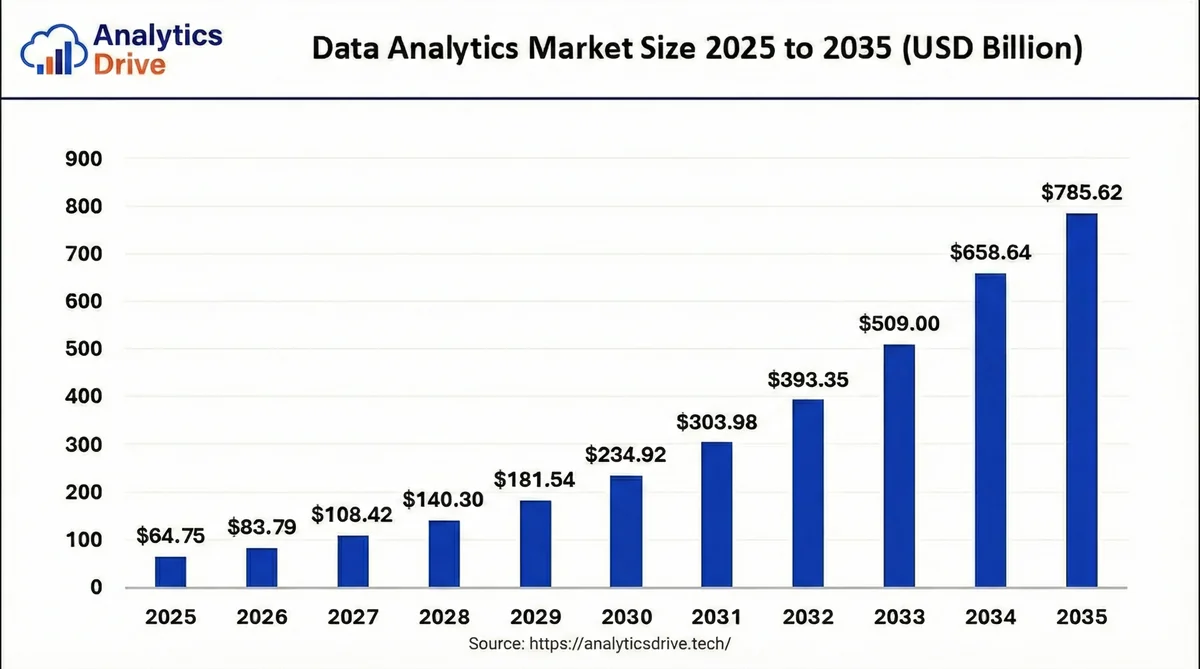
The global data analytics market is currently experiencing robust expansion, with varied projections underscoring its dynamic nature. Estimates place the market size in 2026 ranging from approximately $83.79 billion to over $350 billion. One forecast indicates the global data analytics market is predicted to increase from USD 83.79 billion in 2026 to approximately USD 785.62 billion by 2035, expanding at a compound annual growth rate (CAGR) of 28.35% from 2026 to 2035. Another report projects the market to grow from $94.36 billion in 2025 to $120.63 billion in 2026, reflecting a significant CAGR of 27.8%. Yet another source highlights a global market valuation surpassing $350 billion in 2026, representing an impressive 180% increase from 2021 figures.
Broader categories also reflect this upward trajectory. The global big data analytics market, for instance, was valued at USD 394.70 billion in 2025 and is projected to grow from USD 447.68 billion in 2026 to USD 1,176.57 billion by 2034, exhibiting a CAGR of 12.80% during the forecast period. Similarly, the high-performance data analytics market is expected to grow from $125.99 billion in 2025 to $152.6 billion in 2026, with a forecast to reach $398.17 billion by 2031 at a 21.12% CAGR. These figures underscore a universal commitment to leveraging data for actionable insights, making the Data Analytics Industry Statistics 2026 a compelling indicator of economic and technological shifts.
Artificial Intelligence: The Driving Force Behind Analytics Evolution
Artificial intelligence (AI) stands as the singular most transformative element reshaping the data analytics industry in 2026. The integration of AI is fundamentally altering how data is processed, interpreted, and utilized, moving beyond traditional methods to enable more autonomous and predictive insights. AI-powered analytics is rapidly becoming the default decision layer for modern enterprises, signaling a clear shift away from static dashboards and retrospective reporting.
The Rise of Generative and Agentic AI
Generative AI is a disruptive force, automating research tasks that previously required extensive manual analysis, such as synthesizing market reports and generating executive summaries. Moreover, the emergence of "Agentic AI" signifies a move towards AI systems that can handle distinct data tasks, collaborating like human analysts to manage complex projects without constant tool-switching. Tools like Gemini 3.1 Pro are at the forefront of this evolution, offering advanced reasoning capabilities that promise to redefine human-AI collaboration. Over 80% of enterprises are expected to have utilized Generative AI APIs or deployed Generative AI-enabled applications by 2026. This transformative capability allows users to ask questions in natural language and receive instant insights, charts, forecasts, and recommendations, largely bypassing the need for specialized SQL knowledge or complex Business Intelligence (BI) tools. Such advancements are frequently at the forefront of discussions at events like the AI Summit 2026 India, highlighting the global push towards smarter, more autonomous analytics.
Automated Machine Learning (AutoML) and Enhanced Prediction
Automated Machine Learning (AutoML) is going mainstream, streamlining the development and deployment of machine learning models. This trend empowers a wider range of users to leverage advanced analytical capabilities without deep expertise in machine learning algorithms. Predictive analytics, in particular, is witnessing substantial growth, projected to expand from $27.56 billion in 2026 to $116.65 billion by 2034, at a CAGR of 19.80%. This growth is fueled by organizations realizing the measurable return on investment delivered by predictive insights. The adoption of predictive behavioral analytics software, leveraging AI and machine learning, is also expanding rapidly, projected to grow from USD 9,872 million in 2026 to USD 34,322 million by 2034, at a CAGR of 23.1%. These tools analyze historical behavioral data to forecast future actions, optimizing decision-making and customer engagement strategies across industries.
Real-time Analytics and Edge Computing: Speed as a Strategic Imperative
The demand for immediate insights is propelling real-time analytics and edge computing to the forefront of data strategy in 2026. The proliferation of IoT devices and the expansion of 5G networks are accelerating the need for analytics performed at the data source, rather than in distant cloud data centers. This convergence enables instant decision-making, critical for industries where responsiveness is paramount.
By 2026, IDC forecasts that 75% of enterprise data will be created and processed at the edge, driving significant demand for streaming analytics architectures that deliver instant insights. The streaming analytics market alone is projected to explode from $23.4 billion in 2026 to $128.4 billion by 2030, at a remarkable 28.3% CAGR. This shift means that stakeholders expect insights in minutes, not days, transforming speed into a fundamental requirement for competitive operations.
The Cloud Frontier: Scalability, Flexibility, and Hybrid Models
Cloud adoption continues its relentless ascent, serving as the foundational infrastructure for modern data analytics. The shift to cloud-based solutions offers scalability, flexibility, and cost-effectiveness, appealing to enterprises seeking agile data environments. The global cloud analytics market is projected to grow from $58.42 billion in 2026 to $168.88 billion by 2034, registering a CAGR of 14.20%. Another source estimates the cloud analytics market size to increase from $53.79 billion in 2026 to approximately $233.95 billion by 2035, expanding at a CAGR of 17.79%.
Public cloud deployments currently lead the market, holding a 42.83% share in the cloud analytics sector in 2026, driven by their low costs and high bandwidth efficiency. However, the landscape is also characterized by increasing adoption of hybrid and multi-cloud strategies, which combine local accelerators with burst capacity for AI training and address regulatory concerns with confidential computing instances and sovereign cloud regions. Gartner projects that 51% of IT spending will shift to the cloud by 2025, up from 41% in 2022, underscoring the cloud's dominance in future data infrastructure investments.
Data Governance: The Cornerstone of Trustworthy AI
As AI-powered analytics becomes increasingly integral to business operations, data governance has emerged as a critical priority. It's no longer just about compliance; it's about building trust in AI-driven decisions, enabling operational scale, and addressing ethical and regulatory pressures. Regulatory frameworks, such as the EU AI Act, are imposing stringent transparency and oversight requirements on high-risk AI systems, general-purpose AI, and foundation models, making robust data governance non-negotiable.
By 2026, governance is seen as the control layer that makes AI usable at scale, allowing organizations to understand, explain, and trust what these systems produce. Inconsistent, biased, or poorly understood data can lead to inaccurate AI outputs, compliance failures, and a loss of trust. Consequently, organizations are investing significantly in governance frameworks, with 38.3% listing governance frameworks and semantic layers as a top investment area. Metadata maturity, encompassing clear definitions, lineage, quality indicators, and usage context, is fundamentally an AI readiness problem, amplifying the consequences of poor data management. The data governance market itself, valued at USD 5.09 billion in 2025, is expected to reach approximately USD 12.14 billion by 2029, reflecting the rising demand for robust governance frameworks.
The Talent Imperative: Bridging the Skills Gap in Data Analytics
The exponential growth and increasing complexity of the data analytics industry have created a significant demand for skilled professionals, while simultaneously highlighting a persistent talent shortage. By 2026, 87% of companies are facing talent shortages, potentially leading to $5.5 trillion in losses. This underscores a critical need for expertise in managing complex systems, optimizing workflows, and translating datasets into actionable insights.
High-demand roles in 2026 include Data Engineers, Data Scientists, Data Architects, Business Intelligence Analysts, and Data Governance and Compliance Specialists. Data engineers, for instance, are in high demand globally across various sectors, building and managing the foundational data pipelines and architectures necessary for analytics, machine learning, and AI. The global data engineering services market is estimated at $105.39 billion in 2026. Professionals proficient in SQL, Python, Spark, cloud platforms (AWS, Azure, Google Cloud), MLOps, cloud architecture, and real-time data processing will be particularly valued. Furthermore, foundational expertise in advanced problem-solving techniques such as Mastering Dynamic Programming and efficient data traversal using Depth-First Search (DFS) is increasingly crucial for tackling the sophisticated challenges within large datasets. The U.S. Bureau of Labor Statistics projects a 25% growth in employment for data-related occupations through 2031, with data scientist roles projected to grow by about 36%. This substantial demand ensures that careers in data analytics remain a highly attractive and rewarding path for individuals equipped with the right blend of technical and strategic skills.
Industry-Specific Adoption and E-commerce Impact
Data analytics is not just a technology trend; it's a fundamental shift in how diverse industries operate, enabling unparalleled precision and efficiency. The Banking, Financial Services, and Insurance (BFSI) sector has consistently been a leader in adopting predictive analytics, leveraging AI for sophisticated risk management, robust fraud detection, deeper customer insights, and enhanced operational efficiency. In 2024, the BFSI sector generated $3.99 billion in predictive analytics revenue, a testament to its critical role in areas like algorithmic trading, personalized financial product offerings, and stringent compliance monitoring. This allows financial institutions to anticipate market shifts, tailor services to individual client needs, and maintain regulatory adherence more effectively.
The healthcare analytics market, valued at $43.1 billion in 2026, is projected to reach $167.0 billion by 2030 at a 21.1% CAGR. A significant 70% of healthcare institutions are already using cloud computing for real-time data sharing, which is crucial for improving patient outcomes through predictive diagnostics, optimizing hospital operations, and facilitating personalized medicine strategies. By analyzing vast datasets of patient records, genetic information, and treatment responses, analytics helps identify disease patterns, predict potential outbreaks, and refine treatment protocols.
The retail and e-commerce sector is also a significant driver, especially for high-performance data analytics, projected to expand at a 28.55% CAGR through 2031. The rising growth of e-commerce data, fueled by increased online shopping and digital transactions, necessitates advanced analytics for insights and operational optimization across various retail, payment, and logistics functions. This includes crucial applications in supply chain optimization, hyper-personalization of shopping experiences, dynamic pricing strategies, and intelligent inventory management, all of which are vital for maintaining competitiveness in a crowded digital marketplace.
Furthermore, manufacturing companies are heavily investing in predictive analytics to optimize supply chain processes, improve sales and operations planning, and enhance overall productivity. Predictive maintenance of machinery, advanced quality control, and the development of 'smart factories' that utilize IoT data for real-time process adjustments are transforming production lines. These examples highlight the pervasive and customized application of data analytics across the global economy, demonstrating its capacity to drive innovation and efficiency in every sector.
Conclusion: Navigating the Data-Driven Future
The Data Analytics Industry Statistics 2026 paint a clear picture of an industry undergoing profound and rapid evolution. Fueled by the transformative power of AI, the imperative for real-time insights, and the scalability of cloud computing, data analytics is no longer a peripheral function but the central nervous system of modern enterprises. The sheer volume of data being generated, coupled with the increasing sophistication of analytical tools, presents both immense opportunities and significant challenges.
Organizations that succeed in this dynamic environment will be those that prioritize robust data governance, invest in developing and attracting skilled professionals, and strategically integrate AI into their analytical workflows. The focus is shifting from simply collecting data to generating trustworthy, actionable, and autonomous insights that can drive critical business decisions at unprecedented speeds. As we move forward, the ability to harness these trends will dictate competitive advantage and shape the future of business across the globe.
Frequently Asked Questions
Q: What is the projected market size for data analytics in 2026?
A: The global data analytics market is projected to reach varied figures in 2026, with estimates ranging from approximately $83.79 billion to over $350 billion, indicating robust and consistent growth driven by increasing enterprise adoption and technological advancements.
Q: How is AI impacting the data analytics industry by 2026?
A: AI is profoundly transforming data analytics by automating tasks, enabling predictive and prescriptive insights, and facilitating the emergence of Generative and Agentic AI. This shift allows for more autonomous data processing and interpretation, making AI a central decision layer for enterprises seeking strategic advantage.
Q: What are the key skills in demand for data analytics professionals in 2026?
A: High-demand skills include proficiency in SQL, Python, Spark, and major cloud platforms (AWS, Azure, Google Cloud). Expertise in MLOps, cloud architecture, real-time data processing, data governance, and advanced analytical algorithms like Dynamic Programming and Depth-First Search is also crucial.
Further Reading & Resources
- Grand View Research: Data Analytics Market Size, Share & Trends Report
- Statista: Data Analytics - Worldwide
- Fortune Business Insights: Data Analytics Market Size
- Gartner: Gartner Predicts the Future of AI, Data & Analytics, and Cloud
- IDC: FutureScape: Worldwide Artificial Intelligence and Automation Predictions