For anyone aspiring to a data analyst career and aiming for data mastery, understanding the journey presented in our Data Analyst Career Roadmap (Infographic) is key to navigating the world of insights and informed decision-making. This comprehensive guide, complete with a visual representation in the accompanying infographic, will illuminate the steps, skills, and specializations that define this dynamic profession.
- Decoding the Data Analyst Role: What Do They Actually Do?
- Navigating Your Data Analyst Career Roadmap (Infographic)
- Tools of the Trade: Your Data Analyst Toolkit
- Beyond the Basics: Advanced Tracks and Specializations
- Education and Certification: Formalizing Your Journey
- Conclusion: Your Journey on the Data Analyst Career Roadmap (Infographic)
- Frequently Asked Questions
- Further Reading & Resources
The demand for professionals who can interpret complex datasets and translate them into actionable business strategies has never been higher. From healthcare to finance, retail to technology, every industry is awash with data, and skilled analysts are the navigators charting courses through this ocean of information. If you've ever wondered how companies make their biggest decisions, often a data analyst is at the heart of providing the evidence.
This post will serve as your detailed guide, breaking down the often-overwhelming landscape of data analytics into digestible stages. We'll explore the core responsibilities, the essential toolkit, the various career trajectories, and the continuous learning required to thrive. Whether you're a student considering your future, a professional looking to pivot, or simply a curious mind eager to understand the buzz around data, this roadmap is designed for you.
Decoding the Data Analyst Role: What Do They Actually Do?
At its core, a data analyst is a detective, a storyteller, and a problem-solver all rolled into one. Their primary mission is to collect, clean, analyze, and interpret large datasets to uncover trends, patterns, and insights. These insights then empower organizations to make smarter, data-driven decisions that can lead to improved efficiency, increased revenue, and better customer experiences. It's a role that bridges the gap between raw numbers and strategic action.
Consider a retail company trying to understand why sales dipped last quarter. A data analyst would dive into sales figures, customer demographics, marketing campaign performance, and even external factors like economic indicators. They would meticulously clean messy data, ensuring accuracy before applying statistical methods and creating visualizations to tell a compelling story about the findings. This story, backed by data, might reveal that a particular product line underperformed in a specific region due to a competitor's aggressive pricing strategy, leading the company to adjust its inventory and marketing efforts accordingly. The demand for professionals who can interpret complex datasets and translate them into actionable business strategies has never been higher, as highlighted by recent data analytics industry statistics.
The Everyday Life of a Data Analyst
The daily tasks of a data analyst are incredibly varied, keeping the role stimulating and challenging. One day might involve writing complex SQL queries to extract information from a vast database, while the next could be spent building interactive dashboards in Tableau or Power BI to present findings to stakeholders. They frequently collaborate with different departments, from marketing and sales to product development and operations, understanding their unique data needs.
Much of an analyst's time is dedicated to data cleaning and preparation, often referred to as "data wrangling" or "ETL" (Extract, Transform, Load). This critical step ensures the integrity of the data, removing errors, duplicates, and inconsistencies that could skew analytical results. It's a meticulous process, but vital for producing reliable insights. Analysts also spend time performing statistical analysis, identifying correlations, regressions, and other statistical relationships to validate hypotheses and predict future trends.
Essential Skills for Aspiring Analysts
To excel in this dynamic field, a combination of technical prowess and soft skills is paramount. On the technical front, proficiency in spreadsheet software like Excel is foundational, allowing for initial data manipulation and basic analysis. SQL (Structured Query Language) is indispensable for interacting with databases, enabling analysts to retrieve and manage vast amounts of information efficiently. Programming languages like Python or R are also highly valued for their statistical capabilities, data manipulation libraries, and machine learning potential.
Beyond these tools, a strong understanding of statistical concepts is crucial for interpreting data correctly and avoiding misleading conclusions. Data visualization skills are equally important, as insights, no matter how profound, are useless if they cannot be communicated effectively to a non-technical audience. Soft skills, however, are often the differentiator. Critical thinking, problem-solving, attention to detail, and excellent communication skills—both written and verbal—are vital for understanding business questions, collaborating with teams, and presenting findings persuasively.
Navigating Your Data Analyst Career Roadmap (Infographic)
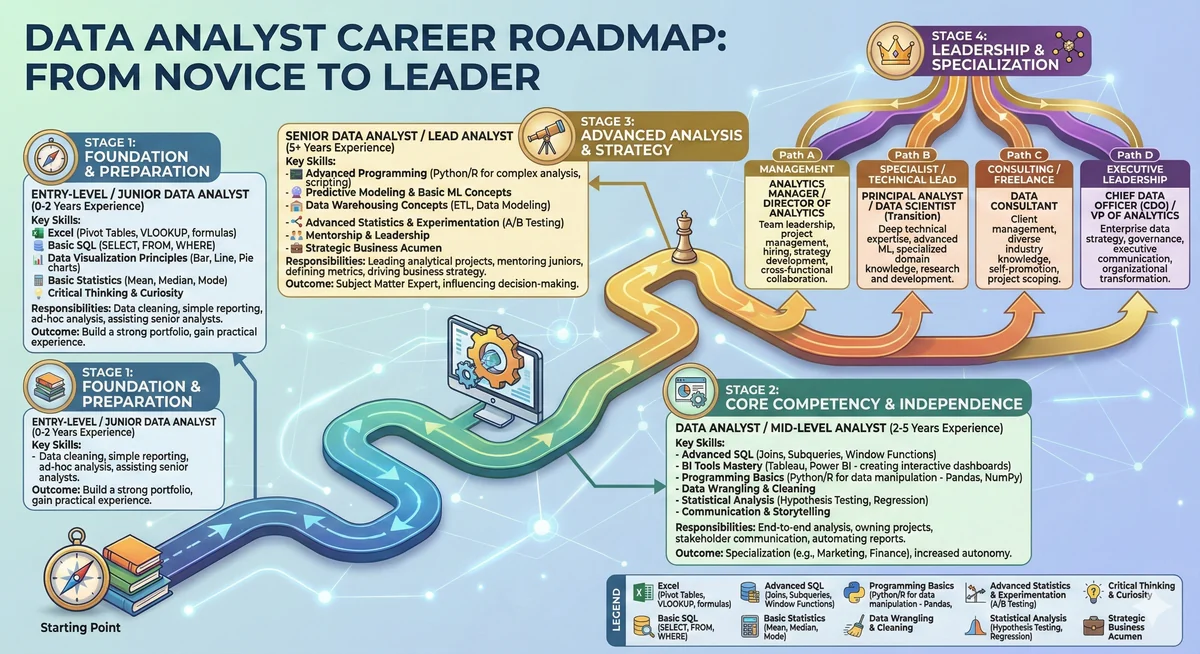
Embarking on a career in data analysis is a journey that typically progresses through several distinct stages, each building upon the last. This Data Analyst Career Roadmap (Infographic) breaks down the path from foundational learning to advanced specialization, illustrating how one can grow and evolve within the field. It's not a rigid path, but rather a flexible guide allowing for individual interests and industry demands to shape the journey.
The initial steps often focus on acquiring fundamental knowledge and practical skills, forming a solid base. As experience accumulates, opportunities for deeper dives into specific analytical techniques or industry sectors emerge. Ultimately, the roadmap can lead to leadership roles, advanced technical specializations, or even a transition into related fields like data science or machine learning engineering. The continuous learning aspect is a constant, ensuring analysts remain current with evolving tools and methodologies.
Step 1: Foundational Learning & Tools
The starting point for any aspiring data analyst is to build a robust foundation. This involves understanding core concepts like descriptive statistics, probability, and basic data types. Simultaneously, hands-on proficiency with essential tools is critical. Microsoft Excel remains a cornerstone for many organizations, used for everything from simple data entry to complex financial modeling. Mastering its functions, pivot tables, and charting capabilities is non-negotiable.
Following Excel, learning SQL is often the next crucial step. SQL allows you to communicate with relational databases, which house the vast majority of organizational data. Being able to write effective queries to extract, filter, and aggregate data is a fundamental skill that unlocks access to information. Many online courses and bootcamps focus heavily on SQL due to its universal applicability.
Step 2: Gaining Practical Experience
Theory without practice is often incomplete. After acquiring foundational skills, the next vital step is to apply them in real-world scenarios. This can take many forms: personal projects, volunteer work, internships, or entry-level roles. Building a portfolio of projects demonstrating your abilities with various tools and techniques is incredibly valuable. These projects don't need to solve global problems; even analyzing publicly available datasets (like Kaggle datasets or government open data portals) can provide excellent experience.
Internships offer an invaluable opportunity to work within a professional environment, understanding data pipelines, collaborating with teams, and tackling real business problems under mentorship. Even if an internship isn't immediately available, seeking out data-related tasks in your current role or volunteering for non-profits can provide the necessary practical exposure. The goal is to move beyond theoretical knowledge and start generating tangible insights.
Step 3: Specialization and Advanced Skills
As you progress, the Data Analyst Career Roadmap (Infographic) naturally leads to opportunities for specialization. This often involves diving deeper into specific programming languages like Python or R, which offer more powerful capabilities for statistical analysis, machine learning, and automation. Python, with libraries like Pandas, NumPy, and Scikit-learn, has become a dominant force in data analysis and data science due to its versatility and extensive community support. R is particularly strong in statistical computing and graphical representations.
Furthermore, specialization can mean focusing on particular domains, such as marketing analytics, financial analytics, healthcare analytics, or supply chain analytics. Understanding the nuances and key performance indicators (KPIs) within a specific industry can make you an invaluable asset. Developing advanced data visualization skills with tools like Tableau, Power BI, or even D3.js for custom web-based visualizations also becomes increasingly important for communicating complex insights effectively to senior leadership.
Tools of the Trade: Your Data Analyst Toolkit
The modern data analyst relies on an increasingly sophisticated array of tools to perform their duties. Just as a carpenter needs a hammer, saw, and measuring tape, a data analyst requires a specific toolkit to collect, clean, analyze, and visualize data effectively. Understanding these tools and when to use them is paramount for efficiency and impact in the field. The landscape of data tools is constantly evolving, but several core technologies remain indispensable.
Investing time in mastering these core tools will not only make you more effective but also significantly enhance your marketability. The choice of tool often depends on the specific task, the size of the dataset, and the organizational infrastructure. However, a well-rounded analyst will possess at least a working knowledge of the most common applications across different categories.
Programming Languages: Python and R
Python has emerged as a powerhouse in the data world, cherished for its readability, extensive libraries, and versatility. For data analysis, its Pandas library provides robust data structures and tools for data manipulation and analysis. NumPy is essential for numerical operations, while libraries like Matplotlib and Seaborn are used for creating static, animated, and interactive visualizations. Beyond core analysis, Python's Scikit-learn library facilitates machine learning tasks, making it a bridge to more advanced data science roles.
R, on the other hand, is a language specifically designed for statistical computing and graphics. It boasts an unparalleled collection of packages dedicated to statistical modeling, machine learning, and advanced data visualization (e.g., ggplot2). While it might have a steeper learning curve for those without a statistical background, R remains a favorite among statisticians and researchers for its analytical depth and powerful graphical capabilities. Many organizations choose one or both based on their specific analytical needs and existing infrastructure.
SQL: The Language of Databases
SQL (Structured Query Language) is arguably the most fundamental technical skill for any data professional. It is the standard language for managing and querying relational databases, which store data in structured tables. From extracting specific records to joining multiple tables, filtering data based on complex conditions, and aggregating information, SQL is the gateway to accessing the raw material of data analysis.
Understanding different SQL dialects (e.g., MySQL, PostgreSQL, SQL Server, Oracle SQL) can be beneficial, though the core syntax remains largely consistent. Proficiency in writing efficient and optimized queries is crucial, especially when dealing with very large datasets, as inefficient queries can consume significant computational resources and time. Many interviews for data analyst roles include practical SQL coding challenges to assess this essential skill.
Visualization Tools: Tableau, Power BI, and Beyond
Once data has been cleaned and analyzed, the findings need to be communicated clearly and compellingly. This is where data visualization tools come into play. Tableau and Microsoft Power BI are industry leaders, offering powerful capabilities to transform complex data into interactive dashboards and reports. These tools allow analysts to drag-and-drop elements, create various chart types, and build dynamic visualizations that enable stakeholders to explore data insights on their own.
Beyond these commercial giants, open-source alternatives like Google Looker Studio (formerly Google Data Studio) offer free options for creating interactive reports. Libraries within Python (Matplotlib, Seaborn, Plotly) and R (ggplot2) also allow for highly customized and programmatic visualization. The ability to choose the right visualization tool for the audience and the message is a mark of an experienced data analyst. Effective visualization can make the difference between an ignored report and a strategic decision.
Spreadsheet Mastery: Excel's Enduring Power
Despite the rise of more sophisticated tools, Microsoft Excel retains its status as a vital component of the data analyst's toolkit. For smaller datasets, quick ad-hoc analysis, or prototyping ideas, Excel's accessibility and versatility are unmatched. Advanced functions like VLOOKUP, INDEX/MATCH, SUMIFS, and statistical functions are essential for everyday tasks. Pivot tables are incredibly powerful for summarizing and analyzing data, allowing users to quickly identify trends and patterns without writing a single line of code.
Excel is also frequently used for data cleaning tasks before importing data into other tools, or for communicating findings to less technical audiences who might be more comfortable interacting with spreadsheets. While it may not handle petabytes of data, its ubiquity in business environments ensures that strong Excel skills will always be a valuable asset for a data analyst.
Beyond the Basics: Advanced Tracks and Specializations
The Data Analyst Career Roadmap (Infographic) isn't a dead end; it’s a launchpad for further specialization and growth. As you gain experience and refine your skills, several advanced career tracks open up, allowing you to deepen your expertise or broaden your scope into related, more technically demanding fields. These specializations often require a stronger grasp of advanced statistics, programming, and sometimes even machine learning concepts.
Choosing a specialization depends on your interests, the industry you work in, and the specific problems you enjoy solving. Some analysts might gravitate towards roles that are more business-oriented, focusing on strategic implications, while others might prefer highly technical roles that involve building predictive models or developing data infrastructure. The continuous evolution of data technology ensures that new specializations are always emerging.
Business Intelligence Analyst
A Business Intelligence (BI) Analyst often works closely with stakeholders to understand business requirements and translates them into technical specifications for data solutions. Their focus is heavily on reporting, dashboarding, and creating user-friendly interfaces that empower business users to explore data themselves. While they perform analysis, their primary goal is to provide accessible, actionable insights through established BI platforms.
BI Analysts are experts in tools like Tableau, Power BI, Looker, and Qlik Sense, leveraging them to build robust data models and insightful visualizations. They ensure data accuracy and consistency across reports, often playing a key role in data governance. This role often requires a strong understanding of business processes and KPIs, bridging the gap between raw data and strategic decision-making at an operational level.
Data Scientist: A Natural Evolution
For many data analysts, the role of a data scientist represents a natural progression. While there's overlap, data scientists typically delve deeper into predictive modeling, machine learning, and advanced statistical analysis. They often work with more unstructured data, design experiments, and build complex algorithms to solve ambiguous business problems. Where an analyst explains what happened, a data scientist often seeks to explain why it happened and what will happen next.
This transition usually requires advanced proficiency in programming languages like Python or R, a strong grasp of statistics and probability, and familiarity with mastering dynamic programming algorithms and machine learning algorithms (e.g., regression, classification, clustering). Data scientists are also often involved in data engineering tasks, preparing data for modeling, and deploying models into production environments. They tackle questions that require more experimental and exploratory approaches.
Machine Learning Engineer: The Cutting Edge
Further along the technical spectrum is the Machine Learning (ML) Engineer. This role focuses less on the analytical interpretation of data and more on the engineering aspects of building, deploying, and maintaining machine learning models and systems. ML Engineers often have a strong software engineering background combined with expertise in machine learning principles.
They work on creating scalable machine learning pipelines, optimizing model performance, and integrating models into existing applications or services. While they need to understand the underlying machine learning algorithms, their day-to-day involves coding, system design, and ensuring that ML solutions are robust, efficient, and reliable in production environments. This role requires advanced programming skills, knowledge of cloud platforms, and expertise in MLOps (Machine Learning Operations).
Education and Certification: Formalizing Your Journey
While practical experience and self-learning are incredibly valuable, formal education and certifications play a significant role in solidifying your knowledge and enhancing your credibility on your Data Analyst Career Roadmap (Infographic). They provide structured learning environments, validate your skills to potential employers, and often open doors to more advanced opportunities. The right educational path depends on your background, financial resources, and learning style.
There isn't a single "correct" path, but a combination of formal education, specialized training, and continuous self-improvement tends to yield the best results. Many successful data analysts come from diverse academic backgrounds, proving that passion and persistence can often overcome a lack of a traditional computer science degree.
Academic Routes: Degrees and Diplomas
A bachelor's degree in a quantitative field such as computer science, statistics, mathematics, economics, or even a business degree with a strong analytical focus, provides an excellent foundation. These programs instill critical thinking, problem-solving skills, and a deep understanding of statistical principles. For those seeking to transition into data science or more research-oriented data roles, a master's degree in Data Science, Business Analytics, or a related field can be highly beneficial, offering specialized knowledge in machine learning, big data technologies, and advanced statistical modeling.
These academic routes typically offer a comprehensive theoretical understanding, which can be invaluable for tackling complex problems and adapting to new technologies. They also provide networking opportunities with peers and faculty, which can lead to mentorship and job prospects.
Accelerated Learning: Bootcamps and Online Courses
For individuals looking for a faster entry into the field or to pivot from a different career, data analytics bootcamps and specialized online courses offer an accelerated and highly practical alternative. These programs are often intense, immersive, and designed to equip students with job-ready skills in a matter of weeks or months. They focus heavily on the most in-demand tools and techniques, such as SQL, Python/R, Excel, and visualization software.
Platforms like Coursera, edX, Udemy, and DataCamp offer a vast array of courses and specializations, some from reputable universities and industry leaders. These can be excellent for targeted skill development, filling knowledge gaps, or even obtaining micro-credentials that demonstrate specific proficiencies. The flexibility of online learning makes it accessible to a broad audience, allowing individuals to learn at their own pace and balance studies with other commitments.
Certifications: Validating Your Expertise
Certifications from prominent technology companies or professional bodies can provide a tangible way to validate your skills and expertise. Examples include the Microsoft Certified: Data Analyst Associate, Google's Professional Data Analyst Certificate, or various certifications related to specific tools like Tableau Desktop Certified Associate. These certifications demonstrate to employers that you have a proven level of proficiency with particular software or methodologies.
While not always a prerequisite for entry-level roles, certifications can certainly boost your resume, especially when applying for positions that specifically mention certain tools. They also encourage continuous learning and staying updated with the latest industry standards and best practices. Combining a strong portfolio with relevant certifications can significantly enhance your appeal in a competitive job market.
Conclusion: Your Journey on the Data Analyst Career Roadmap (Infographic)
The world of data analytics is exciting, constantly evolving, and brimming with opportunities for those who are curious, analytical, and eager to learn. Our exploration of the Data Analyst Career Roadmap (Infographic) reveals a structured yet flexible path, guiding you from foundational skills to advanced specializations. The journey is not just about mastering tools and techniques; it's about developing a mindset that embraces problem-solving, critical thinking, and continuous learning.
From decoding complex datasets with SQL and Python to crafting compelling narratives with Tableau and Power BI, the data analyst plays a pivotal role in driving informed decisions across every sector. The demand for these skilled professionals continues to surge, promising a rewarding and impactful career for those who choose to embark on this path. Embrace the challenges, celebrate the insights, and prepare to make a tangible difference in the data-driven world. Your journey on the Data Analyst Career Roadmap (Infographic) is just beginning, and the possibilities are boundless.
Frequently Asked Questions
Q: What is the primary difference between a Data Analyst and a Data Scientist?
A: A Data Analyst primarily focuses on explaining what happened by collecting, cleaning, and interpreting data to find trends and insights for business decisions. A Data Scientist typically goes further, explaining why it happened and what will happen next by building predictive models, applying advanced statistical analysis, and often working with more complex algorithms and unstructured data.
Q: What programming languages are considered essential for a data analyst?
A: While a strong foundation in SQL for database interaction and proficiency in spreadsheet software like Excel are crucial, Python and R are the most commonly used programming languages for data analysis. Python is favored for its versatility and extensive libraries (Pandas, NumPy, Matplotlib), while R excels in statistical computing and advanced graphics.
Q: Is a formal degree absolutely necessary to become a data analyst?
A: While a bachelor's degree in a quantitative field is often preferred, it's not strictly necessary. Many successful data analysts come from diverse academic backgrounds or gain entry through intensive data analytics bootcamps, online courses, and by building a strong portfolio of practical projects. Employers increasingly value demonstrable skills and project experience alongside formal qualifications.