What is Big O Notation?
Big O notation is a mathematical formalism used in computer science to describe the limiting behavior of an algorithm, specifically characterizing its worst-case execution time or space requirements as the input size approaches infinity.
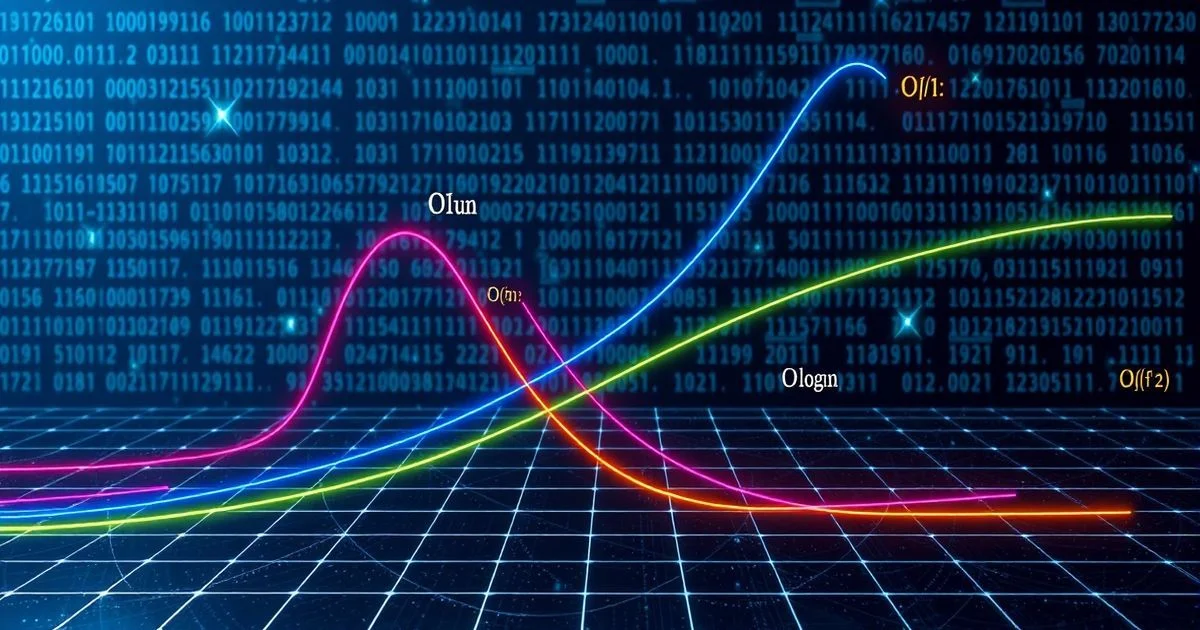
Originating from the work of number theorist Paul Bachmann and popularized by Edmund Landau, the notation serves as the industry standard for algorithmic analysis. It abstracts away machine-specific constants, such as CPU clock speed or memory latency, to focus exclusively on the rate of growth. By expressing performance in terms of input size (n), Big O allows engineers to classify algorithms into complexity classes—such as constant $O(1)$, logarithmic $O(\log n)$, linear $O(n)$, or exponential $O(2^n)$—providing a universal language for efficiency.
From a strategic standpoint, Big O notation is the arbiter of scalability. An algorithm that performs adequately on a local test set may collapse under the weight of petabyte-scale datasets if its complexity class is suboptimal. In modern systems design, the transition from polynomial to exponential time complexity is often the threshold between a viable infrastructure and a system failure. It serves as an essential tool for performance engineering, ensuring that software architectures can sustain growth without requiring prohibitive increases in computational resources.
Key Characteristics
- Asymptotic Analysis: It ignores lower-order terms and constant coefficients, focusing solely on the dominant growth factor as n becomes very large.
- Upper Bound Guarantee: It provides a "worst-case" performance ceiling, offering a mathematical assurance that an algorithm will never exceed a specific growth rate.
- Platform Agnosticism: Because it focuses on the logic of the algorithm rather than the underlying hardware, it facilitates the comparison of code efficiency across diverse computing environments.
Why It Matters
In the contemporary landscape of high-frequency trading, massive-scale data analytics, and state-level cybersecurity, Big O notation is a critical component of strategic edge. For tech enterprises, inefficient algorithms represent a "tax" on operational costs; a move from $O(n^2)$ to $O(n \log n)$ can lead to multi-million dollar savings in cloud computing expenditures. Geopolitically, the mastery of efficient algorithms dictates the speed of signal processing in intelligence gathering and the efficacy of cryptographic defenses. In a digital economy defined by data volume, Big O remains the primary metric for determining which systems will survive the pressure of global scale and which will inevitably be rendered obsolete.