Basics of Orbital Mechanics for Mars Missions: Your Essential Guide
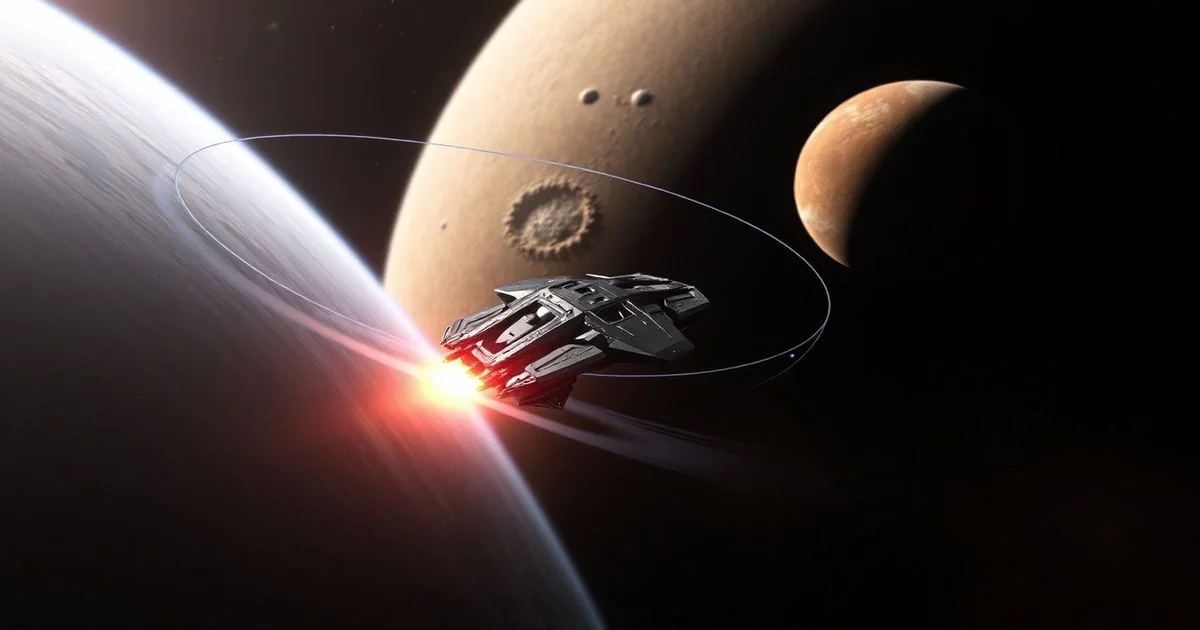
Understanding the basics of orbital mechanics for Mars missions is fundamental to humanity's enduring drive for exploration, pushing the boundaries of what's possible in space. Yet, behind every groundbreaking mission lies a profound understanding of the cosmos, specifically the intricate dance governed by these principles. This fundamental scientific discipline dictates how spacecraft navigate the vast emptiness between planets, transforming a distant red speck into an achievable destination. This essential guide delves into the core principles, complex calculations, and strategic maneuvers that make interplanetary travel a reality, providing a deep dive into the physics that propel our robotic explorers and future human crews towards the Red Planet.
- Understanding Orbital Mechanics: The Language of Space Travel
- The Basics of Interplanetary Travel and Orbital Mechanics for Mars Missions: Navigating the Cosmic Ocean
- Advanced Orbital Maneuvers and Challenges for Mars Missions
- The Role of Computational Models and Future Prospects
- Frequently Asked Questions
- Conclusion: The Enduring Importance of Orbital Mechanics for Mars Missions
- Further Reading & Resources
Understanding Orbital Mechanics: The Language of Space Travel
At its core, orbital mechanics is the application of Newtonian physics and celestial mechanics to the practical problems of spacecraft motion. It's the "GPS" of the solar system, but far more complex, as it involves predicting and manipulating gravitational forces over astronomical distances. For missions to Mars, this discipline moves from theoretical concepts to crucial operational parameters, determining everything from launch timing to fuel consumption and trajectory corrections. Without a precise grasp of these principles, any journey beyond Earth orbit would be a shot in the dark, leading to mission failure or a spacecraft lost forever in the cosmic ocean.
Foundations of Orbital Mechanics: Kepler and Newton
The bedrock of orbital mechanics was laid by two scientific giants: Johannes Kepler and Isaac Newton. Their combined insights provided the mathematical and physical framework necessary to comprehend and predict planetary and spacecraft motion.
Kepler's Laws of Planetary Motion:
- The Law of Ellipses: Planets orbit the Sun in ellipses, with the Sun at one of the two foci. This means orbits are not perfect circles, and the distance between a planet and the Sun varies throughout its year. For Earth, our orbit is only slightly elliptical, but for objects like comets, the eccentricity can be extreme, leading to vast differences in distance from the Sun.
- The Law of Equal Areas: A line segment joining a planet and the Sun sweeps out equal areas during equal intervals of time. This implies that a planet moves faster when it is closer to the Sun (at perihelion) and slower when it is farther away (at aphelion). This principle is crucial for understanding how a spacecraft's speed changes along its trajectory, optimizing timing for burns.
- The Law of Harmonies: The square of the orbital period of a planet is directly proportional to the cube of the semi-major axis of its orbit. This law provides a mathematical relationship between the size of an orbit and the time it takes to complete one revolution. It's fundamental for calculating the travel time of an interplanetary transfer orbit.
Newton's Law of Universal Gravitation:
Newton provided the underlying force responsible for Kepler's observations: F = G * (m1 * m2) / r^2. This equation states that every particle of matter attracts every other particle with a force directly proportional to the product of their masses and inversely proportional to the square of the distance between their centers. This universal law allows engineers to calculate the gravitational pull between planets, moons, and spacecraft, predicting their paths with incredible accuracy. Newton's laws of motion, particularly F = ma, then allow us to understand how these gravitational forces translate into changes in a spacecraft's velocity and position, providing the tools to maneuver in space.
The combination of Kepler's empirical laws and Newton's theoretical framework forms the robust mathematical toolkit that space engineers use to plot courses across the solar system, making our ambitious Mars missions feasible. Understanding these fundamental principles can also enhance one's appreciation for amateur astronomical observation, revealing the hidden order in the celestial ballet.
The Basics of Interplanetary Travel and Orbital Mechanics for Mars Missions: Navigating the Cosmic Ocean
Sending a spacecraft to Mars is not as simple as pointing and shooting. It involves intricate planning to leverage celestial mechanics to our advantage, conserving fuel and ensuring the spacecraft arrives at the right place at the right time. The primary method for achieving this is the Hohmann Transfer Orbit.
Hohmann Transfer Orbit: The Energy-Efficient Path
The Hohmann Transfer Orbit is the most fuel-efficient way to travel between two planets in the same solar system. It's an elliptical orbit that touches the orbit of the departure planet at its perihelion (closest point to the Sun) and the orbit of the target planet at its aphelion (farthest point from the Sun), or vice-versa. This path minimizes the required change in velocity (Δv), thus minimizing fuel consumption.
Here's how it works for a journey from Earth to Mars:
- Departure Burn (Δv1): The spacecraft, initially in Earth's orbit around the Sun, performs a precisely timed burn. This burn increases its velocity relative to the Sun, raising its orbital energy and pushing it onto an elliptical path. This path's perihelion is tangent to Earth's orbit.
- Coasting Phase: The spacecraft then "coasts" along this elliptical transfer orbit, slowly moving away from the Sun. Its speed decreases as it moves further from the Sun, in accordance with Kepler's second law. This leg of the journey can take 7 to 9 months for Mars, depending on the specific alignment and mission parameters.
- Arrival Burn (Δv2): As the spacecraft approaches Mars's orbit, it performs another burn. This burn either slows the spacecraft down to be captured by Mars's gravity and enter orbit around it (for an orbiter) or directs it into the atmosphere for landing (for a lander/rover). This second burn circularizes the orbit around Mars or adjusts the trajectory for atmospheric entry.
The beauty of the Hohmann transfer lies in its minimal use of propellant. Propellant is heavy, and every kilogram saved at launch translates into significant cost reductions and increased mission capability. However, this efficiency comes at a cost: time. Hohmann transfers are relatively slow, taking many months to complete.
Earth Orbit Radius: ~1 AU
Mars Orbit Radius: ~1.52 AU
Hohmann Transfer Semi-major Axis: (1 AU + 1.52 AU) / 2 = 1.26 AU
Launch Windows: The Clockwork of the Cosmos
One of the most critical aspects of orbital mechanics for Mars missions is the concept of a "launch window." Because Earth and Mars are constantly moving in their respective orbits around the Sun, there are only specific, periodic opportunities when their positions are aligned correctly for a Hohmann transfer.
Synodic Period: Mars and Earth have different orbital periods around the Sun (Earth: ~365 days; Mars: ~687 days). This means they don't maintain a constant relative position. The time it takes for them to return to the same relative alignment for an optimal transfer is called their synodic period, which is approximately 780 days, or about 26 months.
Therefore, Earth-Mars launch windows open up roughly every 26 months. Missing a window means waiting over two years for the next one, which significantly impacts mission timelines, funding cycles, and technological readiness. This meticulous planning underscores the importance of core principles of effective time management in complex space missions. Engineers use complex calculations, often visualized through "pork chop plots," to identify the precise dates and times that offer the best balance of propellant efficiency and transit time. These plots show contour lines of delta-v (propellant cost) and flight time against launch date and arrival date.
Delta-V (Δv): The Currency of Space Travel
Delta-v, or Δv, literally meaning "change in velocity," is the fundamental metric for measuring the amount of propulsive effort required for any orbital maneuver. It's not a measure of fuel, but rather the impulse that fuel can provide. Think of it as the "gas" required to change a spacecraft's speed or direction.
Every maneuver—escaping Earth's gravity, entering the Hohmann transfer, adjusting trajectory, capturing into Mars orbit, or descending to the surface—requires a specific Δv budget. The total Δv required for a mission determines the amount of propellant that must be carried, which in turn dictates the mass and size of the launch vehicle.
Key Δv components for a Mars mission:
- Earth Escape Δv: The velocity change needed to escape Earth's gravitational pull and inject into a heliocentric transfer orbit. This is often the largest single Δv component.
- Mid-Course Correction Δv: Small adjustments made during the cruise phase to fine-tune the trajectory and correct for minor errors or perturbations. These are typically very small compared to other burns.
- Mars Insertion/Capture Δv: The velocity change required to slow down the spacecraft sufficiently to be captured by Mars's gravity and enter an orbit around it. This can be significantly reduced by atmospheric braking.
- Descent and Landing Δv: For landers or rovers, additional Δv is needed to reduce speed for atmospheric entry, potentially using parachutes or retro-thrusters for a soft landing.
Minimizing the total Δv requirement is a primary goal for mission designers, as it directly impacts mission feasibility and cost. Advanced mission designs and technologies aim to reduce this budget to enable more ambitious payloads or faster transits.
Advanced Orbital Maneuvers and Challenges for Mars Missions
While the Hohmann transfer provides the basic framework, real-world interplanetary travel incorporates more sophisticated techniques and grapples with numerous challenges. The basics of orbital mechanics for Mars missions extend beyond simple ellipses to encompass complex gravitational interactions and precision engineering.
Gravity Assists (Slingshot Effect)
Though less critical for direct Earth-Mars Hohmann transfers, gravity assists are powerful tools for deeper space missions or for optimizing interplanetary trajectories. A gravity assist involves a spacecraft flying close to a planet or moon, using its gravitational pull to accelerate or decelerate the spacecraft and/or change its direction, without expending any propellant.
How it works: As a spacecraft approaches a celestial body, it "falls" towards it, gaining speed. As it swings past and departs, it uses the body's momentum to alter its own velocity vector relative to the Sun. This is analogous to a baseball player using a bat to change the direction and speed of a ball. The spacecraft gains energy from the planet, while the planet loses an infinitesimally small amount of energy, conserving momentum. Missions like Voyager and Cassini famously utilized multiple gravity assists to reach the outer solar system. For Mars missions, gravity assists might be used in more complex scenarios, perhaps involving Venus or the Moon, or for returning missions where precise entry angles are critical.
Atmospheric Braking (Aerobraking and Aerocapture)
Upon arrival at Mars, simply slowing down with rocket engines to enter orbit or land is incredibly fuel-intensive due to the high arrival speed. Mars has a thin but usable atmosphere, which offers a "free" method of slowing down: atmospheric braking.
- Aerobraking: This technique is used for orbiters. After an initial propulsive burn to establish a highly elliptical orbit around Mars, the spacecraft repeatedly dips into the upper atmosphere at its lowest point (periapsis). The drag from the thin atmosphere gradually reduces the spacecraft's speed, lowering and circularizing its orbit over weeks or months. This saves significant propellant that would otherwise be needed for propulsive orbital insertion. Missions like Mars Global Surveyor and Mars Reconnaissance Orbiter extensively used aerobraking to achieve their operational orbits.
- Aerocapture: A more aggressive maneuver where a spacecraft performs a single, deep pass through the atmosphere to shed enough velocity to be captured directly into orbit. This is much riskier due to the precision required and the high thermal and dynamic loads on the spacecraft, but it offers even greater propellant savings. It has not yet been demonstrated for a deep-space mission but is a promising technology for future missions, especially human ones, where propellant mass is a major constraint.
Interplanetary Navigation and Trajectory Correction Maneuvers (TCMs)
Even with the most precise calculations, real-world factors introduce tiny deviations. Solar radiation pressure, subtle variations in gravitational fields, and even small imperfections in the initial launch burn can nudge a spacecraft off course. This necessitates continuous tracking and occasional trajectory correction maneuvers (TCMs).
- Deep Space Network (DSN): A global network of large radio antennas operated by NASA that provides the essential communication link for tracking and commanding interplanetary spacecraft. By analyzing the Doppler shift and ranging data from radio signals, mission controllers can determine a spacecraft's precise velocity and position with remarkable accuracy.
- TCMs: Small, short bursts of thrusters are fired to nudge the spacecraft back onto its desired path. These are typically planned in advance at specific points in the trajectory (e.g., halfway to Mars, or shortly before arrival) and are crucial for ensuring the spacecraft arrives at its target with the required precision for orbit insertion or atmospheric entry. The earlier a correction is made, the less Δv is usually required, demonstrating the value of continuous monitoring.
The Role of Computational Models and Future Prospects
The complexity of interplanetary trajectories demands sophisticated computational power. Modern orbital mechanics relies heavily on advanced simulations and real-time data analysis to ensure mission success.
From Two-Body to N-Body Simulations
While Kepler's and Newton's laws are elegant for a simple two-body system (like Earth orbiting the Sun), the real solar system is an N-body problem, involving the gravitational influence of the Sun, Earth, Mars, Jupiter, their moons, and even minor bodies. These additional gravitational tugs, known as perturbations, are minor but accumulate over time, making precise long-term predictions challenging.
- Computational Tools: Engineers use powerful computers and specialized software to run N-body simulations. These simulations numerically integrate the equations of motion for all relevant celestial bodies and the spacecraft, predicting their paths with incredible accuracy. These tools are also used to simulate engine burns, atmospheric drag, and other mission-specific parameters, allowing for detailed mission planning and real-time trajectory adjustments.
- Real-time Monitoring: Data from ground tracking stations like the DSN is continuously fed into these models, allowing mission controllers to monitor a spacecraft's actual trajectory against its planned path and calculate necessary TCMs. This iterative process of tracking, predicting, and correcting ensures mission success even in the face of unpredictable cosmic forces.
Future Outlook for Orbital Mechanics in Mars Missions
The field of orbital mechanics continues to evolve, driven by the increasing ambition of Mars missions, especially the prospect of human exploration. New technologies and theoretical approaches promise to make Mars more accessible.
Advanced Propulsion Systems:
Current missions predominantly use chemical rockets, which are efficient but have limited specific impulse (a measure of how efficiently a rocket creates thrust). Future advancements could revolutionize interplanetary travel:
- Ion Propulsion: Already used by missions like Dawn and Deep Space 1, ion thrusters provide very low thrust but operate continuously for months or years, achieving extremely high specific impulse. This enables much more efficient and perhaps faster journeys with less fuel for robotic probes, though current designs are too low-thrust for human-rated missions requiring rapid acceleration.
- Nuclear Thermal Propulsion (NTP): This technology uses a nuclear reactor to heat hydrogen propellant to extremely high temperatures (thousands of degrees Celsius), expelling it through a nozzle to create thrust. NTP offers significantly higher specific impulse (roughly twice that of chemical rockets) and much higher thrust than ion engines, making it a game-changer for human missions. It could potentially reduce Earth-Mars transit times from 7-9 months to 3-4 months, which would be transformative by drastically reducing astronaut radiation exposure, physiological degradation, and overall mission costs.
- Solar Sails: Utilizing the faint but continuous pressure of sunlight (photons) for propulsion, solar sails offer fuel-less, continuous acceleration. While providing extremely low thrust, this constant push allows for gradual acceleration to very high speeds over long durations. While too slow for crewed Earth-Mars transits, they are ideal for long-duration science missions, cargo transport, or for maintaining orbital stations around Mars or the Sun without consuming propellant.
Optimized Trajectories and Mission Architectures:
Beyond Hohmann transfers, researchers are exploring "low-energy transfers" (LETs) or "interplanetary superhighways," which leverage complex gravitational forces from multiple celestial bodies (like the Moon or Jupiter) to achieve highly fuel-efficient but much longer trajectories. These paths exploit stable manifold structures in the gravitational landscape, often involving multiple planetary flybys. While significantly extending transit times, they are exceptionally propellant-frugal, making them ideal for cargo missions where time is less critical, or for deploying long-lived scientific observation platforms.
For human missions, new architectures might involve "cyclers"—spacecraft that perpetually orbit between Earth and Mars, passing close to each planet on a regular schedule. Crews would then launch from Earth, rendezvous with the cycler, ride it for a portion of the journey, and then depart for Mars. This approach would simplify launch and return logistics, as the cycler itself wouldn't need to be launched each time, essentially acting as a permanent space ferry.
Frequently Asked Questions
Q: What is a Hohmann transfer orbit?
A: A Hohmann transfer is the most fuel-efficient elliptical trajectory for travel between two planets, such as Earth and Mars. It uses two precisely timed engine burns—one to initiate the elliptical path and another to enter the target planet's orbit—leveraging gravitational forces for an energy-minimal journey.
Q: Why are launch windows critical for Mars missions?
A: Launch windows are specific, periodic times when Earth and Mars are optimally aligned in their orbits around the Sun to allow for a fuel-efficient Hohmann transfer. These windows occur roughly every 26 months, and missing one means a multi-year delay for the mission due to the planets' differing orbital speeds.
Q: What is Delta-V (Δv) in the context of space travel?
A: Delta-V, or Δv, represents the total change in velocity required for a spacecraft to perform a series of orbital maneuvers. This includes everything from escaping a planet's gravity to adjusting trajectory or entering another planet's orbit. It's a critical metric dictating the amount of propellant a mission needs.
Conclusion: The Enduring Importance of Orbital Mechanics for Mars Missions
The journey to Mars is a monumental undertaking, blending cutting-edge engineering with a profound understanding of the cosmos. Every successful launch, every precise orbital insertion, and every safe landing on the Red Planet stands as a testament to the elegant principles of orbital mechanics. From Kepler's elliptical paths to Newton's universal gravitation, and from the efficiency of Hohmann transfers to the cleverness of aerobraking, these foundational concepts are the silent heroes behind our species' drive to explore new worlds.
As we look towards an ambitious future of establishing a sustained human presence on Mars, the basics of orbital mechanics for Mars missions will only grow in importance. Continued innovation in propulsion, trajectory design, and real-time navigation will be crucial in overcoming the vast distances and intricate gravitational dynamics that govern interplanetary travel. Our mastery of these celestial mechanics is not just about reaching another planet; it's about expanding our scientific knowledge, pushing the limits of human ingenuity, and ultimately, securing our future as a multi-planetary species. The cosmic clockwork continues to turn, and with it, our dreams of Mars draw ever closer.