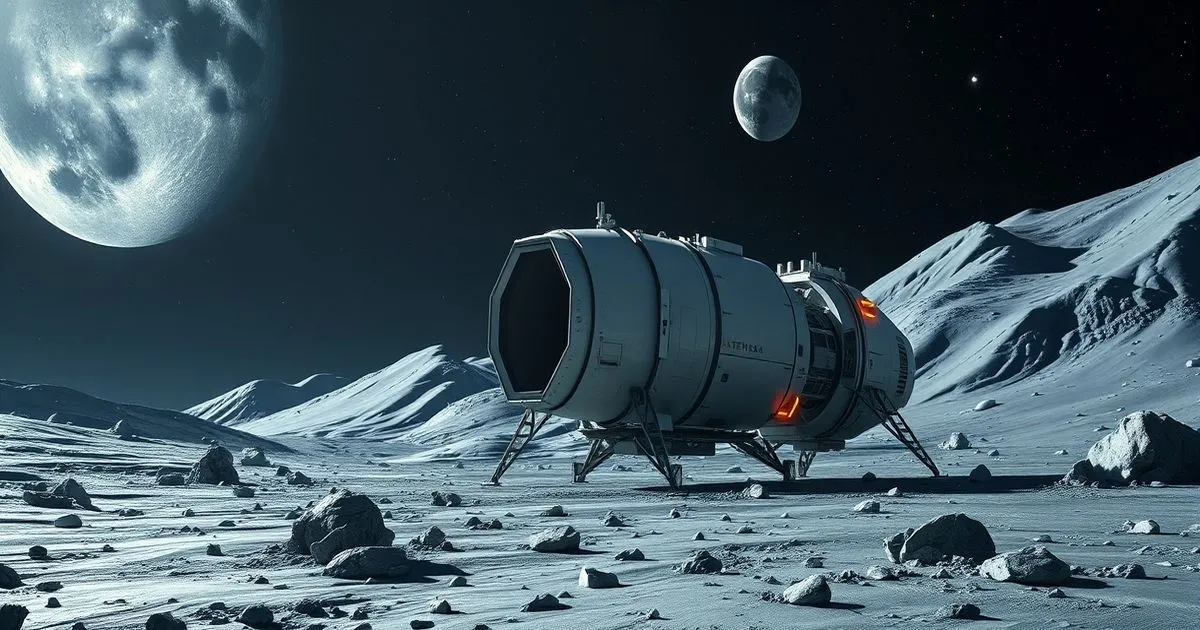
Artemis II: Astronauts Prepare for Lunar Journey to the Moon

As the world watches with anticipation, the Artemis II: Astronauts Prepare for Lunar Journey to the Moon, a monumental step in humanity's ambitious return to deep space, is rapidly approaching. This mission, a pivotal part of NASA's Artemis program, is poised to send a crew of four astronauts on a historic trip around the Moon, setting the stage for future lunar landings and ultimately, human exploration of Mars. The journey will validate critical systems of the Orion spacecraft and its Space Launch System (SLS) rocket, demonstrating the capabilities needed for sustained presence beyond Earth orbit. With the rocket recently rolled out to Launch Pad 39B at Kennedy Space Center and the crew entering quarantine, the preparations are in their final, thrilling stages. This daring expedition marks the first time humans will venture to the Moon's vicinity in over five decades, building on the success of the uncrewed Artemis I flight in 2022.
- A New Era of Lunar Exploration: Artemis II: Astronauts Prepare for Lunar Journey
- The Historic Crew: Pioneers of the Next Lunar Chapter
- Rigorous Training for a Deep Space Mission
- The Orion Spacecraft: Humanity's Deep Space Vehicle
- The Space Launch System (SLS) Rocket: A Powerful Ride
- Launch Window and Current Preparations
- The Significance and Future of Artemis
- Conclusion
- Frequently Asked Questions
- Further Reading & Resources
A New Era of Lunar Exploration: Artemis II: Astronauts Prepare for Lunar Journey
The Artemis program represents a bold new chapter in space exploration, aiming not just for a return to the Moon, but for the establishment of a long-term human presence. Artemis II is the crucial second mission in this series, following the successful uncrewed Artemis I test flight in late 2022. Unlike its predecessor, Artemis II will carry a human crew, testing the integrated systems of the SLS rocket and Orion spacecraft with astronauts onboard for the first time. This mission is designed to push the boundaries of human deep-space travel, verifying life support, navigation, communication, and environmental control systems in real flight conditions far beyond Earth's protective magnetosphere.
The objectives of Artemis II are extensive and critical for the program's future. The mission will assess the overall performance of the SLS and Orion, especially with a crew operating the spacecraft. Astronauts will actively evaluate crew interfaces, habitability, and guidance, navigation, and communications systems. A key demonstration involves performing a proximity operations demonstration using the spent Interim Cryogenic Propulsion Stage (ICPS) as a target, simulating future docking procedures in lunar orbit. This flight is not merely a rerun of past lunar flybys; it's a comprehensive test flight designed to gather invaluable data to reduce risks for subsequent missions, including the planned lunar landings.
The Historic Crew: Pioneers of the Next Lunar Chapter
On April 3, 2023, NASA introduced the four astronauts who will embark on this historic journey: Commander Reid Wiseman, Pilot Victor Glover, and Mission Specialists Christina Koch (all from NASA), and Mission Specialist Jeremy Hansen from the Canadian Space Agency (CSA). This diverse crew represents a new generation of explorers, making history in several ways. Victor Glover will become the first person of color, and Christina Koch the first woman, to travel to the vicinity of the Moon. Jeremy Hansen will be the first non-U.S. citizen and first Canadian to venture beyond Earth orbit to the Moon.
Each member brings a wealth of experience to the mission. Commander Reid Wiseman previously served as Flight Engineer aboard the International Space Station (ISS) for Expedition 41. Victor Glover was a pilot and second-in-command on SpaceX Crew-1 and a flight engineer for ISS Expedition 64. Christina Koch holds the record for the longest single spaceflight by a woman, with 328 days in space during ISS Expeditions 59, 60, and 61, and participated in the first all-female spacewalks. Jeremy Hansen, a former CF-18 fighter pilot, became the first Canadian to lead a NASA astronaut class, overseeing the training of U.S. and Canadian astronaut candidates. While Wiseman, Glover, and Koch have extensive spaceflight experience, Artemis II will mark Hansen's first trip to space.
Rigorous Training for a Deep Space Mission
Preparing for a mission beyond low Earth orbit demands an entirely new level of training, distinct from that for the ISS. The Artemis II crew officially began their intensive training in June 2023, preparing for a mission that requires greater autonomy and critical decision-making far from Earth. Unlike ISS missions, Artemis II offers no nearby safe harbor or the option to return to Earth within hours if a problem arises.
Their training regimen covers a broad spectrum of activities:
- System Mastery: Astronauts are not just learning procedures, but are deeply understanding Orion and SLS systems to adapt to changing conditions. This includes how each system functions individually and as an integrated whole.
- Spacecraft Operations: The crew is refining their understanding of Orion's systems and practicing how to live in the compact crew module for approximately 10 days, covering daily operations, food preparation, exercise, and the operation of life support and habitation equipment.
- Emergency Procedures: Extensive simulations prepare them for ascent, entry, and landing, as well as various emergency scenarios, emphasizing the need for robust decision-making in deep space.
- Lunar Observation and Photography: A key component involves studying the Moon's far side, identifying crater shapes, surface textures, color variations, and reflectivity. Though Artemis II won't land, these observations are crucial for future missions.
- Ground Systems Tests: The crew has completed integrated ground systems tests at Kennedy Space Center, including suited tests, full mission rehearsals, and launch-day dry runs. This includes practicing the journey to the launch pad and entering the Orion spacecraft.
- Geology Training: In May 2023, the crew participated in lunar science fundamentals training at NASA's Johnson Space Center, studying samples from Apollo missions and discussing photography of lunar surface areas not seen by Apollo astronauts.
This comprehensive preparation ensures the crew is ready for every aspect of this pioneering mission, which will be the furthest and fastest crewed space mission ever undertaken, reaching speeds of approximately 25,000 miles per hour (40,000 km/h) during atmospheric reentry.
The Orion Spacecraft: Humanity's Deep Space Vehicle
Central to the Artemis II mission is the Orion spacecraft, developed by Lockheed Martin, which is designed to carry astronauts beyond low Earth orbit and safely return them home. Orion is a critical component of NASA's vision for human deep space exploration, serving as the vehicle that will sustain the crew on missions to the Moon and eventually Mars.
Key features and capabilities of the Orion spacecraft include:
- European Service Module (ESM): Provided by the European Space Agency (ESA) and built by Airbus, the ESM is critical for propulsion, power, air, and water for the astronauts. It provides the final push to enter lunar orbit and guides the spacecraft back to Earth on a free-return trajectory.
- Advanced Propulsion and Launch Abort Systems: Orion's robust propulsion system guides it through every phase of the mission, from launch abort protection and orbital maneuvers to lunar flyby and the journey home. The launch abort system ensures crew safety in case of an emergency during launch.
- Life Support and Environmental Controls: The spacecraft is equipped with sophisticated life support and environmental control systems, which the Artemis II crew will extensively test in the deep space environment. The crew module provides approximately 315 cubic feet of living space, about 30% larger than the Apollo spacecraft, accommodating an extra person for the 10-day mission.
- Heat Shield Integrity: Following the Artemis I mission, where the heat shield experienced greater-than-expected erosion during reentry, extensive testing and adjustments were made to ensure the integrity of Orion's heat shield for crewed flights.
- Rendezvous, Proximity Operations, and Docking (RPOD) Systems: Orion's RPOD systems, utilizing advanced sensors, cameras, and LiDAR, are crucial for precision docking with other spacecraft, a capability that will be demonstrated during Artemis II.
The Space Launch System (SLS) Rocket: A Powerful Ride
The Orion spacecraft will be launched atop NASA's Space Launch System (SLS) rocket, the most powerful rocket ever built. The SLS Block 1 variant will provide more than 8.8 million pounds of thrust at liftoff, generating enough power to send Orion, its crew, and cargo directly to the Moon in a single launch.
The journey profile for Artemis II involves several critical phases:
- Launch and Initial Earth Orbit: After liftoff from Kennedy Space Center's Launch Complex 39B, Orion will be inserted into a temporary low Earth orbit. During this phase, the crew will complete initial system checks and verify life support, guidance, and communications systems.
- Highly Elliptical Earth Orbits: Unlike Apollo missions, Artemis II will not perform an immediate trans-lunar injection. Instead, Orion will complete two highly elliptical Earth orbits, gradually raising the spacecraft's apogee (farthest point from Earth). This staged approach offers abort flexibility and additional system verification, enhancing safety.
- Trans-Lunar Injection (TLI): After thorough checks, the Interim Cryogenic Propulsion Stage (ICPS) will perform a powerful burn to send Orion onto a trans-lunar injection trajectory, propelling it towards the Moon.
- Lunar Flyby and Free-Return Trajectory: The mission will take the crew on a looping journey around the Moon on a free-return trajectory. This path uses the Moon's gravity to slingshot Orion back to Earth without requiring a major engine burn near the Moon, a passive safety feature similar to Apollo 13. Orion will pass thousands of miles beyond the Moon, with its closest approach approximately 4,047 miles (6,513 km) from the far-side lunar surface. This will be the furthest human distance from Earth, potentially surpassing the record set by Apollo 13.
- Return to Earth and Splashdown: The return journey will take approximately four days. Orion will separate into its crew module and service module, with the crew module relying on its heat shield to survive the intense heat of reentry before a parachute-assisted splashdown in the Pacific Ocean.
Launch Window and Current Preparations
NASA is targeting an early April 2026 launch window for Artemis II, with the earliest opportunity being April 1. Several other launch dates are available through April 6, and another on April 30. The precise timing of the launch will influence the crew's proximity to the Moon, with distances ranging from 4,000-6,000 miles (6,450-9,650 km) above the lunar surface.
The SLS rocket and Orion spacecraft recently completed an 11-hour, 4-mile trek from the Vehicle Assembly Building (VAB) to Launch Pad 39B at Kennedy Space Center, carried by NASA's massive crawler-transporter 2. This critical rollout signifies the final stretch of prelaunch preparations. The crew has also entered pre-flight quarantine in Houston, a standard procedure to ensure their health before liftoff. While there have been delays and technical hurdles, including a liquid hydrogen leak and a valve issue, NASA has addressed these, and the mission is formally cleared to proceed.
The Significance and Future of Artemis
Artemis II is more than just a test flight; it's a foundational mission for humanity's future in space. It will provide new insights into astronaut health and how deep space travel influences the body, mind, and behavior, informing future missions to Mars. The data collected will be instrumental in advancing technologies and scientific understanding.
The Artemis program aims to establish a long-term U.S. presence on the Moon, with future missions like Artemis III (targeting low Earth orbit demonstration of lunar landers by mid-2027) and Artemis IV (the first crewed lunar landing since Apollo 17, planned for early 2028) building upon Artemis II's success. These missions envision astronauts spending about a week at the lunar south pole, an unexplored region believed to contain water ice. The long-term goal is to build a lunar space station, Gateway, in orbit around the Moon and eventually establish a habitable lunar base, all serving as stepping stones for sending humans to Mars.
Conclusion
The impending launch of Artemis II: Astronauts Prepare for Lunar Journey marks a truly historic moment, ushering in a new era of human space exploration. With its dedicated crew, advanced Orion spacecraft, and the mighty SLS rocket, this mission will validate the crucial systems needed for humanity's sustained return to the Moon and beyond. The insights gained will not only pave the way for future lunar landings but also lay the groundwork for the ambitious journey to Mars. As the world eagerly awaits liftoff, Artemis II stands as a testament to human ingenuity, perseverance, and our innate drive to explore the unknown.
Frequently Asked Questions
Q: What is the primary goal of the Artemis II mission?
A: The primary goal of Artemis II is to send a crew of four astronauts on a test flight around the Moon, validating the critical systems of the Orion spacecraft and Space Launch System (SLS) rocket with humans onboard. This mission is crucial for paving the way for future lunar landings and sustained human presence.
Q: Who are the astronauts on the Artemis II mission?
A: The crew consists of Commander Reid Wiseman, Pilot Victor Glover, and Mission Specialists Christina Koch (all from NASA), along with Mission Specialist Jeremy Hansen from the Canadian Space Agency (CSA). This crew includes the first person of color and first woman to travel to the vicinity of the Moon, and the first non-U.S. citizen to venture beyond Earth orbit.
Q: What is the significance of the Orion spacecraft for Artemis II?
A: The Orion spacecraft is humanity's deep-space vehicle, designed to carry astronauts beyond low Earth orbit and safely return them. For Artemis II, Orion will be thoroughly tested with its crew, evaluating life support, navigation, communication, and environmental control systems in the deep space environment, far from Earth.